
The global food industry is constantly evolving as manufacturers strive to balance quality, affordability, nutrition, and consumer preferences. In recent years, one ingredient category has quietly gained momentum across multiple food sectors: dairy blends.
Once considered a niche ingredient solution, dairy blends are now playing an increasingly important role in modern food production. Their versatility, cost efficiency, functional benefits, and ability to support product innovation have made them attractive to food manufacturers around the world.
From bakery products and confectionery items to ice cream, infant formula, sauces, and ready-to-eat meals, dairy blends are helping companies develop products that meet consumer expectations while maintaining production efficiency.
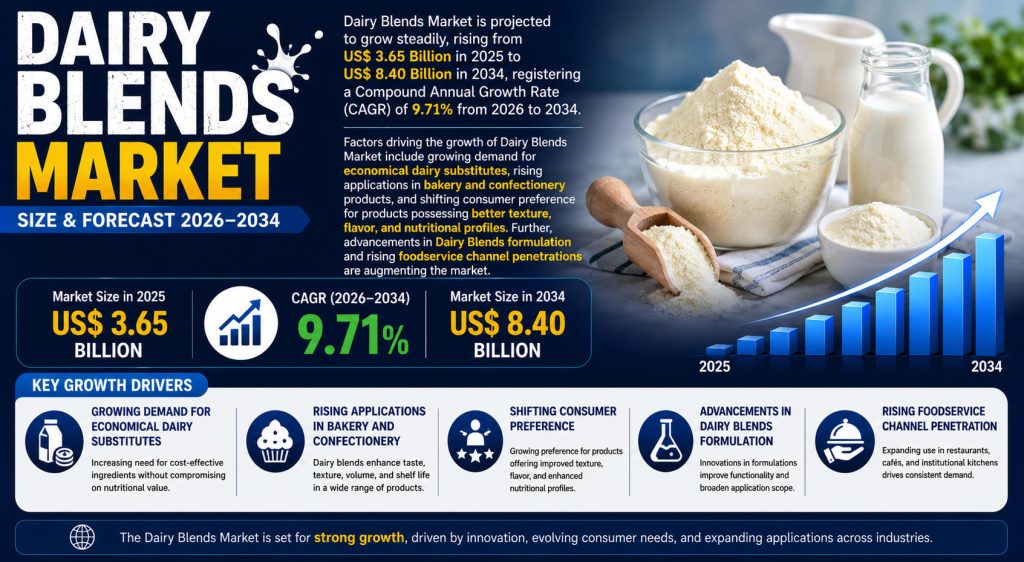
According to Renub Research, the Global Dairy Blends Market is projected to grow from US$ 3.65 billion in 2025 to US$ 8.40 billion by 2034, expanding at a strong compound annual growth rate (CAGR) of 9.71% between 2026 and 2034. This rapid growth highlights the increasing importance of dairy blends within the global food and beverage industry.
As food manufacturers continue seeking flexible ingredient solutions and consumers demand better nutrition and convenience, dairy blends are emerging as a valuable tool for future food innovation.
What Are Dairy Blends?
Dairy blends are food ingredients created by combining traditional dairy components such as milk solids, butter, cream, or cheese with non-dairy ingredients including vegetable oils, proteins, emulsifiers, and stabilizers.
The objective is to create products that retain many of the functional and sensory characteristics of conventional dairy products while offering additional benefits such as improved shelf life, lower costs, enhanced texture, and nutritional flexibility.
Unlike pure dairy ingredients, dairy blends can be customized to meet specific manufacturing requirements and consumer demands.
Food producers use dairy blends across a wide range of applications because they provide consistency, versatility, and performance in large-scale production environments.
Today, dairy blends are found in bakery products, confectionery items, frozen desserts, sauces, spreads, dairy beverages, ready meals, and infant nutrition products.
Their growing adoption reflects the increasing need for ingredient solutions that balance functionality with economic efficiency.
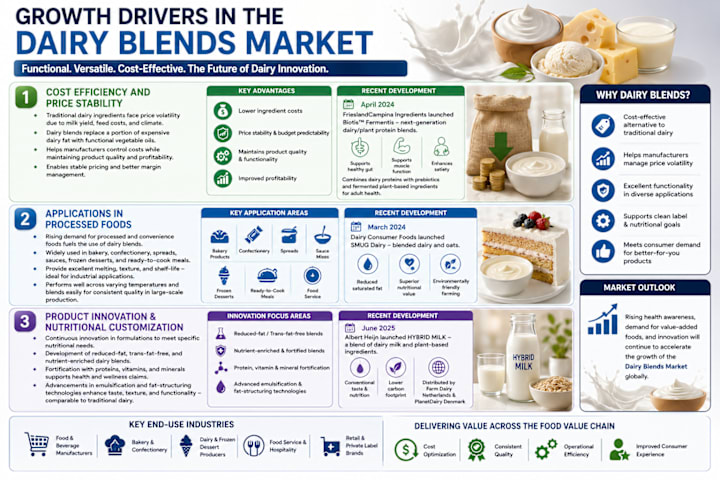
Cost Efficiency Is a Major Growth Driver
One of the strongest factors driving growth in the dairy blends market is cost optimization.
Traditional dairy ingredients such as butterfat, cream, and cheese are often subject to significant price fluctuations due to factors including milk supply, feed costs, weather conditions, and global dairy market dynamics.
For food manufacturers, these fluctuations can create uncertainty and pressure on profit margins.
Dairy blends offer an effective solution by allowing manufacturers to partially replace expensive dairy fats with functional vegetable oils and other ingredients while maintaining desired product characteristics.
This flexibility helps stabilize production costs and reduce exposure to dairy commodity price volatility.
In highly competitive food categories, even modest cost reductions can significantly improve profitability.
As manufacturers continue seeking efficient ingredient strategies, dairy blends are becoming an increasingly attractive option.
Processed Food Demand Is Expanding Globally
Another major factor contributing to market growth is the rising consumption of processed and convenience foods.
Modern consumers increasingly seek products that offer convenience, longer shelf life, and consistent quality. Busy lifestyles, urbanization, and changing eating habits have accelerated demand for ready-to-eat meals, packaged snacks, frozen desserts, and bakery products.
Dairy blends play a critical role in many of these products because they help improve texture, stability, flavor, and processing efficiency.
Manufacturers appreciate their ability to perform consistently under varying production conditions while supporting large-scale manufacturing operations.
Their versatility also allows companies to develop products tailored to different consumer preferences and price points.
As global demand for convenience foods continues to rise, dairy blends are expected to become even more important within food production systems.
Product Innovation Is Creating New Opportunities
Innovation has become a defining characteristic of the dairy blends market.
Consumers increasingly seek foods that align with health, wellness, sustainability, and dietary preferences. In response, manufacturers are developing specialized dairy blend formulations designed to meet specific nutritional and functional requirements.
Today’s dairy blends can be fortified with proteins, vitamins, minerals, prebiotics, and other beneficial ingredients.
Manufacturers are introducing reduced-fat products, trans-fat-free formulations, and hybrid dairy-plant combinations that appeal to health-conscious consumers.
Recent innovations have demonstrated how dairy blends can support emerging food trends while maintaining familiar taste and texture profiles.
Advances in emulsification technologies and fat-structuring techniques have further improved product performance, enabling dairy blends to closely replicate traditional dairy experiences.
These innovations are expanding application possibilities across multiple food categories.
The Rise of Hybrid Dairy Products
One of the most interesting developments within the market is the growing popularity of hybrid dairy products.
Hybrid products combine traditional dairy ingredients with plant-based components, offering consumers the benefits of both worlds.
Many consumers appreciate the familiar taste and nutritional value of dairy while also seeking products that support sustainability goals and dietary diversity.
Hybrid dairy blends address these preferences by reducing environmental impact while preserving sensory characteristics that consumers enjoy.
Food manufacturers are increasingly exploring this category as they seek to appeal to evolving consumer expectations.
The success of hybrid products highlights how dairy blends are helping bridge the gap between traditional dairy and plant-based innovation.
Functional Benefits Support Food Manufacturing
Beyond cost savings, dairy blends provide important functional advantages that enhance food production.
Manufacturers often rely on dairy blends to improve texture, consistency, mouthfeel, melting behavior, emulsification, and shelf stability.
In bakery applications, dairy blends help improve dough handling, crumb softness, and fat distribution.
In confectionery products, they contribute to smooth texture and flavor development.
Sauces, spreads, and dressings benefit from improved emulsion stability and creaminess, while frozen desserts gain enhanced texture and controlled ice crystal formation.
These functional properties make dairy blends valuable ingredients for companies seeking consistent product quality at scale.
As food manufacturing becomes increasingly sophisticated, demand for multifunctional ingredients is expected to grow.
Dairy Blend Mixtures Gain Popularity
Pre-formulated dairy blend mixtures represent one of the fastest-growing segments within the industry.
These mixtures combine dairy and non-dairy ingredients in carefully controlled proportions, simplifying manufacturing processes and reducing formulation complexity.
Food producers benefit from greater consistency, faster production times, and reduced risk of formulation errors.
The ability to perform reliably under varying temperature and processing conditions further enhances their appeal.
Large-scale food manufacturers, in particular, appreciate the operational efficiencies these mixtures provide.
As production volumes continue increasing worldwide, demand for ready-to-use ingredient solutions is expected to remain strong.
Ice Cream Manufacturers Are Embracing Dairy Blends
The frozen dessert sector has become a major application area for dairy blends.
Ice cream manufacturers increasingly use dairy blends to partially replace milk fat while maintaining desirable texture, creaminess, and flavor characteristics.
These formulations help control production costs without significantly compromising product quality.
Dairy blends also contribute to improved stability and reduced ice crystal formation, which are important factors in consumer satisfaction.
In markets where affordability plays a key role in purchasing decisions, dairy blends allow manufacturers to offer competitive products while maintaining profitability.
The continued popularity of frozen desserts worldwide is expected to support further growth within this segment.
Infant Nutrition Requires Specialized Formulations
The infant formula segment represents another important area of dairy blend utilization.
Manufacturers develop highly specialized dairy blends designed to provide balanced nutrition and support healthy infant development.
These formulations combine dairy ingredients with carefully selected lipids, proteins, vitamins, and micronutrients.
Because infant nutrition products are subject to strict regulatory standards, quality and consistency remain critical priorities.
Advancements in blending technologies continue improving the nutritional performance of these products while supporting evolving healthcare recommendations.
Although highly regulated, the infant nutrition segment offers substantial growth opportunities for specialized dairy blend producers.
Powdered Dairy Blends Dominate the Market
Among product formats, powdered dairy blends remain particularly popular.
Powdered products offer several advantages, including extended shelf life, ease of transportation, reduced storage requirements, and versatility across multiple applications.
Manufacturers use powdered dairy blends in bakery products, beverage mixes, confectionery items, instant meals, and dry ingredient systems.
The ability to transport and store these products without refrigeration makes them especially attractive for international trade and large-scale manufacturing.
As demand for convenience foods and global food distribution continues expanding, powdered dairy blends are expected to remain a leading product category.
Challenges Facing the Industry
Despite strong growth prospects, the dairy blends market faces several challenges.
Consumer Perception and Labeling Issues
Some consumers perceive dairy blends as more processed or less natural than traditional dairy products.
The growing popularity of clean-label products has increased scrutiny of ingredient lists and manufacturing practices.
Manufacturers must balance innovation with transparency to maintain consumer trust.
Clear communication regarding product benefits and ingredient quality will remain essential.
Regulatory Complexity
Regulatory requirements vary significantly across countries.
Different jurisdictions maintain unique rules regarding ingredient composition, labeling standards, dairy content, and product claims.
Navigating these regulations can increase compliance costs and complicate international trade.
Manufacturers must continually adapt to evolving standards while maintaining product consistency across markets.
Regional Markets Driving Growth
United States
The United States remains one of the most developed dairy blends markets, supported by strong demand from food processors, bakeries, confectionery manufacturers, and foodservice operators.
Innovation and advanced food technology continue driving market expansion.
United Kingdom
The UK’s mature food processing sector increasingly utilizes dairy blends to improve efficiency, manage costs, and support product reformulation efforts.
China
China’s rapidly growing processed food industry is generating substantial demand for dairy blends across bakery, confectionery, and frozen dessert applications.
Brazil
Brazil’s expanding food manufacturing sector and growing urban population continue creating opportunities for dairy blend adoption.
Saudi Arabia
Saudi Arabia’s focus on food security, local production, and processed food manufacturing supports increasing use of dairy blend ingredients across multiple categories.
The Future of the Dairy Blends Industry
The future of the dairy blends market will likely be shaped by innovation, sustainability, and nutritional customization.
Manufacturers are expected to continue developing formulations that address health concerns, environmental goals, and evolving consumer preferences.
Hybrid dairy-plant products, functional nutrition solutions, and clean-label innovations are likely to gain further traction.
Advancements in ingredient technologies will continue improving taste, texture, and performance, making dairy blends even more competitive with traditional dairy products.
As food companies seek flexible and scalable ingredient solutions, dairy blends are expected to become increasingly important within the global food supply chain.
Final Thoughts
The global dairy blends market is experiencing strong momentum as manufacturers search for ingredients that offer both economic and functional advantages.
With the market projected to grow from US$ 3.65 billion in 2025 to US$ 8.40 billion by 2034, dairy blends are becoming a critical component of modern food innovation. Their ability to support cost efficiency, nutritional customization, product consistency, and large-scale manufacturing makes them highly valuable across a wide range of applications.
Although challenges related to consumer perception and regulatory compliance remain, ongoing advancements in formulation technology and changing consumer preferences continue creating new opportunities.
As the food industry evolves to meet the demands of a growing and increasingly health-conscious global population, dairy blends are well positioned to play an essential role in shaping the future of food production.