
The African Development Bank Group and Japan are deepening a long-standing collaboration to direct more private capital into African economies, build quality infrastructure, and help African countries take projects from preparation to delivery.
The partnership brings together concessional finance, private sector co-financing, project preparation, technical assistance, human capital development, and knowledge exchange. Together, these instruments help African countries develop bankable projects, reduce project risk and connect national development priorities to regional and global value chains.
This approach reflects shared priorities in quality infrastructure, resilient supply chains, private sector development and institutional capacity. It builds on the Ninth Tokyo International Conference on African Development (TICAD 9), held in Yokohama in August 2025, where Japanese and African counterparts emphasised implementation, private capital mobilisation and stronger economic ties.
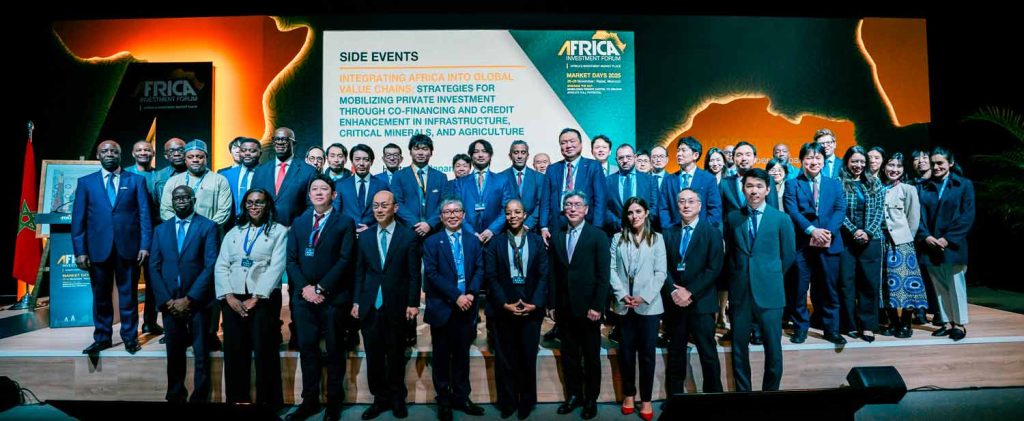
Recent activity with Japanese businesses shows how this work is moving from policy dialogue to investment activity. At the Africa Investment Forum 2025 Market Days in Rabat, startups, trading firms, financial institutions and development partners gathered at the Japan Special Room to discuss private capital mobilisation, and the integration of African countries into regional and global supply chains.
Discussions highlighted Bank Group-backed examples of Japanese private sector activity in African countries, including the 35-megawatt Menengai Geothermal Plant in Kenya, developed with Toyota Tsusho and Fuji Electric, and Côte d’Ivoire’s Agricultural Growth Program, implemented by NEC Corporation.
Bank Group President Dr Sidi Ould Tah said at the Forum: “These are tangible demonstrations of what is possible when we combine Africa’s opportunities with Japan’s strengths and the Bank Group’s catalytic financing.”
A Relationship Built Across Several Channels
Japan joined the African Development Fund in 1973 and the African Development Bank in 1982. Its partnership with the Bank Group now spans capital subscriptions, grants and concessional loans, private sector co-financing and bilateral trust funds. The country also supports the Enhanced Private Sector Assistance for Africa initiative, the Fund for African Private Sector Assistance, and the Policy and Human Resource Development Grant.
The Bank Group collaborates with Japanese institutions including the Japan International Cooperation Agency, the Japan Bank for International Cooperation, Nippon Export and Investment Insurance, and the Japan External Trade Organization.
Japan is a leading contributor to the African Development Fund, the Bank Group’s concessional window for low-income and structurally vulnerable African countries, pledging approximately $600 million in grant resources and Multilateral Debt Relief Initiative compensation to the Fund’s seventeenth replenishment (ADF-17), with a yen-denominated concessional loan of approximately $583 million.
Japan’s contributions help countries advance their own priorities while strengthening conditions for longer-term investment. During ADF-17 discussions, it endorsed a selective approach focused on quality infrastructure, governance and debt management, while emphasising critical minerals supply chains, health systems, procurement reforms and private capital mobilisation.
Scaling Private Sector Financing
While the African Development Fund addresses country-level priorities and concessional financing, the Enhanced Private Sector Assistance for Africa initiative provides a dedicated platform for scaling private sector investment. Established by Japan and the Bank Group in 2005, it remains the main joint mechanism for private sector development on the continent.
Its sixth phase, signed on the sidelines of TICAD 9, has a co-financing target of $5.5 billion for 2026 to 2028. As of December 2025, Japan had provided cumulative contributions of $7.4 billion to the multi-phase initiative, with priority sectors including energy, transport, health, connectivity, agriculture and nutrition.
The Fund for African Private Sector Assistance (FAPA) backs the upstream work needed to prepare projects, strengthen enterprises and improve conditions for private sector participation. Since 2005 it has received $128 million in Japanese contributions and financed 111 projects worth $86.8 million, with grants directed to project preparation, clean technologies, quality standards, micro- and small-scale ventures, startups and business incubators.
Minoru Hasegawa of Japan’s Ministry of Finance underscored FAPA’s role in helping Japanese firms enter African markets: “For Japanese companies considering expansion into Africa, FAPA is a practical and powerful tool. Japan remains fully committed to supporting business expansion and contributing to Africa’s sustainable growth.”
Through the Policy and Human Resource Development Grant, established in 1994 and now exceeding $44 million in Japanese contributions, Japan provides technical assistance for project, policy and human resource development in agriculture, food and nutrition security, climate change, debt management and health. The grant also backs the Africa-Asia Platform, launched in November 2025 to promote knowledge exchange, technology transfer and innovation between African and Asian countries.
The next phase of the collaboration will focus on implementation. For Japan, the Bank Group offers a trusted multilateral platform for advancing development priorities and reaching high-growth African markets. For African countries, the relationship widens access to long-term finance, technical expertise, institutional capacity and private sector networks that help turn priorities into delivered projects. It aligns with the Bank Group’s Ten-Year Strategy 2024-2033 and the reform agenda set out in President Ould Tah’s Four Cardinal Points.