
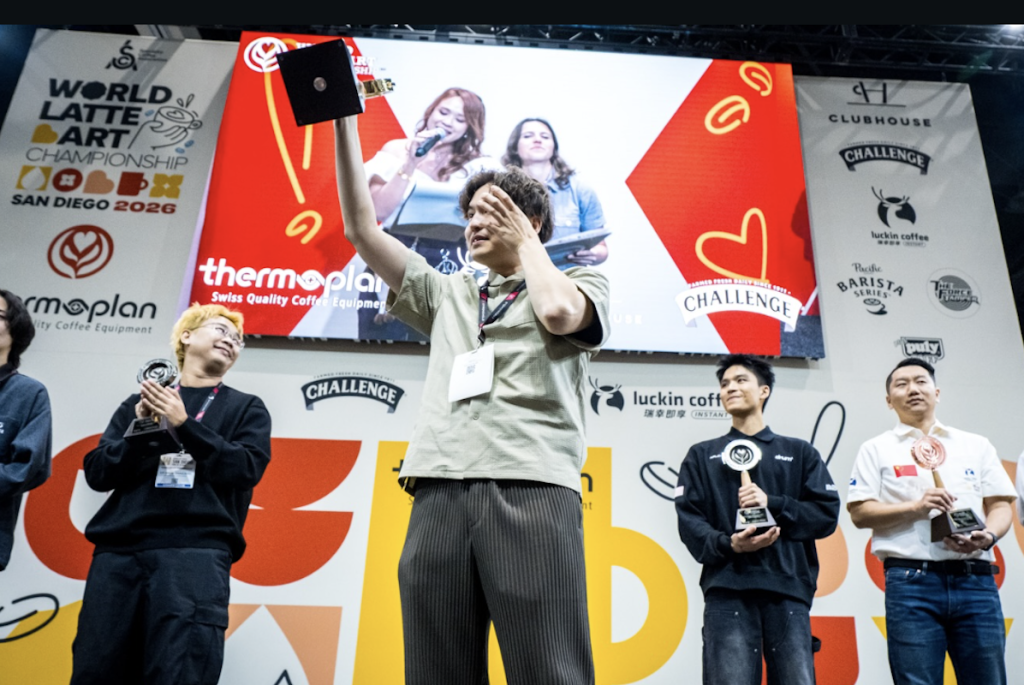
When Bala stepped onto the podium in San Diego in April, holding the trophy for the 2026 World Latte Art Championship, the backdrop behind him said “Luckin Coffee” — the Chinese chain that was an official sponsor of the event.
He had just poured a raccoon, a giraffe and red pandas to claim the title with a winning score of 531 points. The official announcement listed him as representing Taiwan.
About a week later, however, the Specialty Coffee Association quietly changed “Taiwan” to “Chinese Taipei” in the World Coffee Championships’ records. There was no announcement or explanation for why the change was made.
Only a revision — soon followed by reports that the WCC had also stripped past rankings PDFs from its website, hiding the historical record of who had represented whom. The renaming of a barista may seem like a footnote to Beijing’s larger pressure campaign against Taiwan — the warships, the semiconductor controls, the diplomatic isolation.
But it is something more: a signal that China’s coercion has reached a domain few governments or analysts are tracking – the global infrastructure of specialty coffee. And it reveals something larger still: when the private organizations that govern global cultural industries face geopolitical pressure, their professed neutrality is the first thing to give way.
A hard-won stage
Taiwan’s coffee community came to the world stage late. The World Barista Championship has been held annually since 2000, but no Taiwanese competitor took the stage until 2007, when Lin Tung-Yuan — known internationally as Van Lin, Taiwan’s first national barista champion in 2004 — finally competed.
What followed was a remarkable run. Pang-Yu Liu won the World Cup Tasters Championship in 2014. Jacky Lai won the World Coffee Roasting Championship the same year. Berg Wu became the first Taiwanese World Barista Champion in 2016.
Chad Wang followed with the World Brewers Cup in 2017. Xie Yi-chen won the World Latte Art Championship in 2024. Bala’s win in 2026 was the latest in a lineage that took the Taiwanese coffee community more than two decades to build.
The SCA itself recognized this rise. In its 2022 announcement bringing the World Coffee Championships to Taipei, the association celebrated Taiwan’s “strong specialty coffee culture,” its “estimated 4,000 roasters,” and the country’s “16 World Coffee Championship finalists”, naming Berg Wu, Chad Wang, Pang-Yu Liu, and Jacky Lai by their Taiwanese affiliations.
Until April 2026, the association’s records listed every champion above as representing Taiwan. As the Taiwan Coffee Association revealed in its statement following the change, the body had been “fighting for the maintenance of the TAIWAN representative name for 19 years”—a fight, it said, that had now finally proved “fruitless.”
The recent revision is not a return to long-standing convention. It is the end of a 19-year struggle to preserve one.
Two moves, one logic
The renaming did not happen in isolation. Six months earlier, in October 2025, the SCA executed another consequential move. It took control of the Q Grader Program — the global certification that defines what counts as quality coffee, with roughly 10,000 certified graders worldwide — from the Coffee Quality Institute, which had operated it for two decades.
The certification was rebuilt around the SCA’s Coffee Value Assessment, a framework introduced in 2023 that, for the first time, formally treats origin, processing, and cultural context as legitimate components of a coffee’s value. The CVA, the SCA explained, recognizes that “coffee is more than a score” — that it is “culture, craftsmanship and context.”
Six months after announcing that origin and context deserved formal recognition in coffee’s value, the same organization quietly removed Taiwan from its records.
These two moves are not contradictions. They are the same logic. When origin becomes a legitimate component of commercial value, the question of who decides what an origin is called ceases to be administrative and becomes a matter of governance.
The CVA’s progressive language—respect for context, recognition of culture—is the sales pitch. The renaming is what the governance actually does. Respecting origin is a market discourse. Deciding how origin gets named is power.
On May 1, the SCA defended the change in a statement, calling it an “administrative decision” and citing the International Olympic Committee and FIFA as precedents. The framing is revealing. The SCA is correct that it operates like the IOC and FIFA — and that is precisely the problem.
These are private bodies governing global cultural life through technical standards while remaining structurally exposed to the demands of their largest markets. Their neutrality holds until the pressure is large enough to overcome the inertia of convention.
In the same weeks that Bala was being renamed in the WCC’s records, another transaction was being finalized.
Centurium Capital, the controlling shareholder of China’s Luckin Coffee — itself a sponsor of the very championship Bala had won — announced its acquisition of Blue Bottle Coffee, the iconic American specialty chain, from Nestle for under US$400 million. Nestle confirmed the sale on April 24, days before the SCA revised its records.
The two events have not been publicly linked. They do not need to be. Their simultaneity is the story. Chinese capital is not just lobbying global coffee governance — it is buying the cultural infrastructure that governance regulates.
The chain that once defined American third-wave coffee is now controlled by Luckin’s controlling shareholder. The championship Luckin sponsored has now scrubbed Taiwan from its records.
What this reveals
For policymakers and analysts tracking China’s sharp power, the lesson is that coercion has reached domains nobody is monitoring.
According to the Taipei Times, the renaming followed “suspected political pressure from China,” with one source familiar with the matter noting that Luckin Coffee’s role as a main sponsor “suggested that China had influence behind the scenes.”
If a private organization governing the global standards of an entire cultural industry can be moved this quietly, no comparable body is structurally insulated. Standards organizations, certification bodies, sports federations, and industry consortia across Asia and beyond are all governed by the same logic—and exposed to the same pressures.
For consumers who treat ethical coffee as a small political act, the lesson is harder. The progressive vocabulary of specialty coffee — origin, terroir, direct trade, respect for context— has not protected Taiwan’s coffee community from being unnamed.
It has, in some ways, made the unnaming easier, by transferring the authority over what origin means from the producer to the certifier.
In the days following the change, Taiwan’s coffee community launched a “one-person-one-email” campaign, urging the WCC to restore Taiwan’s designation. Berg Wu, the 2016 World Barista Champion, was among the first to push back publicly.
“Taiwan is not just a name,” he wrote on Facebook the day after the change. “It is an identity and a shared memory built by many competitors, coaches, judges, cafes, roasters, and all the consumers who have supported us along the way.”
That memory took 26 years to build. It was revised in a week.
Tzuyi Kao is a research fellow in sociology at National Tsing Hua University, Taiwan, supported by the National Science and Technology Council’s Talent Recruitment Program. Her research on labor and value in Taiwan’s specialty coffee industry has been published online first in Sociology (Q1, SSCI). She also co-runs a specialty coffee shop in Taipei.