
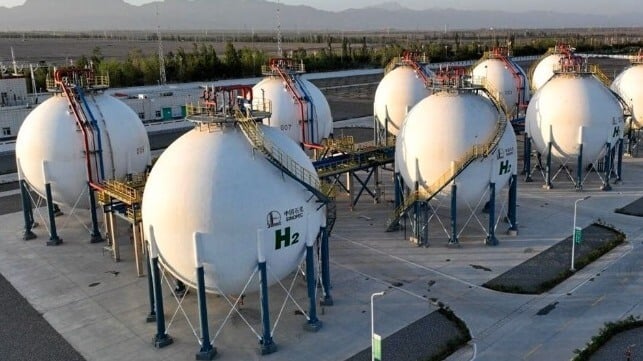
As global shipping builds momentum for a net-zero emissions future, countries are increasingly investing in production of green fuels. China continues to be a trailblazer in the green fuel industry, going by data released last week by the country’s energy regulator, the National Energy Administration (NEA).
As of March, China’s green hydrogen production capacity exceeded over 1.1 million tons. This consists of 250,000 tons for operational projects, which is more than double the capacity in 2024. The other remaining 900,000-plus tons is for projects under construction. The huge pipeline of projects – now exceeding the installed capacity – reflects on the success of China’s hydrogen policy, launched in 2022.
In addition, NEA revealed that China has so far built an overall green fuel production capacity of around 8 million tons of oil equivalent per year. This production scale reflects expansion from traditional ethanol and biodiesel fuels to green ammonia and green methanol. NEA added that annual production capacity for green ammonia stands at 700,000 tons, while that of green methanol is around 380,000 tons.
With disruptions in the Strait of Hormuz, NEA has emphasized the development of green fuels as a strategic priority. NEA described the transition as progressively substituting petroleum for energy security. “This is new for green fuel. It is the first time green fuels have been explicitly framed in China as part of an energy security narrative,” commented Kai Yu, a researcher in China’s clean energy.
Besides the policy milestones, Beijing has also rolled out incentives for city clusters supporting scaling of hydrogen applications to areas such as aviation, shipping and manufacturing. The reward scheme promised by the central government to five city clusters is worth around $232 million.
In a world moving towards decarbonization, hydrogen will play a fundamental energy role, especially in the production of other alternative fuels like green methanol and ammonia. China is still in the initial phases of achieving commercial scale for these fuels, supported by renewable electricity surplus and electrolyzer deployment.

Stay on Top of the Daily Maritime News
The maritime news
that matters most
Get the latest maritime news delivered to your inbox daily.
However, the risks at this stage are also massive. The hydrogen fuels market is not yet mature and the export volumes are low. Again, there are few bankable offtake plans and the next 12-24 months will be pivotal in indicating ammonia and methanol demand levels. The fact that China is not waiting for the hydrogen market to mature could indicate it is aiming for an influential role in production of green fuels.
This positioning is also evident in recent strategic decisions taken by one of China’s largest shipbuilding companies, the Yangzijiang Group. The Singapore-listed company last month unveiled a new ship repair and conversion arm, targeted at the rising demand for retrofits and green upgrades of vessels.