
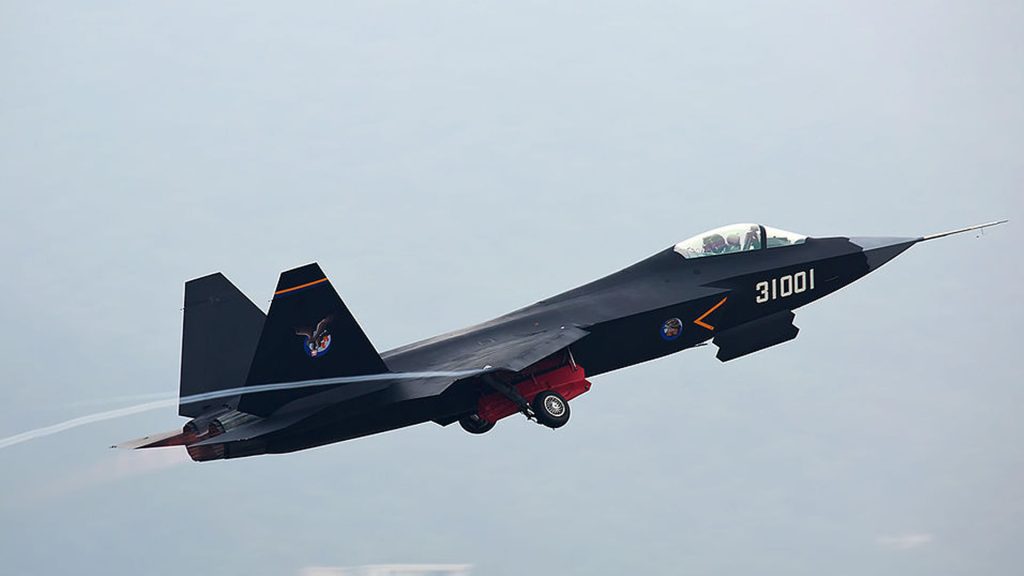
China has officially nicknamed its Shenyang J-35 the “Blue Shark,” which, experts note, likely signals it is close to operational status. Roughly equivalent to the US’ F-35C “Lightning,” the J-35 is stealth-capable and designed for carrier launch.
If true, then this officially gives China a second near- or fully-operational stealth fighter alongside the Chengdu J-20. That would make it the only country, alongside the United States, with this capability.
The J-35 is a single-seater, multi-role aircraft, meaning it can carry out air combat and strike missions when required. In essence, the aircraft gives the Chinese navy the capability to fight through defending space from a carrier.
Apart from the “branding” aspect of the new name, this move likely signals that the J-35 is now transitioning from its prototype phase to real deployment with the People’s Liberation Army Navy (PLAN).
Its name also fits the existing conventions for the PLAN, all of which are shark-based. For reference, the Shenyang J-15 is called the “Flying Shark,” with the J-15D the “Electric Shark.”
“Blue Shark” rises
Officially revealed by Shenyang Aircraft Corporation on Thursday (April 23), this now confirms rumors from the Zhuhai Airshow in November 2024 of the name. It also confirms reports of the nickname that have circulated since at least 2022.
The aircraft itself has come a long way since its first official test flight back in October of 2012. Redesigns, better engines, and improved stealth and aerodynamics culminated in its first catapult launch test in 2021.
Primarily designed for use with the PLA, variants also exist for land-based use called the J-35A. The carrier variant incorporates many features necessary for the role, including foldable wings and heavily reinforced landing gear.
It also comes with an arrestor hook and catapult launch bar for use with China’s most modern carriers, like the Fujian. Of greater import for China is the J-35’s alleged stealth capability; however,
It features internal weapons bays and an angular airframe to reduce its radar cross-section as much as possible. The aircraft also has hidden engine faces (serpenetine ducts) for the same reasons.
According to reports, the J-35 also has a highly flexible weapon loadout capability. It can carry a mixture of missiles or bombs internally, but also has the ability to mount munitions externally on six hard points when required.
Not yet fully operational
This includes some of China’s most advanced missiles, like the PL-15 and PL-21. It has a reported combat range of around 746 miles (1,200 km) and a maximum takeoff weight of about 66,139 pounds (30,000 kg).
Pulling it all together, we now know that the J-35 is able to fly, has been built in small numbers, and has been proven on carriers. However, it is not yet at a fully operational status.
In the trade, this is known as low-rate initial production, or LRIP for short. This means China is now focusing on building enough of them to train pilots, test systems, and iron out any issues with the design.
It is not yet ready for mass production, but it will likely be very soon, providing they can settle on an ideal engine for the aircraft. This has been one of its main bugbears for years, with several engine types experimented with.