
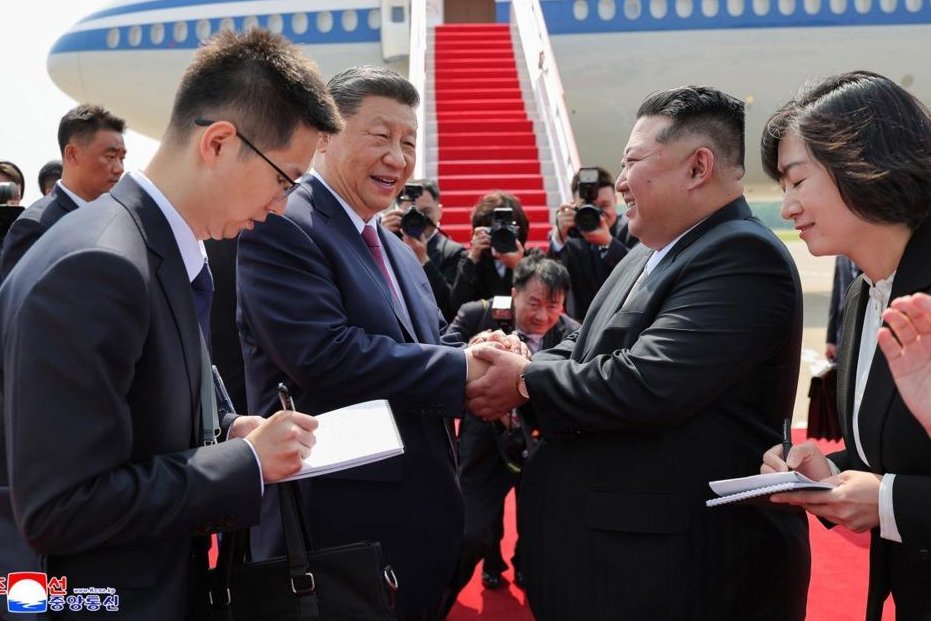
Chinese President Xi Jinping (2-L) shakes hands with North Korea leader Kim Jong Un (2-R) at the international airport before his departure from Pyongyang, North Korea, on June 9. Beijing has effectively imported Pyongyang’s proven playbook of substituting crumbling communist ideology with hyper-nationalist indoctrination. Photo by North Korean Central News Agency/EPA
July 1 (UPI) — The author prefers to use the lowercase “n” to challenge the Kim family regime’s legitimacy.
Many in the West operate under the comfortable assumption that totalitarianism vanished from the geopolitical stage with the defeat of Nazi Germany in World War II.
For westerners, victory in that global conflict remains a crowning point of civilizational pride. To be sure, that victory liberated numerous colonized nations, including the Korea Revolution, laying the groundwork for the modern Republic of Korea.
For the blood spilled to protect freedom, we must always respond with profound and enduring gratitude. However, today’s Western world seems to have forgotten the very essence of the freedom they once defended, showing a dangerous apathy toward the evolution of modern totalitarianism and communist regimes.
The cost of this apathy is arriving far sooner, and in a much more insidious form, than anyone anticipated.
For decades, the international community viewed north Korea’s hermetic, totalitarian society as a bizarre anomaly, dismissing its draconian laws as an isolated tragedy.
When Pyongyang enacted its Three Evil Laws, Law on Reactionary Ideology and Culture Rejection Act, which mandates the death penalty for watching foreign media; the Youth Education Guarantee Act, regulating clothing and hairstyles; and the Pyongyang Cultural Language Protection Act, criminalizing ordinary South Korean slang, many in the West reacted with mere ridicule or detached indifference.
They viewed it as a dystopian relic impossible in the 21st century — a tragedy confined to a distant world.
Yet, this indifference has invited a creeping reality onto the global stage. Effective Wednesday, China officially enforced its new National Unity Progress Promotion Act.
The fatal venom of this law lies in its extra-territorial overreach. It brazenly declares that anyone outside of China, including foreign citizens, who compromises Peking’s ambiguous definition of “national unity,” can be subject to criminal prosecution. This is a savage declaration of intent to project ideological and speech control far beyond China’s borders.
Is South Korea, a champion of liberal democracy, safe from this tide?
On Tuesday, a controversial amendment to South Korea’s Act on Promotion of Information and Communications Network Utilization and Information Protection will take effect. Though introduced under the guise of eradicating fake news and cybercrime, it has triggered widespread anxiety across online communities.
Many rightly fear that it creates a framework for state-sanctioned censorship of online discourse, chilling free expression.
This is precisely why we should never have looked away from north Korea’s “Three Evil Laws.” Pyongyang’s extreme legal apparatus is not an isolated manifestation of a rogue dictator’s madness. It is a highly contagious “authoritarian virus” that demonstrates exactly how far a regime will go once it begins to institutionalize total control.
It was a canary in the coal mine for humanity, but few heeded the warning. When we turn a blind eye to the oppression of others, the technologies and justifications for surveillance quietly evolve until they arrive at our own doorstep.
Whether it is Beijing choking global speech in the name of “national unity” or Seoul muzzling online discourse under the banner of “public interest,” both are alarming signals of individual liberty being subjugated to state power.
Amid this rising tide of modern authoritarianism, the analytical framework currently dominant among Western think tanks and foreign policy circles is profoundly disappointing.
They view that the Korean Peninsula strictly through the binary lens of the U.S.-China superpower rivalry, repeatedly falling back on a simplistic “puppet narrative.”
This narrative posits that China deliberately built up and nurtured north Korea into a global menace solely to distract American military resources and secure diplomatic leverage.
While this perspective serves western anti-China rhetoric, it suffers from a fatal blind spot. It entirely fails to comprehend the unique, self-sustaining totalitarian system that north Korea built on its own, as well as the deeply volatile dynamics of Sino-north Korean history.
Pyongyang did not copy its total control of speech and behavior from Beijing; it was the pioneer.
Long before China’s Cultural Revolution in 1966, Kim Il-sung purged the pro-China “Yanan faction” in 1956 and executed the Book-Purging Project (the May 25 Instructions) in 1967, burning all literature incompatible with his monolithic Juche ideology.
north Korea consciously discarded Marxism-Leninism to entrench a hereditary cult of personality. Western analysts completely invert this historical chronology.
Furthermore, Western observers remain blind to the historical episodes of north Korean defiance against Beijing.
During the chaos of China’s Cultural Revolution, when thousands of Chinese citizens fled across the border to escape the Red Guards, Pyongyang did not deport them.
Suffering from a severe labor shortage following post-war purges, the Kim regime defied Mao Zedong’s fierce disapproval and integrated these Chinese refugees into its mines and farms. This was a clear historical demonstration of north Korea exploiting China’s internal volatility to advance its own national interests.
Even the weaponization of anti-Japan nationalism in education reveals that Beijing was the student, not the master.
north Korea pioneered anti-Japan sentiment as a core tool for regime legitimacy and domestic brainwashing in the late 1940s. Conversely, Mao’s China initially suppressed anti-Japan rhetoric to secure Japanese economic aid.
It was only after the 1989 Tiananmen Square massacre when the Chinese Communist Party faced an existential legitimacy crisis that Deng Xiaoping mandated aggressive “patriotic and anti-Japan education” in 1991, weaponizing the humiliation of the First Sino-Japanese War (1894-1895).
Beijing effectively imported Pyongyang’s proven playbook of substituting crumbling communist ideology with hyper-nationalist indoctrination. U.S.. pundits routinely miss this ideological flow.
The same ignorance applies to the Sino-north Korean border. Some western analysts naively describe the border as a line drawn after a historical Chinese conquest, misinterpreting the presence of ethnic Koreans on both sides through the lens of Chinese expansionism.
This is a complete inversion of historical reality. The regions along the Yalu and Tumen Rivers were the ancient domains of Goguryeo and Balhae, inhabited by the Korean people for millennia.
During the late Joseon Dynasty and the Japanese colonial era, Korean independence fighters and migrants cultivated these lands at the cost of their blood and sweat, only to be arbitrarily categorized as an ethnic minority when China drew its borders.
Moreover, the current border was established equitably through the 1962 Sino-north Korean Border Treaty, where north Korea secured more than half of Heaven Lake on Mount Baekdu. To describe this as a legacy of unilateral Chinese domination is historical illiteracy.
north Korea’s fierce independence was cemented by what it perceived as China’s betrayal during the 1972 Nixon-Mao summit.
Stunned that its supposed blood ally would embrace its archenemy, the United States, without prior consultation, Pyongyang abandoned any illusion of relying on external powers.
It doubled down on Juche (self-reliance) and pivoted its strategy toward targeting South Korea directly through subversion and military provocation. Pyongyang is not a submissive proxy that blindly reports to Beijing.
The relationship is a bilateral, highly transactional system of “hostile symbiosis” bound together not by shared ideals, but by a mutual strategic need to deter Western influence. By reducing this complexity to a crude master-servant dynamic, Washington analysts completely overlook the desperate internal mechanics of the Kim regime.
The most dangerous miscalculation committed by South Koreans is mistaking the partisan rhetoric of these private U.S. pundits for the official policy of the United States government or the Trump administration.
These commentators are private citizens and ideological “bomb-throwers” seeking media attention through sensationalism. They do not speak for the state. Treating their flawed personal opinions as gospel truth is a grave error.
We must never forget the historical reality: the Korean War was a joint criminal enterprise of the communist bloc, conceived by Kim Il-sung, greenlit by the Soviet Union and sustained by China’s massive military intervention.
The memoirs of United Nations veterans, including British prisoners of war, vividly detail the sophisticated psychological atrocities committed by the Chinese People’s Volunteer Army.
In POW camps, Chinese forces systematically segregated British and American troops, subjecting them to relentless indoctrination aimed at framing the United States as the sole imperialist aggressor.
This historical campaign of ideological remolding was so distinct that it gave birth to the very term “brainwashing” in the Western lexicon. The Sino-north Korean alliance has always paired kinetic warfare with the systematic destruction of truth.
Today, the Republic of Korean public, particularly the conservative establishment, faces a severe philosophical crisis. Outraged rhetoric against electoral anomalies or partisan attacks against opposition leaders do not automatically qualify anyone as a geopolitical strategist.
While ROK’s left wing possesses a rigid, systematic ideological anchor in juche — allowing members to methodically infiltrate politics, economics, culture and civil protests to destabilize the state, the self-proclaimed right wing suffers from a profound intellectual vacuum.
Clinging to the mere slogan of the “ROK-U.S. Alliance,” many South Korean conservatives remain trapped in a dependent delusion, assuming Washington will automatically solve every national security dilemma.
Lacking a coherent philosophical anchor of their own, they blindly applaud and parrot the flawed analysis of American pundits. While they waste time looking to Washington for answers, the virus of ideological subversion continues to quietly contaminate the cultural and political air they breathe.
north Korea has officially abandoned the rhetoric of peaceful reunification, formally defining ROK as its “principal enemy” and a hostile belligerent state to be obliterated.
Yet, South Korean society remains remarkably complacent, its threat perception blinded by Washington’s preoccupation with Beijing. This fixation on China at the expense of ignoring the immediate nuclear threat at the doorstep is itself a triumph of north Korea’s sophisticated psychological warfare. We must stop outsourcing our strategic thinking to foreign commentators.
Only by reclaiming a fiercely independent, historically grounded perspective can South Korea see through the illusions of false peace and defend its liberty against the evolving tactics of its true adversary.
Jihyun Park, a British Korean Conservative politician and regular contributor to the Korea Regional Review, is a North Korean escapee who fled twice from the country — in 1998, which resulted in a forced repatriation, and in 2008, which was successful. She is a senior fellow for human security at the Center for Asia Pacific Strategy.