
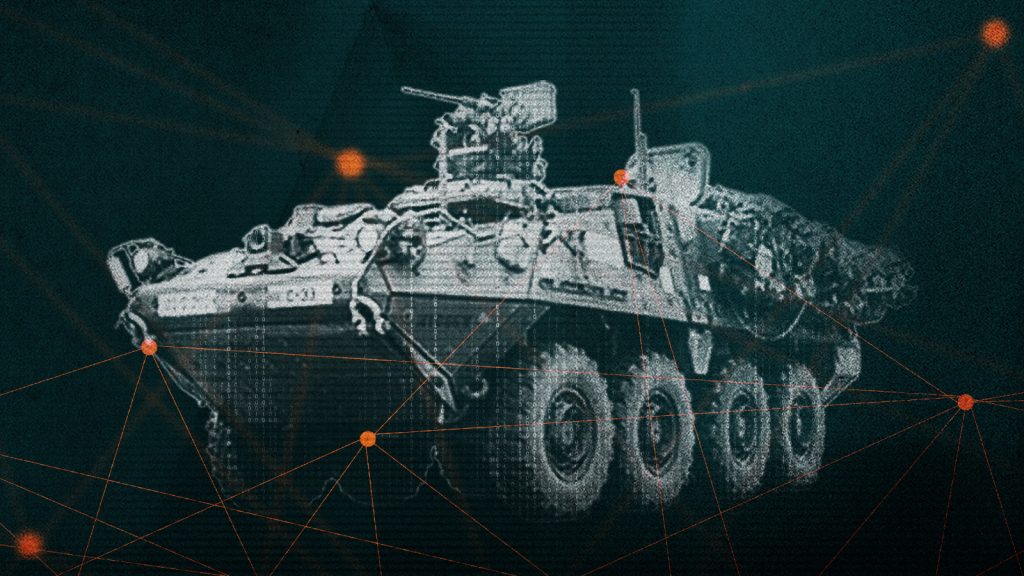
But Colorado-registered ETS Solutions didn’t disclose that, according to a Kharon investigation, it shares a founder, owner, and deep business ties with a Beijing firm the U.S. had placed on its export-restricting Entity List less than three months earlier — for acquiring U.S.-origin testing equipment and then supplying restricted Chinese entities.
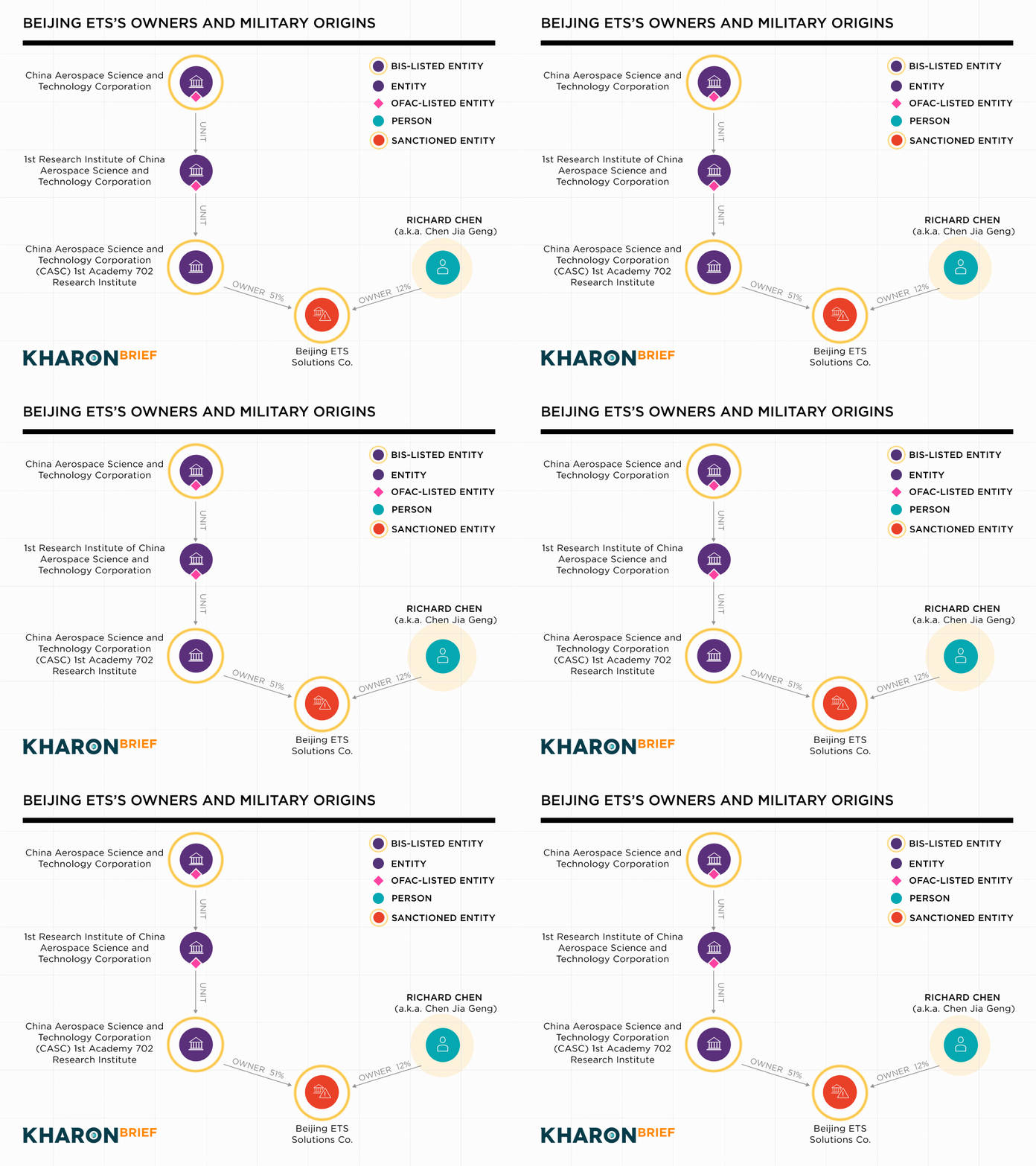
That affiliate, known outside China as Beijing ETS Solutions, openly touts its work for China’s military in its Chinese marketing materials. And, according to corporate records, it traces up through layers of ownership to one of the primary state-owned contractors for China’s own defense and space programs.
“It’s a huge red flag,” said Emily Kilcrease, a senior fellow at the Center for a New American Security. “If you are a U.S. company that wants to be engaged in the defense sector, you do not want to be anywhere near an Entity Listed or designated company.”
Clips from ETS Solutions videos demonstrate its testing equipment — and connect the dots between companies. (Kharon complilation)
A spokesperson for the U.S. Army Combat Capabilities Development Command (DEVCOM), the unit overseeing the project, told The Brief it “takes all national security and cybersecurity concerns seriously” and noted that prime contractors “have the responsibility to properly vet all subcontractors in accordance with the Federal Acquisition Regulation.”
Richard Castiglia, general counsel for the prime contractor, DCS Corp., said it was internally investigating the matter.
ETS Solutions North America manager and co-founder Graham Carmichael acknowledged in a phone call that his company had a prior relationship with Beijing ETS Solutions, whose name in Chinese translates to Beijing Aerospace Hill Test Technology, but said they shared “no connection” since its addition to the Entity List. Corporate records, trade data, and online pages for the ETS brand suggest that is not the case.
Kilcrease and other former senior officials said the ETS Solutions example illustrates the risks of what the White House last month cast as a mounting vulnerability in U.S. national security: defense supply chains that remain, in many cases, a big black box.
Zoom in: President Trump’s executive order from July 20 requires defense contractors to map their entire supply chains and cut off suppliers linked to foreign adversaries. Poor supply chain security can expose U.S. weapon systems to “physical, cyber, and economic subversion,” the order said.
- The new policy follows a Government Accountability Report that found the Pentagon’s procurement database provides “little visibility” into where its supplies are manufactured. Adversaries, it warned, can exploit that gap to gain back-door “intelligence pathways.”
Chinese Origins and Ties
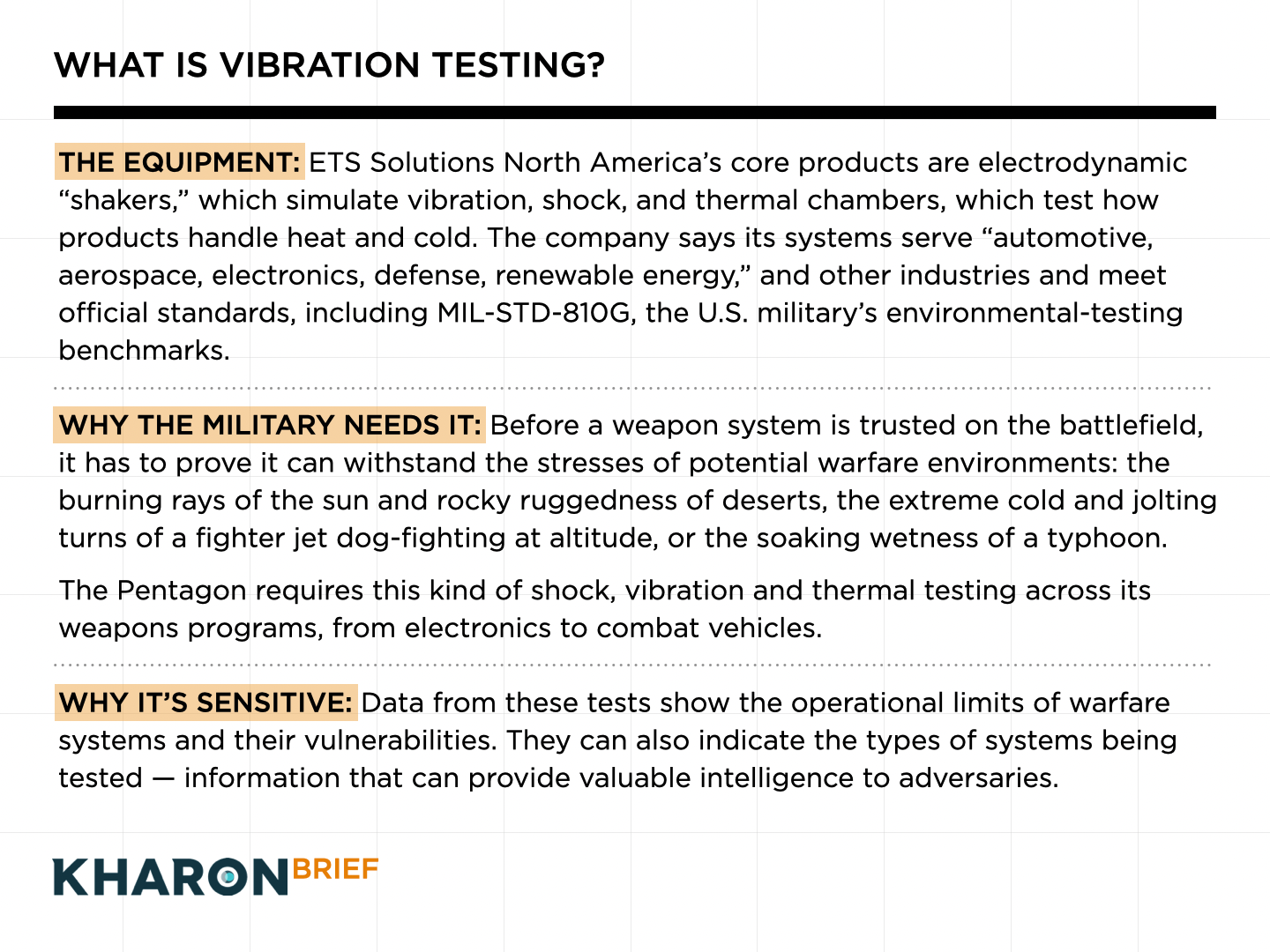
ETS Solutions North America, which was established in Ohio in 2011 as ETS Solutions NA LLC, sells the goods and services to stress-test military and commercial equipment — shaking, heating, and shocking components to verify they can survive real-world conditions.
But the company’s equipment, like its origins, trace to Beijing ETS and, from there, to China’s military aerospace complex, according to corporate records, trade data, company websites, and local media reports.
- A key founder of ETS Solutions North America was Chinese national Richard Chen, who helped launch it with a 15.5% stake. (Its other founders hailed from the U.S. and the U.K., according to corporate records.) Carmichael told The Brief on an initial call that Chen no longer had an ownership stake in his Colorado-based firm, but he later said the co-founder maintained a 10% interest. At the same time, listed under his Chinese name, Chen Jia Geng, he also holds a 12% stake in Beijing ETS Solutions and wholly owns ETS Solutions (China), which the EU blacklisted in April.
- ETS Solutions North America was built largely around products made by Beijing ETS, appearing to sell equipment almost exclusively manufactured by it. As of late July, a website for the ETS Solutions brand — whose videos depict the headquarters of the Beijing branch — referred to ETS Solutions NA LLC as its “USA Sales and Support Office” and “our US based vibration test laboratory.”
- Beijing ETS Solutions’ majority owner, meanwhile, is one of China’s oldest military research and testing labs, the 702 Research Institute, which developed the country’s first indigenous vibration testing system for missiles after the onset of Cold War-era export controls. The lab is owned by a state conglomerate, China Aerospace Science and Technology Corporation (CASC), which is responsible for developing the country’s ballistic missiles and space launch vehicles.
According to corporate records and company websites, Chen began establishing partnerships overseas soon after Beijing ETS Solutions’ founding, teaming up with American and European engineers to form local companies that sold ETS Solutions products. Some sold not only to the U.S. defense sector but to Israel’s.
U.S. military contracts: Despite its roots in the Chinese military complex, ETS Solutions secured a contract the same year it launched, in 2011, with the U.S. Navy to provide testing equipment. It called itself a “U.S.-owned business” then, too, records show.
According to U.S. government procurement data, the company has since won nearly a dozen more Defense Department contracts and subcontracts totaling more than $4 million. The $2 million subcontract on the Army’s future-warfare project is its largest to date.
The DCS contract with DevCom is a major Army modernization project, covering software, electronics, and autonomy engineering across a wide range of ground combat platforms, according to government briefings and DCS’s own description of the work.
On the record: Carmichael said he was not aware of Chen’s ongoing ownership in Beijing ETS, nor that firm’s relationship to China’s military complex. He also said ETS Solutions North America had told DCS that the testing product was made in China.
- (DCS did not directly respond to a question from The Brief about that statement.)
Neither of Chen’s ownership stakes were disclosed in ETS Solutions North America’s federal contract filings reviewed by Kharon, which include fields for foreign and parent-company ownership details.
An ETS Solutions Corporate Web
But the ETS companies’ ties run deeper than shared ownership.
When BIS added Beijing ETS Solutions to the Entity List in November 2024, listing it under Beijing Aerospace Hill Test Technology, it identified four additional aliases for it. Trade records show one of them, the Chen-owned ETS Solutions (China), as the exporter of goods sent to ETS Solutions North America in multiple shipments both this year and last.
- Several of those shipments also included exporter addresses matching the BIS entry.
Carmichael speculated that filing errors might be to blame and said that ETS Solutions North America was not receiving goods directly from Beijing ETS Solutions.
Instead, he said that his company’s business relationship since the Entity Listing had been with a different, Hong Kong-based firm called ETS Solutions International, which Carmichael lists as one of his employers on LinkedIn and which he said was unrelated to Beijing ETS Solutions.
Corporate and trade records, however, suggest the two are closely connected.
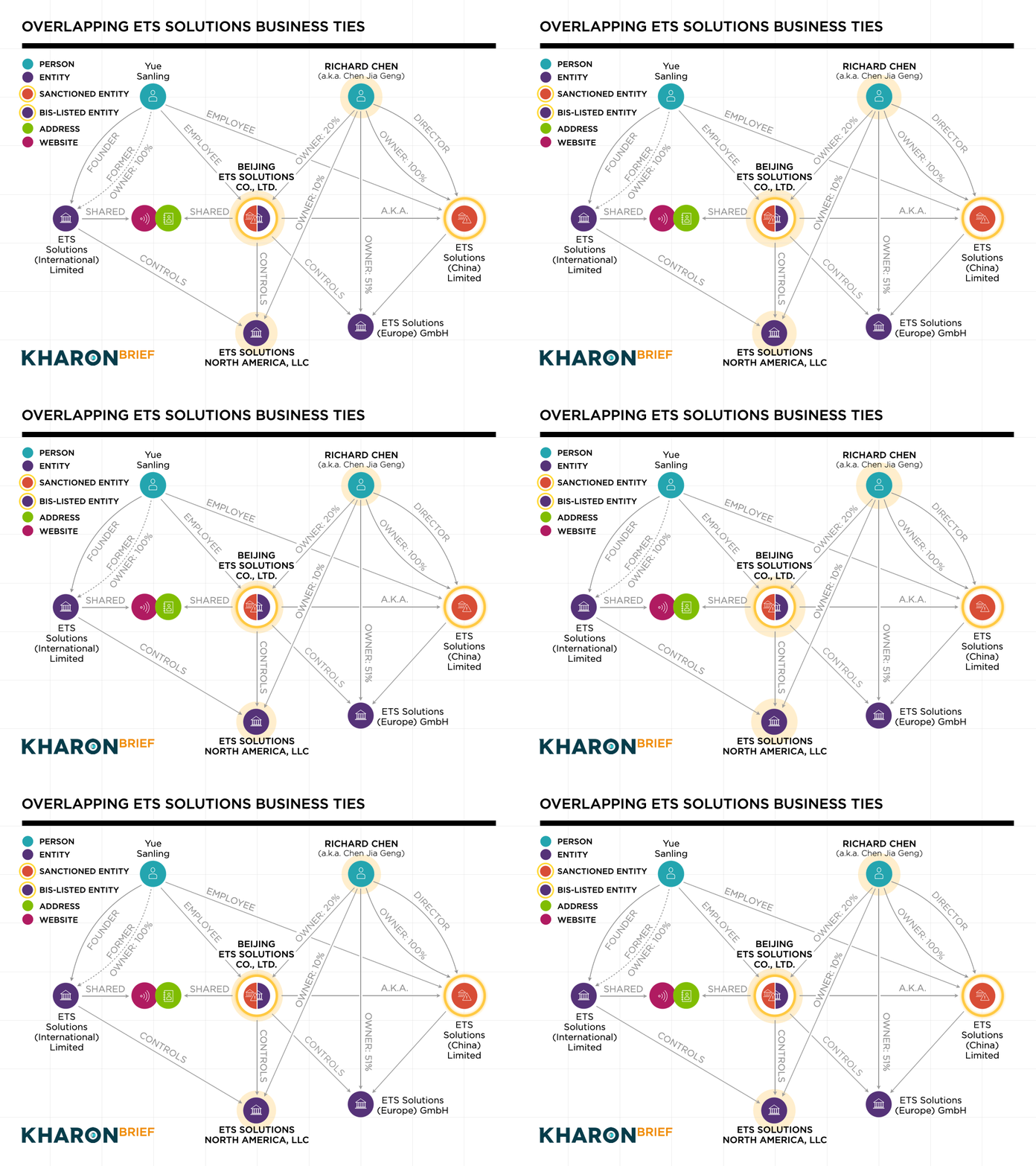
The two companies also share an English-language website, a Kharon review found, and videos on ETS Solutions International’s YouTube channel showcase Beijing ETS Solutions’ headquarters and engineering facilities.
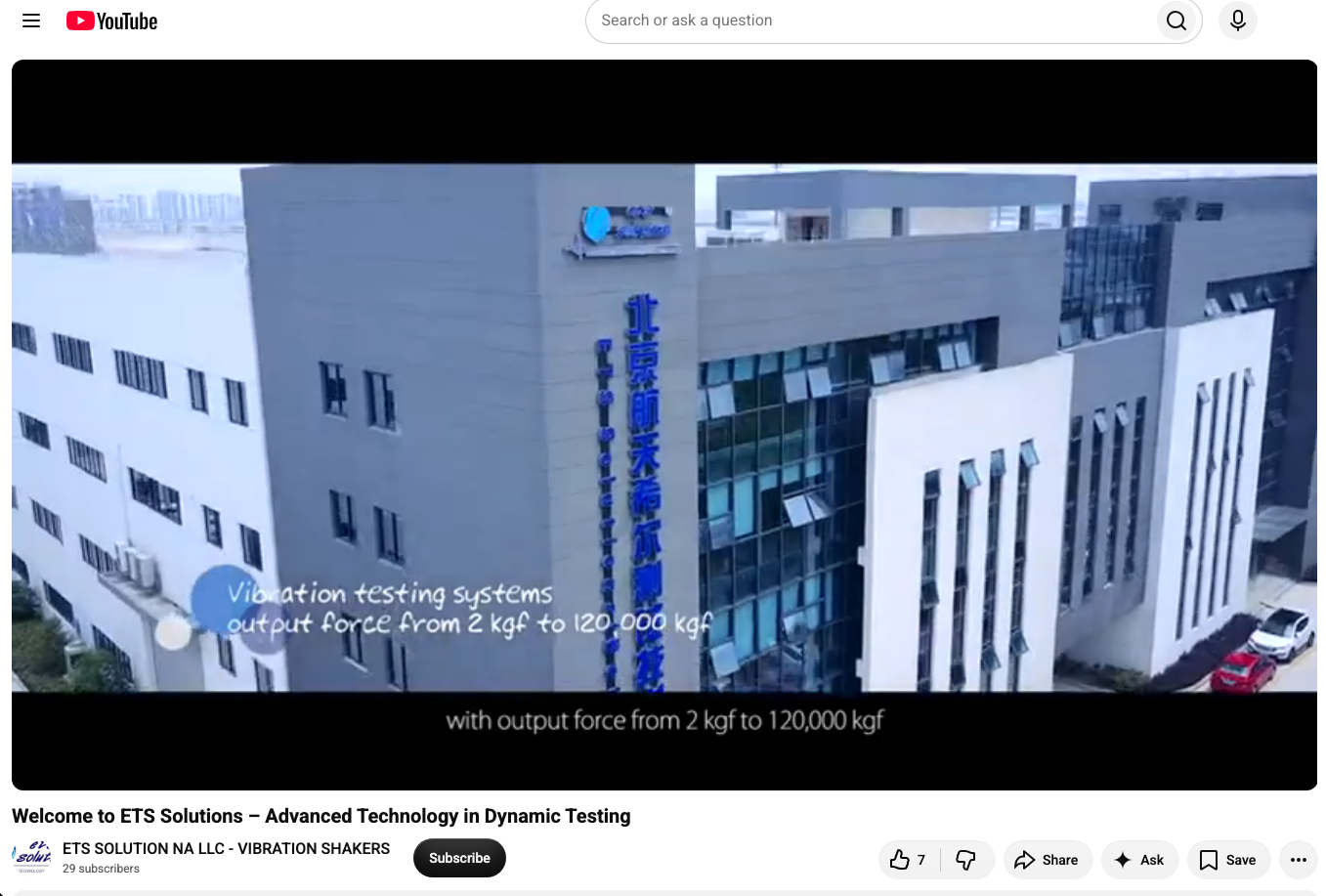
A “Welcome to ETS Solutions” video posted by ETS Solutions NA LLC, an earlier name for ETS Solutions North America, depicts Beijing Aerospace Hill Test Technology’s headquarters.
Why Testing Matters
The potential risks, according to the former U.S. national security officials who spoke with The Brief, lie not just in ties to a Chinese military firm but also in the specific Army work involved.
“Testing in particular is sensitive because it exposes vulnerabilities in a system,” said Kilcrease, who was formerly a senior official at the National Security Council and oversaw the Office of the U.S. Trade Representative’s work on the Committee on Foreign Investment in the U.S. “It’s really important information from a counterintelligence perspective.”
- A 2025 U.S. Defense Counterintelligence and Security Agency (DCSA) report warned that commercial entities, mainly from Asia, frequently attempted to establish relationships with cleared military contractors, often “with the underlying intent of acquiring export-controlled technologies.”
- And subcontractors can present another loophole.
Testing provides information on the operational parameters of warfare systems, explained one veteran DCSA official, who spoke to The Brief on the condition that his name be withheld because he has ongoing business with the government.
“When we classified information for a system, the most classified stuff are the operational parameters,” he said. “If you know the operational parameters, that’s very bad, but worse than that, if they’re doing maintenance, they can also just suck down all of the programmable logic control data.”
And because of China’s civil-military fusion laws, “the PRC has the right to demand any and all customer data that those companies have” from employees and owners, the former DCSA official added.
ETS Solutions North America markets its most advanced testing equipment as having internet and remote access capabilities. Carmichael said no data from the U.S. Army’s future-combat vehicles project was shared with its Chinese suppliers or affiliates. “We haven’t tested it, and we haven’t used that function,” Carmichael said.
The DevCom spokesperson said the equipment from ETS Solutions had not been opened since its delivery and that all equipment undergoes “established risk assessment and mitigation processes” before installation.
As DOD and its prime contractor assess their exposure, Carmichael said he’d reached his own conclusion.
Calling The Brief last week, he said he didn’t “like the association” his company had with a sanctioned, military-linked supplier through Chen, whom he said he was now struggling to reach.
He suggested he would try to cut Chen out.
“He’s not a bad guy,” Carmichael said. “But it presents risk.”
Read more from The Brief: