
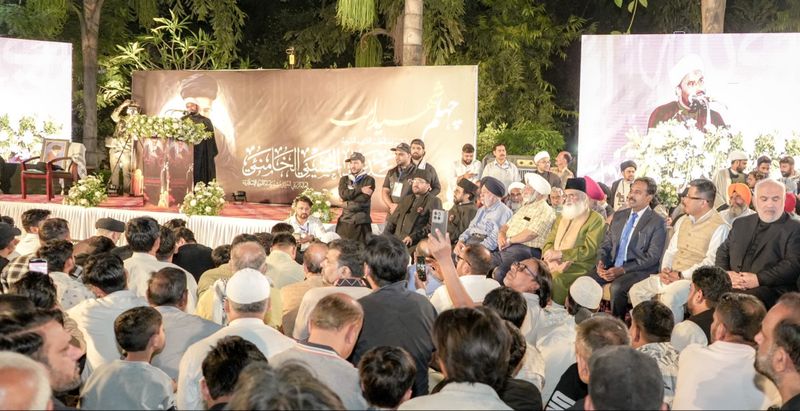
Sunday’s ceremony at the Iran embassy in New Delhi, following the US-Iran peace talks in Islamabad, marked the Chehelum, observed on the 40th day after death in Shia tradition.
New Delhi: Even as US President Donald Trump announced a naval blockade of the Strait of Hormuz following the collapse of talks with Iran, minister of state for external affairs Pabitra Margherita on Sunday (April 12) represented the Indian government at a mourning ceremony for Supreme Leader Ali Khamenei at the Iranian embassy in the capital.
The presence of a minister at the ceremony signals a higher level of engagement than the earlier visit by foreign secretary Vikram Misri, who had signed the condolence book on behalf of the government.
In a post on X, MEA spokesperson Randhir Jaiswal said Margherita “offered solemn respects on behalf of the Government of India” at the 40th day mourning ceremony organised by the Iranian embassy, adding that India-Iran ties are rooted in deep civilisational and cultural links.
Sunday’s ceremony at the Iran embassy in New Delhi marked the Chehelum, observed on the 40th day after death in Shia tradition.
Khamenei was killed on February 28 in coordinated missile strikes on Tehran carried out by the United States and Israel.
The US-Iran strikes triggered a wider conflict that quickly expanded across the region, as Iran retaliated against Israeli targets and US military installations in Gulf countries. Energy infrastructure and civilian facilities were also hit in subsequent exchanges inside Iran and elsewhere.
After Iran formally notified Khamenei’s death, India did not issue statement condemning Khamenei’s death, despite New Delhi having friendly ties with Tehran.
The silence drew criticism from Indian opposition, as Prime Minister Narendra Modi was also making phone calls with Gulf leaders and criticised Iranian missile strikes on their territory, without taking Iran’s name.
On April 4, Iran embassy opened a condolence book which was signed by Misri.
The violent escalation in the Gulf spilled into the Strait of Hormuz, where Iran’s selective targeting of ship led to commercial tankers hesitating to cross the waterway, effectively disrupting one of the world’s busiest energy corridors which ferried 20% of the world’s oil and LNG supplies.
Before the war, 150 ships used to go through the waterway daily. Only about 15 to 20 ships, including 8 Indian-flagged vessels, passed through the Strait between Feb 28 and April 8, as per tracking data.
A two-week ceasefire took effect on April 8 after weeks of hostilities, though tensions remained high. Talks aimed at stabilising the situation were held in Islamabad on April 11, with US Vice President JD Vance travelling to Pakistan for the discussions with Iran. But, after 21 hours of discussions, no deal was reached.
Trump stated that due to Iran’s decision not to accept US demands at the discussions, he had ordered the US Navy to blockade the strait of Hormuz.
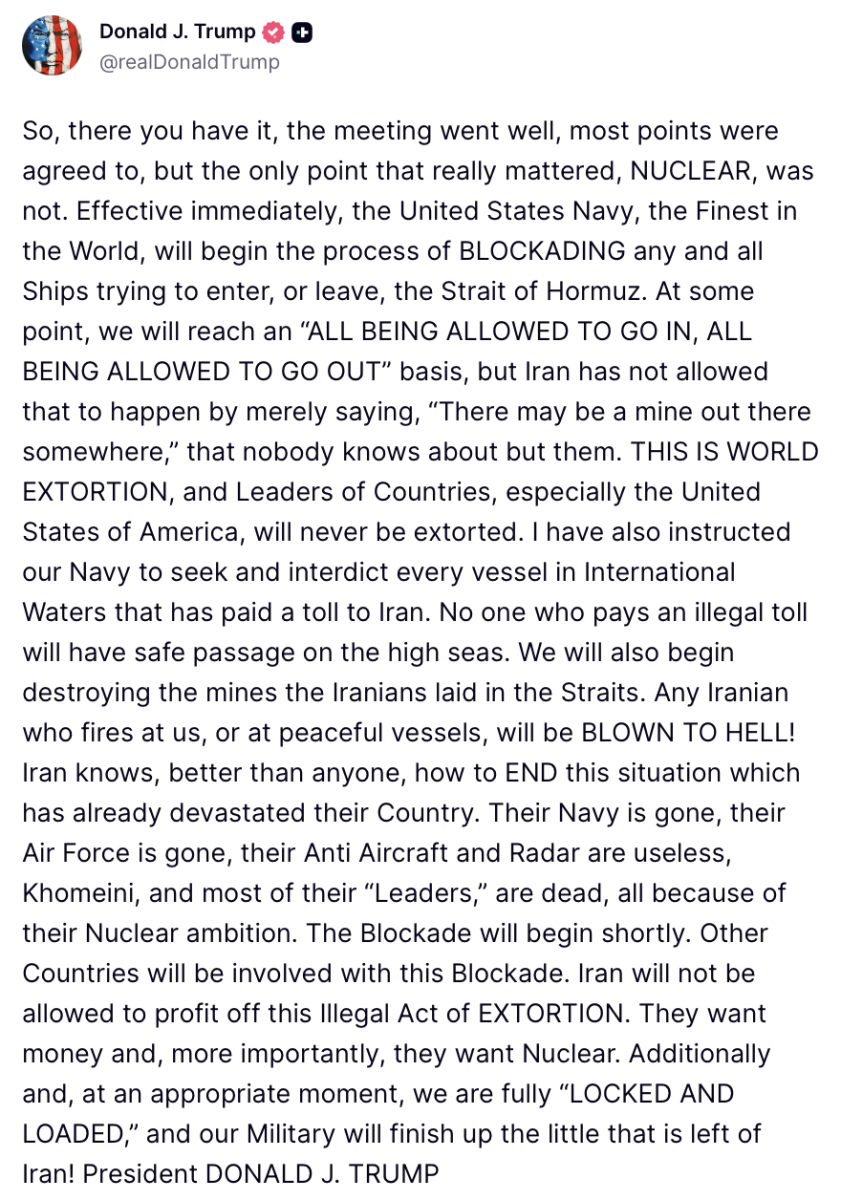
In a post on Truth Social, Trump said Iran had “failed” to reopen the Strait of Hormuz despite assurances during talks and alleged that the situation had caused “anxiety, dislocation, and pain” globally. He claimed the US Navy would begin blocking “any and all ships trying to enter, or leave” the waterway, describing it as an “international waterway” that must be kept open.
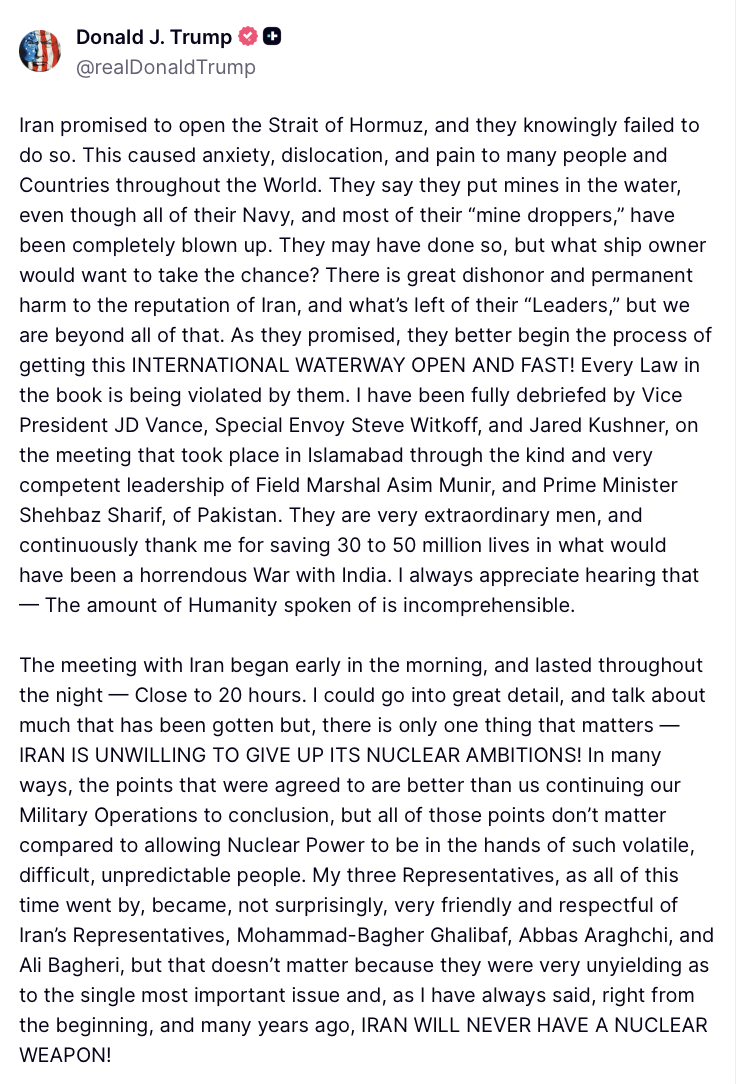
He also suggested that Iran may have deployed mines in the strait, though he added there was uncertainty over the extent of such actions, and framed the blockade as necessary to prevent further disruption to global shipping.
“Iran will not be allowed to profit off this illegal act of extortion,” he wrote, noting that any ship that has “paid a toll to Iran” would be stopped. While he didn’t make it clear, he also was likely was talking about Iran allowing ship with its own energy resources going through the Strait.
The developments come even as India has quietly adjusted its energy posture amid disruptions in the Gulf. According to Reuters, New Delhi has recently granted waivers to allow at least two Iranian cargoes to dock at Indian ports, despite one vessel being older than normally permitted and another being under US sanctions.
The waivers were cleared on a case-by-case basis as India faces one of its worst cooking gas shortages in decades, with LPG supplies hit by the disruption of Gulf routes. Officials told Reuters that only vessels meeting safety requirements were being allowed, even as New Delhi relaxed some of its usual restrictions to secure supplies.
India is the world’s second-largest importer of liquefied petroleum gas, most of it through the Strait of Hormuz. The supply crunch has forced the government to prioritise household consumption while rationing industrial use.
There has been no response from India to Trump’s decision to implement a naval blockade.
Trump, in another post, also referred in the same breath to the recent four-day India-Pakistan military confrontation, claiming that his administration had helped avert a much larger war. He praised Pakistan’s leadership, calling them “very extraordinary men”, and said they had thanked him for “saving 30 to 50 million lives” in what he described as a potential conflict with India.
The US president has repeatedly claimed that he forced India and Pakistan to stop their hostilities in May last year. India that had the ceasefire was due to direct military-to-military talks with Pakistan.
This article went live on April thirteenth, two thousand twenty six, at twenty-five minutes past twelve at night.
The Wire is now on WhatsApp. Follow our channel for sharp analysis and opinions on the latest developments.