
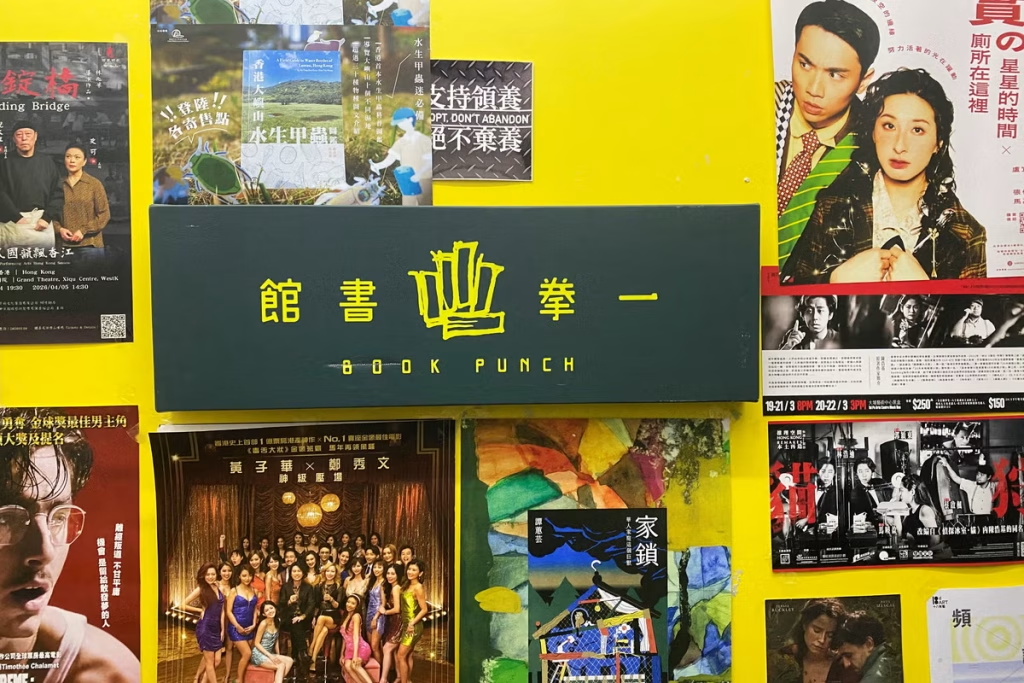
Writers like attention, but not this kind. I was in shock when a Reuters journalist told me that Hong Kong authorities had arrested four people for selling my biography of Hong Kong newspaperman Jimmy Lai, The Troublemaker. A bookstore owner and three of his staff were arrested on sedition charges under the city’s national security legislation, and each faces up to seven years in prison.
When China took over the former British colony in 1997, it promised that free speech would remain intact under the ‘one country, two systems’ approach. That meant that Hong Kong would be as free as ever, with little resemblance to China’s repressive state.
But that promise was broken. The arrest of the booksellers is just one more in China’s string of betrayals. Something about the image of a shuttered bookstore, its gate padlocked with a sign announcing its closure for an “unexpected emergency”, piqued the collective imagination and global media picked up the story. But the whole experience left me feeling humbled, sad, and, somehow, soiled.
Authors spend a lot of time alone. We start with nothing but an idea. We follow it up with some notes and an outline, and then start writing. We do interviews – more than 100 in the case of this book – and read a lot, and then we start typing. We write a page. Two hundred and eighty seven more of those pages and lots of fact-checking and copy-editing later, we have a book. Reviews dribble in. Book talks draw scores of people more frequently than they do hundreds. Viewers and listeners tune in to television and radio and podcast appearances, but the author doesn’t see them. Much as an author hopes to make a difference, it’s a pretty solitary endeavour.
Then comes news that four brave Hong Kong booksellers face seven years in prison for what’s on those 288 pages. It’s a heady feeling, honestly, to have a government stamping its seal of disapproval on a cause I know is right. But as much as I like standing up for what is morally correct, I feel ashamed even for thinking this way. Jimmy Lai – and six other of my former Apple Daily colleagues, as well as hundreds of others in the former British colony – are still in jail.
It’s humbling to consider the staff of Book Punch, a little shop that packs, well, a big punch. I’ve never met the owner, Pong Yat-ming. But I’ve admired him as he’s resisted government harassment since founding the independent community-minded bookstore in 2020, the same year Beijing imposed a vague and sweeping national security law on Hong Kong. He’s now been sentenced for running an illegal language school for giving Spanish lessons. He’s also been convicted of serving alcohol illegally because he distributed cups of sake after a Japanese author spoke, and fined fined HK$32,000.
Pong, in short, has been testing the limits of newly authoritarian Hong Kong. But why did authorities choose to pick my book as an excuse to lower the hammer on Pong? An answer of sorts came in a Hong Kong English-language newspaper, The Standard. Ironically, I was the publisher and editor-in-chief at the paper two decades ago. Although its owner, Charles Ho, had made his peace with Beijing, he gave us lots of latitude to push the boundaries of what was acceptable in what now looks like a halcyon age. Indeed, Charles, who died last year, once told me that China would be a social democracy “like France” by the mid-2020s.
Now, The Standard serves as a conduit for government thinking. The paper told its readers that the “seized biography of Lai allegedly disregards facts by glorifying Lai’s actions in colluding with foreign forces to endanger national security, attacks Hong Kong’s judicial personnel, misrepresents the government’s detention arrangements for Lai, and deliberately vilifies Hong Kong and the mainland in an attempt to incite sedition among Hong Kong residents”.
Roughly six out of ten Hong Kong voters supported pro-democracy candidates in every election from the first territory-wide Legislative Council elections held in 1991, during British colonialism, until the District Council elections in November 2019. Although hundreds of thousands of pro-democracy citizens left the territory after the crackdown beginning in 2020, it’s a safe bet that many of the seven million people still in the city want freedom.
Hong Kong authorities continue to fret about “soft resistance”. It would be hard to find something much softer than the paperback Chinese-language edition that Book Punch sold. The question is why they bother drawing attention to Jimmy Lai or the book.
Mark L Clifford is the author of The Troublemaker: How Jimmy Lai Became a Billionaire, Hong Kong’s Greatest Dissident, and China’s Most Feared Critic. He served on the board of Apple Daily’s parent company and is the president of the Committee for Freedom in Hong Kong Foundation