
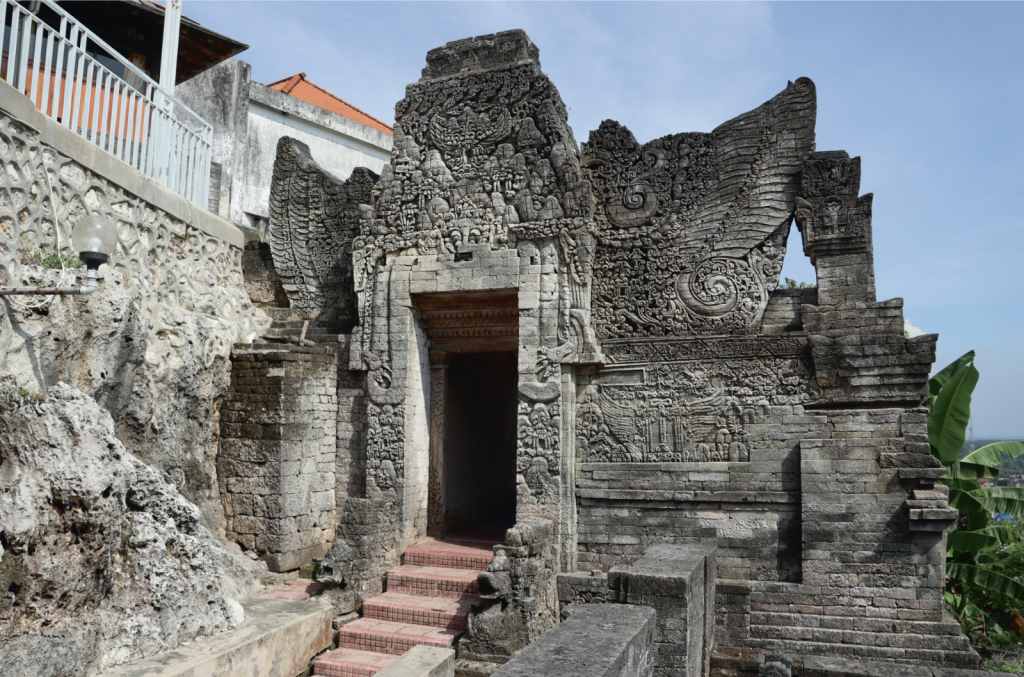

The winged gate of Sendang Duwur in Lamongan, East Java. Photo by Panggah Ardiyansyah
If you studied Indonesian history in school in the 1990s, you learned to divide the archipelago’s past into neat chapters: Hindu-Buddhist kingdoms, then Islamic sultanates, with a brief “transitional period” somewhere in between. Colonial archaeologists created these categories in the nineteenth century, and they’ve structured Indonesian historiography ever since — shaping not only how we study ancient sites, but also what counts as history in the first place and what we archive and remember for the future.
But visit Sendang Duwur, a sixteenth-century Islamic compound in East Java, and these categories begin to fracture. Here, soaring temple gates adorned with Hindu iconography guard an active mosque. Pilgrims climb stairs designed like pathways to heaven, passing through spaces that resist singular religious meanings. The site has been continuously inhabited, renovated, and reinterpreted for five centuries, yet archaeological scholarship tends to freeze it in time.
What if this framework blinds us to how Javanese communities actually understand sacred space? What recourse do scholars have to resist these inherited categories and to imagine decolonial futures for Indonesian archaeology?
In this week’s episode, Tito chats with Panggah Ardiansyah, a research associate at the University of Sheffield’s Digital Humanities Institute, whose research challenges us to read Indonesian antiquities through Indonesian epistemologies. Drawing on his 2025 paper “Fragment and Evocation: Hindu-Buddhist Hauntings in the Islamic Complex of Sendang Duwur”, published in the journal Art History as part of a special edition on decoloniality, Panggah argues that the concept of kramat — sacred sites imbued with ancestral power — offers better tools for understanding sites like Sendang Duwur than the binaries inherited from colonial scholarship.
In 2026, the Talking Indonesia podcast is co-hosted by Dr Tito Ambyo from RMIT, Dr Jemma Purdey from the Australia-Indonesia Centre, Dr Clara Siagian from the University of College London, Dr Jacqui Baker from Murdoch University, and Dr Elisabeth Kramer from the University of New South Wales.