
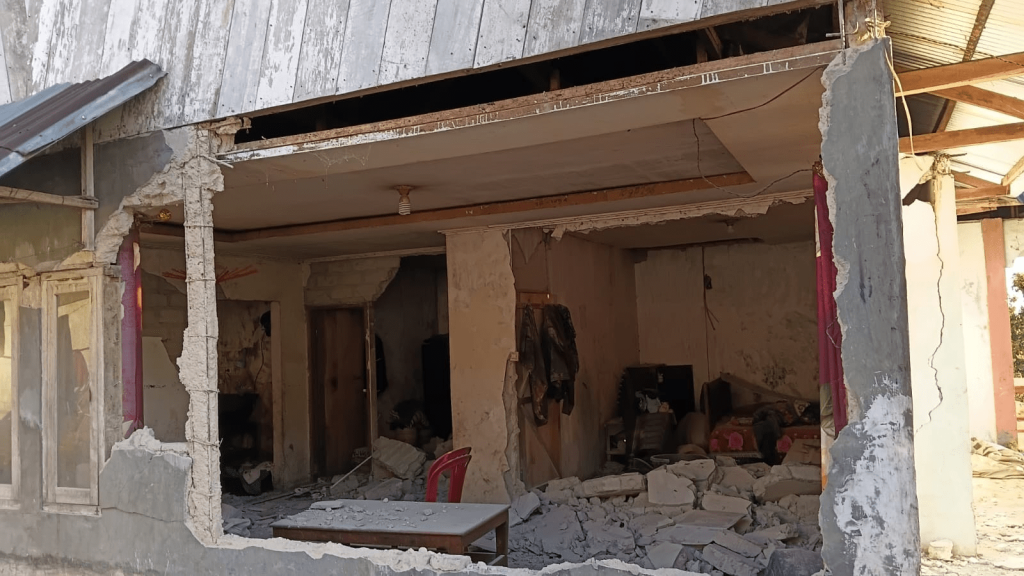
The Indonesian Peasants’ Union (SPI) expresses its deepest condolences and solidarity following the earthquake that struck the East Nusa Tenggara/Nusa Tenggara Timur (NTT) region on Saturday (15/8/2026). Two days after the disaster, communities across affected areas remain in an emergency situation and have not yet been able to resume their normal daily lives.

The earthquake, which affected several districts such as West Manggarai, Manggarai, East Manggarai, Ngada, Ende, Nagekeo, and Sikka, caused damage to homes, places of worship, and various public facilities. In some areas, infrastructure and access between areas have also been disrupted, affecting people’s mobility and emergency response efforts on the ground.
According to information from the NTT Regional Disaster Management Agency (BPBD) as of Tuesday (18/8/2026), the death toll has reached 69 people. In addition, 331 people have been injured, and more than thirty thousand others have been displaced due to damaged homes and ongoing unsafe conditions. Hundreds of houses have sustained damage ranging from severe to moderate and minor levels, while dozens of public facilities, including schools, health services, and places of worship, have also been affected.
As reported by Detik.com, based on the latest data from BPBD NTT, a total of 19,297 houses have been affected across Flores and surrounding areas. Of this total, 6,463 units were heavily damaged, 2,481 moderately damaged, and 12,006 lightly damaged.
In addition, damage has also affected various public facilities, including 658 educational units, 172 health service facilities, 172 places of worship, 187 office buildings, and 89 other public facilities. These damages occurred across eight districts: Manggarai, West Manggarai, East Manggarai, Ende, Sikka, Ngada, Nagekeo, and East Sumba.


In rural areas, peasants and rural communities are among those directly affected. Damage to homes, disruption of daily activities, and damage to agricultural land due to disrupted irrigation systems have further worsened conditions. This is compounded by ongoing aftershocks, which continue to limit community activities. As of today (18/8/2026), a total of 2,119 aftershocks have been recorded, with the largest magnitude reaching 6.2.
The Chair of SPI Chapter East Nusa Tenggara (NTT), Bastian, stated that aftershocks are still occurring frequently and continue to be felt by residents. He explained that SPI Chapter NTT is currently conducting data collection on affected members and communities across various areas.
“We are currently collecting data on members who were severely affected in Kisol, including damage to a church. As for fatalities, so far, we are aware of one person near where I live,” said Bastian.
He hopes that conditions will improve soon, aftershocks will subside, and residents will be able to resume their activities more calmly without being overwhelmed by panic.
Meanwhile, according to Yusuf, an SPI peasant in West Manggarai who is also an alumnus of SPI’s agroecology training, residents are still choosing to stay outside their homes due to frequent aftershocks that continue to cause concern. Many families are evacuating independently with limited shelter, making basic needs such as food, clean water, clothing, medicines, and emergency supplies crucial during the disaster response period.
Amid these conditions, SPI expresses its solidarity with all affected communities. This solidarity is crucial as a form of collective presence during the difficulties faced by the people.
As part of its response, the SPI NTT Chapter has established an emergency response post located in Tanah Datar, East Manggarai. SPI calls on all elements of society to strengthen solidarity for earthquake-affected communities in NTT. Support in the form of necessities such as food, clothing, and medicines is urgently needed to help communities endure the emergency period.
Beyond that, people’s solidarity is a vital force in facing disaster situations. The support provided not only helps meet urgent needs but also serves as a foundation for communities to remain resilient and support one another during this difficult time.
SPI encourages the continued strengthening of cooperation, ensuring that affected communities do not face this situation alone. The solidarity built today will be an essential part of the recovery process moving forward. SPI calls on all its members and networks, people’s movements, and the wider public to strengthen humanitarian solidarity for the victims of the NTT earthquake.
For further information, please contact:
1. Ali Fahmi (Vice Chairperson of SPI) +62 813-1864-8684
2. Zulfikar (Head of SPI Peasants’ Action Agency) +62 895-1836-5857