
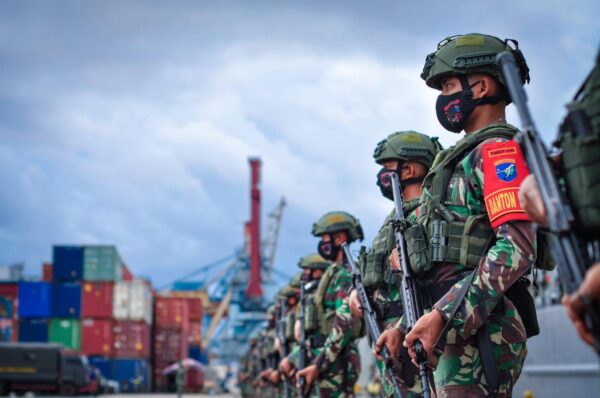
In January, a draft presidential regulation (perpres) on the Indonesian National Armed Forces’ (TNI) Role in Counterterrorism was released. Much like an earlier version released in 2020, the draft outlines three main counterterrorism functions for the military: prevention, which grants authority for the TNI to carry out intelligence, territorial, information, and “miscellaneous” operations for counterterrorism purposes; enforcement, which permits TNI’s use of force in response to terrorist acts that, among others, threaten the president and vice president, targets strategic national infrastructure, or poses danger to Indonesia’s state ideology and sovereignty; and recovery, which the draft leaves largely unspecified.
As in 2020, the draft drew strong criticism from the public. Following its release, the Civil Society Coalition for Security Reform – a network of 21 civil society organizations including notable human rights groups such as Imparsial, the Commission for Disappeared and Victims of Violence, and Amnesty International Indonesia – issued a press statement contending that the draft’s broad expansion of the military’s counterterrorism role, combined with the vague definitions of its operational scope, risks enabling overreach and creating unnecessary overlaps of authority with other counterterrorism units.
Responding to the criticism, State Secretary Prasetyo Hadi emphasized that the draft remains under discussion and cautioned against drawing premature conclusions.
While the proposed presidential regulation remains tabled at the time of writing, these regulatory developments underscore the enduring prospect of the military’s expanding role in Indonesia’s counterterrorism strategy.
Against this backdrop, it is important to examine the evolution of TNI’s counterterrorism role since the 2000s and identify key lessons for future regulations governing such involvement. To avoid a recurrence of past challenges associated with TNI’s participation, future regulations should incorporate three key safeguards: a limitation of the military’s involvement in high-threat environments that existing institutions are unable to address, a clear coordination mechanism to align TNI’s initiatives with those of other agencies, and a strong oversight mechanism to ensure accountability and address the public’s fear over military overreach.
An Overview of TNI’s Participation in Counterterrorism (2000-2020)
The military’s participation in Indonesia’s counterterrorism strategy since 2000 can be broadly divided into four periods. During the first period, Indonesia’s counterterrorism strategy was firmly spearheaded by the police. Indeed, due to the surge of political violence in the early 2000s, placing significant strain on the police’s resources and the government’s reluctance to invest in the police’s counterterrorism capabilities, counterterrorism operations during this time in practice still depended on some of TNI’s institutional resources. Following the 2002 Bali Bombings, for example, shortcomings in the police’s intelligence analysis capacity led their counterterrorism unit, the Gegana Regiment II, to largely rely on TNI’s intelligence infrastructures to arrest key perpetrators.
Even after the creation of the Special Detachment (Densus) 88 in 2003, which largely addressed the police’s earlier counterterrorism capacity shortcomings, TNI’s resources were still periodically mobilized to support large-scale counterterrorism operations. During the 2007 Tanah Runtuh Operations against Jemaah Islamiyah (JI) in Poso, Central Sulawesi, for example, over 1,300 TNI personnel were placed on standby to aid the police-led raids. Despite their persistent presence, however, counterterrorism operations during this period remained firmly under police control, with the military providing tactical support only when requested. As an International Crisis Group report described, “no matter how complex the problem, it was still the police, not the military, who were in charge.”
This hierarchy of authority began to shift in 2010. During this second period, the military saw an increased role in shaping Indonesia’s countering violent extremism (CVE) strategy through their involvement in the National Counterterrorism Agency (BNPT). Due to the 2009 Jakarta Hotel Bombings, then-President Susilo Bambang Yudhoyono became convinced that terrorism was a matter of state security requiring the military’s involvement. This not only fast-tracked the establishment of the BNPT but also entrenched the military’s role in its structure. Indeed, since its inception, senior posts in BNPT’s office focused on deradicalization, led by the deputy for prevention, protection, and deradicalization (Deputy I), were largely reserved for the TNI, despite the police possessing much of the experience needed to design effective deradicalization programs at the time.
As an Institute for Policy Analysis of Conflict Report noted, the TNI’s mark on Indonesia’s CVE framework was quickly evident. In the 2011 Strategic Plan that Deputy I released, for example, among the first reasons noted to cause terrorism were “a weak sense of nationhood” and “weak citizenship education” – two factors that closely aligned with TNI’s vision of its mandate to safeguard national sovereignty. More importantly, the Strategic Plan omitted several key causes of radicalization that years of police-led deradicalization efforts had already identified, including the differing dynamics of radicalization in conflict and non-conflict zones, along with the critical role of social networks in sustaining individuals’ radicalization process.
Starting from the third period, however, the military’s counterterrorism role began to formally extend into operational engagements. This shift began in 2015 with Operation Camar Maleo, a police-led mission in Poso, Central Sulawesi, targeting the Mujahideen of East Indonesia (MIT). Initially, the military participated in the campaign unofficially – firing rockets and naval gunfire at Mount Biru, where MIT members were believed to be hiding as part of a President-sanctioned “combat exercise.” By late 2015, however, the military’s involvement was formally institutionalized. As reports from the time recounted, across the third and fourth phase of Operation Camar Maleo, a total of 760 TNI personnel was deployed alongside the police to pursue MIT members.
The TNI’s involvement in operations increased substantially with Operation Tinombala, the continuation of Operation Camar Maleo. During the first phase of Operation Tinombala alone, over 1,791 military personnel were deployed, exceeding the 1,543 police personnel involved. Unlike the earlier Operation Camar Maleo, however, the now joint military-police operation established a clearer division of responsibilities: the military was tasked to track MIT members in Mount Biru to leverage its jungle warfare capabilities, while the police focused on disrupting the group’s logistical networks in urban areas. This operational arrangement was notably more effective, as by mid-to-late 2016, the operation had shot dead MIT leader Santoso and forced his successor, Basri, to surrender.
The fourth period of the military’s counterterrorism involvement began in 2018, marking the point at which the TNI was formally assigned a legal mandate to participate in operations under Indonesia’s Anti-Terrorism Law. Following an escalation of attacks in early 2018, namely the Depok Prison Riot and the Surabaya Bombings, Indonesia’s parliament moved to revise the country’s 2003 Anti-Terrorism Law. Partly driven by perceptions of the police’s weakness stemming from their failure to prevent said attacks, alongside the perceived success of Operation Tinombala, the resulting 2018 Anti-Terrorism Law explicitly came to recognize TNI’s mandate to participate in counterterrorism as part of its Military Operations Other Than War duties.
While the 2018 Anti-Terrorism Law did acknowledge the military’s counterterrorism mandate, it did not fully define the scope and limits of its involvement. Instead, as stated in Article 43I(3), detailed provisions governing the implementation of the military’s participation in counterterrorism were to be further regulated through a subsequent presidential regulation. Notably, however, efforts to formulate this regulation have repeatedly stalled over the last seven years, with drafts consistently facing public backlash. Consequently, while the military now possess a clearer legal mandate to partake in counterterrorism operations than ever before, their actual involvement remains largely unchanged from that in 2015.
Lessons for Future Regulations on the Military’s Involvement in Counterterrorism
The past 25 years of TNI’s involvement in counterterrorism offers three key lessons for the future design of regulatory frameworks. First, military participation in counterterrorism is necessary, but should only be authorized during high-threat environments that police’s capabilities are unable to address.
Indeed, notable cases exist where TNI’s deployment played a central role in the success of counterterrorism operations. During the initial operations against MIT, for example, the police’s limited familiarity with guerilla tactics and the region’s mountainous terrain allowed the group – who were better adapted to such conditions – to repeatedly evade arrest. It was only after TNI’s involvement supplemented the operations with their unique jungle warfare expertise that it began to yield meaningful results.
However, assigning the TNI counterterrorism responsibilities that other agencies are already capable of handling not only risks unnecessary duplication of existing efforts, but may also intensify institutional rivalries in ways that undermine coordination and efficacy.
For example, when the TNI was tasked with coordinating Indonesia’s CVE initiatives through BNPT’s Deputy I, it had to relearn many lessons the police experienced during their early 2000s deradicalization efforts, leading to similar program shortcomings such as inconsistent follow-up and inadequate evaluation mechanisms. Moreover, because TNI’s expanded deradicalization role was perceived to have encroached on initiatives that the police pioneered, both agencies became reluctant to share crucial intelligence on in-prison networks and program best practices.
Second, future involvement of the military in counterterrorism operations should only be authorized when it is carried out in close coordination with other existing counterterrorism units. As Operation Tinombala demonstrated, the military’s involvement in counterterrorism operations yielded effective results only when it was properly coordinated with the police’s plans. Prior to this, there were numerous instances where independent military counterterrorism initiatives undermined the effectiveness of broader counterterrorism missions. For example, although the military’s “combat exercise” during the early stages of Operation Camar Maleo was regarded by many military officials as a necessary deterrence against MIT, it unintentionally caused MIT members to disperse from Mount Biru, ultimately preventing the operation from arresting the group’s leaders.
Notably, this was not the only time the military’s well-intentioned initiatives undermined the police’s counterterrorism efforts. Prior to Operation Camar Maleo, for example, the TNI often conducted social outreach programs in Poso to win the hearts and minds of MIT supporters and persuade its key leaders to surrender. However, as these efforts were done largely independent from the police’s efforts, they in fact became counterproductive to the police’s broader intelligence gathering operations in the region. As a police officer at the time noted, these TNI operations had instead disrupted police initiatives to map out and intercept MIT’s supply lines because “we no longer know who’s friend and who’s foe.”
Finally, future involvement of the military in counterterrorism operations should be made subject to multiple institutional oversight mechanisms. Notably, counterterrorism is just as much about perceived legitimacy as kinetic efficacy. There have been many instances where counterterrorism operations inadvertently increased popular support for groups despite successfully dismantling their networks. In the 2007 Tanah Runtuh Operation, for example, while the police’s numerous house raids successfully dismantled much of JI’s network in Poso, the way it was carried out also generated significant discontent and anger from the local population. As further research noted, it is these grievances that ultimately created fertile conditions for future jihadist mobilization in the region.
Placing robust institutional oversight on the military’s involvement in counterterrorism operations – such as parliamentary scrutiny or monitoring by independent monitoring agencies – will be essential to assure the public that such engagement is not only justified, but will be held to high accountability. This is particularly important amid growing fears that the TNI’s participation in counterterrorism operations could be misused to detain protestors, as well as broader declines in public trust in the TNI due to their growing involvement in non-defense matters. Without such safeguards, military participation in counterterrorism risks reinforcing terrorists’ online propaganda narratives, which often exploit anti-government sentiment and calls for a “national revolution.”
Conclusion
Indonesia is entering its fourth consecutive “zero attack” year. While this achievement should be largely credited to the country’s substantial investment in the police’s kinetic counterterrorism capabilities and its sustained efforts to implement nationwide CVE reforms, it would be inaccurate to suggest that the military played no role. As shown above, over the past 25 years, the military has periodically provided critical support that proved central to the success of some counterterrorism operations – ranging from providing police access to its intelligence networks during the pursuit of the 2002 Bali Bombing suspects, to contributing jungle warfare expertise in operations against MIT members in 2015.
However, while TNI’s past counterterrorism involvement has proved beneficial, it is important not to overlook how a further expansion of its role could complicate existing efforts. Left unchecked, a broader TNI role in counterterrorism risks repeating past problems such as intensifying institutional rivalries, fostering overlapping police-military operations that undermine each other’s efficacy, and growing public distrust toward the country’s broader counterterrorism efforts. To mitigate these risks, it is crucial that future regulations governing the TNI’s counterterrorism role limit its role to high-threat situations that existing agencies’ capabilities are unable to address, provide clear coordination mechanisms to synchronize TNI’s operations with other agencies, and subject all of TNI’s deployment to layered institutional oversight.