
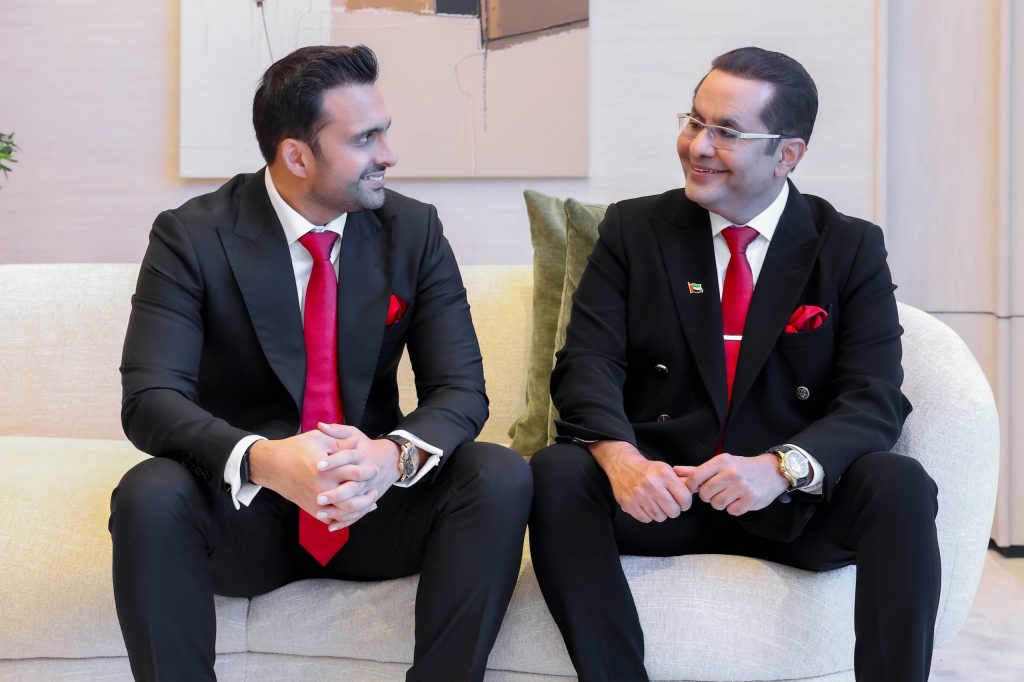
- Rizwan and Adel Sajan interview
- Some rivals may be overleveraged
- Supplies 75% of its own site materials
Dubai’s property market has been slowing, but there is little sign of it in Danube Properties’ crowded office.
On a Tuesday almost five months into the US-Israel-Iran war, brokers hurry between tables, families inspect a model villa and one man shows his wife a room over video call. During the next half hour, at least two dozen prospective buyers walk in.
“People say the war is happening and real estate is over,” said Adel Sajan, managing director of the multibillion-dollar Danube Group and its property development arm, Danube Properties. “But come to our office and you see that’s simply not the case.”
The scene is a rebuttal – but only up to a point. The slowdown is real too.
Residential deals fell almost a third in the second quarter from a record high last year, while their value dropped nearly 40 percent to AED110 billion ($30 billion), according to Dubai Land Department figures.
After five years in which the annual value of Dubai property sales rose more than eightfold, the market is facing its toughest conditions in years.
For Danube, however, the downturn is less a test of demand than a test of which developers can survive without the momentum of the boom.
Further reading:
Further reading:
“The pie has become smaller in the short term because a large part of the population is taking a wait-and-watch approach,” Adel said. “But the [number of developers] competing for that pie has also reduced drastically.”
Some rivals, including newcomer developers, will struggle to deliver what they have sold, he adds.
“Not everybody has the cashflow, the margins or the appetite to complete projects on time,” Adel said. “So you’ll see a lot of delays.”
His father, Rizwan Sajan, founder and chairman of Danube Group, is more blunt.
Danube owns only the land needed for its current development and one planned launch, having resisted the temptation to stockpile sites.
“If I had thought like other people – ‘The market is robust, let me buy this, let me buy that’ – I would have been in trouble,” Rizwan said. “The people who have gone overboard will be in trouble.”
Newcomers who arrived on the bull market “might have issues”, he said. “I don’t know how much leverage they’ve taken.”
Separating ‘the boys from the men’
S&P Global Ratings says the full impact of the conflict on Dubai developers is “not yet visible”, but it has revised to negative the outlooks for two – PNC Investments, parent company of Sobha Realty, and luxury property group Omniyat Holdings.
Danube primarily targets the affordable segment of the market with lower entry prices and attractive payment plans, but has also expanded to offer more premium developments.
S&P expects “further downside” for developers in the coming months, warning that weaker presales, rising materials costs and project delays could erode credit quality.
On the construction and contracting industry, the ratings agency said: “In a downside scenario, we foresee more severe impacts on profit margins and a higher risk of project delays and cancellations.”
Adel casts the shake-out as a necessary correction.
“Some consolidation is healthy for the market,” he said. “It will separate the boys from the men.”
When rivals stall
New off-plan launches fell about 90 percent between the first and second quarters, according to Savills.
For Danube, the contraction is creating an advantage.
“All my sites are running better than before because a lot of projects from other developers have stopped,” Rizwan said. “All the workers, the contractors, are moving towards me.”
That advantage is also rooted in the construction materials business Rizwan built with his brother Anis Sajan, now group vice chairman. Danube was founded in 1993 and followed a similar trajectory to many of Dubai’s homegrown conglomerates: a small trader that diversified into related sectors during the development boom and has handed the new operation to the next generation to lead.
The building materials business supplies about three-quarters of what Danube uses on site. It has also stockpiled supplies against the disruption in the Strait of Hormuz. Raw material costs for residential projects rose by more than 8 percent year on year in the first quarter.
Distressed plots are now being offered at discounts of 10 to 20 percent, but this is not yet enough to tempt Rizwan.
“Bring me a good plot at 50 percent,” he said, half in jest, “and I’ll buy”.
Build and they will come
Danube has kept launching in the slowdown, while becoming more selective about what it brings to market.
“Why should I hold back?” Rizwan said. “Customer confidence is still there. People who want to be in Dubai still want to buy. Perhaps I won’t sell in one or two days. It may take one or two months – but eventually I will sell.”

The company says a one-day sales event in May generated AED183 million ($50 million) in bookings, with discounts of between 5 and 7 percent on selected units.
A second event in June brought in AED250 million.
Danube also opened a central London office last month, betting that overseas demand for Dubai property will endure.
Richard Waind, chief executive of agency Betterhomes, takes a similar view to Rizwan. “Activity has been led by residents with a long-term view,” he said.
Greenz, Danube’s first villa community, was designed with that buyer in mind.
Adel canvassed potential purchasers and picked through some 50 rival projects, cataloguing complaints – cramped rooms, thin storage, shared bathrooms and open kitchens – and designed around each.
But the family’s conviction predates Danube’s development business.
Rizwan bought his first Dubai properties in 2003 and 2004 and sold none during the 2008 financial crisis or the Covid pandemic.
Adel said: “If you have a long-term view in Dubai, you’ll always win.”