
KEY POINTS
- Fuji Keizai projects Japan DER supply value potential at 35.2 trillion yen in fiscal 2040, 2.8 times fiscal 2024
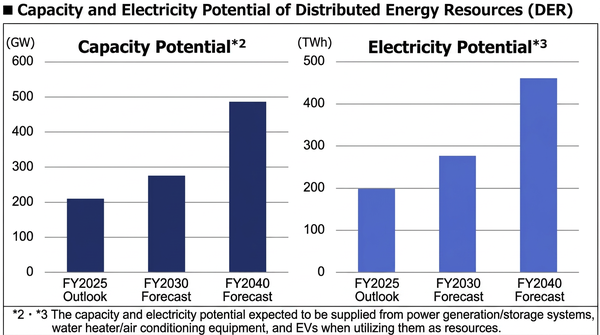
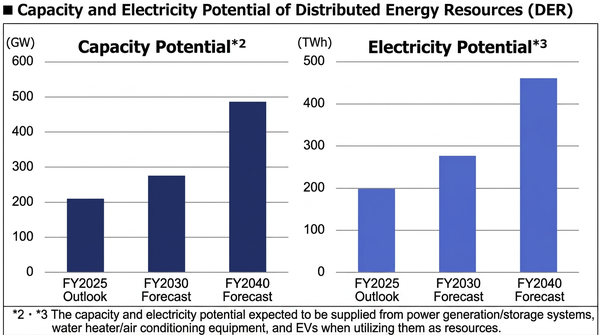
- Usable DER potential reaches 487 GW and 461 TWh in fiscal 2040 under a 100% controllability assumption
- ERAB rollout, low-voltage market access and DR-ready standards support wider DER use through the 2030s
Fuji Keizai
Fuji Keizai said on July 23 that Japan’s distributed energy resource, or DER, supply value potential is projected to reach 35.196 trillion yen ($215.9 billion) in fiscal 2040, 2.8 times the level in fiscal 2024, as the spread of DER and the adoption of related systems and devices expand.
The market research firm published the findings in a report on Japan’s DER-related markets, examining the capacity and electricity-volume potential of assets including power generation and storage systems, water-heating and air-conditioning equipment, and electric vehicles. It also estimated the energy and environmental value that could be generated if those resources were traded in the market, and assessed 15 categories of systems and devices needed to utilize and monetize DER.
Based on the installed stock of DER in Japan, Fuji Keizai forecast that usable capacity potential would reach 487 gigawatts and electricity-volume potential 461 terawatt-hours in fiscal 2040, assuming all supplied capacity and electricity could be controlled, or a 100% control rate.
At present, non-residential solar power systems and air-conditioning equipment account for a large share of the potential because of their large installed base. Over the medium to long term, non-residential battery storage systems, including grid-scale storage, are expected to grow.
Fuji Keizai also estimated that the energy and environmental value potential generated by DER would total 997.3 billion yen in fiscal 2025 and 28.351 trillion yen in fiscal 2040. Within that, kilowatt-hour value is estimated at 95.4 billion yen in fiscal 2025, equivalent to 94.4% of the fiscal 2024 level. Environmental value is projected at 388.4 billion yen in fiscal 2025 and 12.822 trillion yen in fiscal 2040, while delta-kilowatt value, a measure tied to balancing capacity, is seen at 26.5 billion yen in fiscal 2025 and 1.817 trillion yen in fiscal 2040.
The company said solar power systems were excluded from kilowatt-value and delta-kilowatt-value estimates because they cannot generate those forms of value under the study’s assumptions. Heat-pump water heaters and air conditioners were also excluded from delta-kilowatt estimates because they were deemed difficult to control in a way that follows steep fluctuations.
For DER-related utilization systems, the market for aggregation coordinator and resource aggregator systems is expected to reach 12.0 billion yen in fiscal 2025, up 62.5% from fiscal 2024, and expand to 15 times the fiscal 2024 level by fiscal 2040. The market for equipment-control-type demand response systems is projected to rise to 90 times the fiscal 2024 level in fiscal 2025.
Fuji Keizai said the commercial rollout of energy resource aggregation business, or ERAB, is advancing in Japan. ERAB refers to business models that aggregate supply and balancing capacity from DER for market use.
The report said momentum to use customer-site energy equipment is expected to strengthen from the latter half of the 2020s into the early 2030s, helped by the opening of Japan’s supply-demand balancing market to low-voltage resources and by the development of DR-ready standards and compatible devices. DR, or demand response, refers to adjusting electricity use in response to grid or price signals.
In the late 2030s, Fuji Keizai expects broader DER applications as technology development and social implementation advance in areas such as resilience enhancement and maximizing renewable energy use. The research covered the period from February to April 2026. Exchange rate used: USD/JPY = 163.