
Illustration: Liu Xidan/GT
Japan’s Cabinet approved its annual economic and fiscal policy guidelines this Tuesday, which made a notable mention of defense spending. No specific spending figure was set, but the document explicitly cited the defense budgets of NATO, South Korea and Australia – roughly 3.5 percent, 3.5 percent and 3 percent of GDP, respectively – as reference points, and pledged to “transform the country’s defense capabilities within five years.”
This is not the first time Japan has aligned its spending with NATO’s targets. Last October, Prime Minister Sanae Takaichi announced that Japan would hit the “2 percent of GDP” defense mark two years ahead of the original 2027 schedule – which at the time was NATO’s minimum benchmark. Now, Tokyo appears to be moving beyond that goal and inching toward NATO’s new 3.5 percent standard. In short, Japan is pushing the boundaries of its postwar defense posture.
Why is Japan attempting to approach NATO’s goal? A nation geographically far from the North Atlantic is now seeking to strategically embed itself in NATO’s defense logic. Matching NATO’s spending levels is not about upgrading self-defense – it is about legitimizing military expansion.
“The introduction of NATO criteria provides what appears to be a rational but highly politicized justification for Japan’s defense budget increases. Otherwise, why should an Asian nation measure its security needs by NATO’s yardstick?” Lü Yaodong, deputy director of the Institute of Japanese Studies at the Chinese Academy of Social Sciences, told the Global Times.
At the Shangri-La Dialogue in Singapore on May 30, US Defense Secretary Pete Hegseth voiced hope that Asian allies would raise defense spending to 3.5 percent of GDP. Japan’s Chief Cabinet Secretary Minoru Kihara responded on June 1 that Japan would make its “own judgment.” Yet for all its talk of autonomous defense, Japan’s actions firmly track Washington’s expectations – effectively making it a follower and executor of US military expansion in the Asia-Pacific.
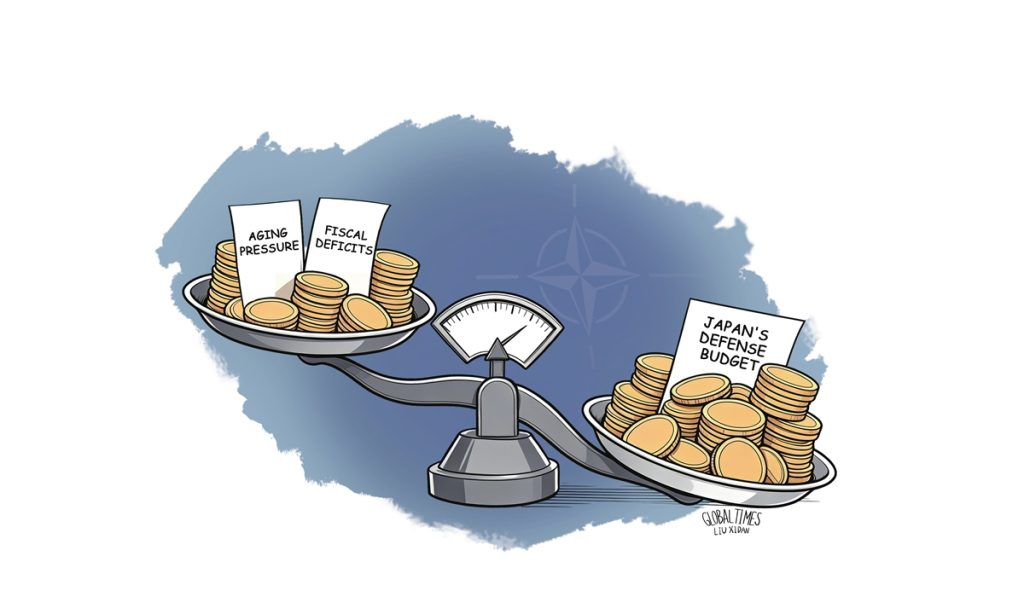
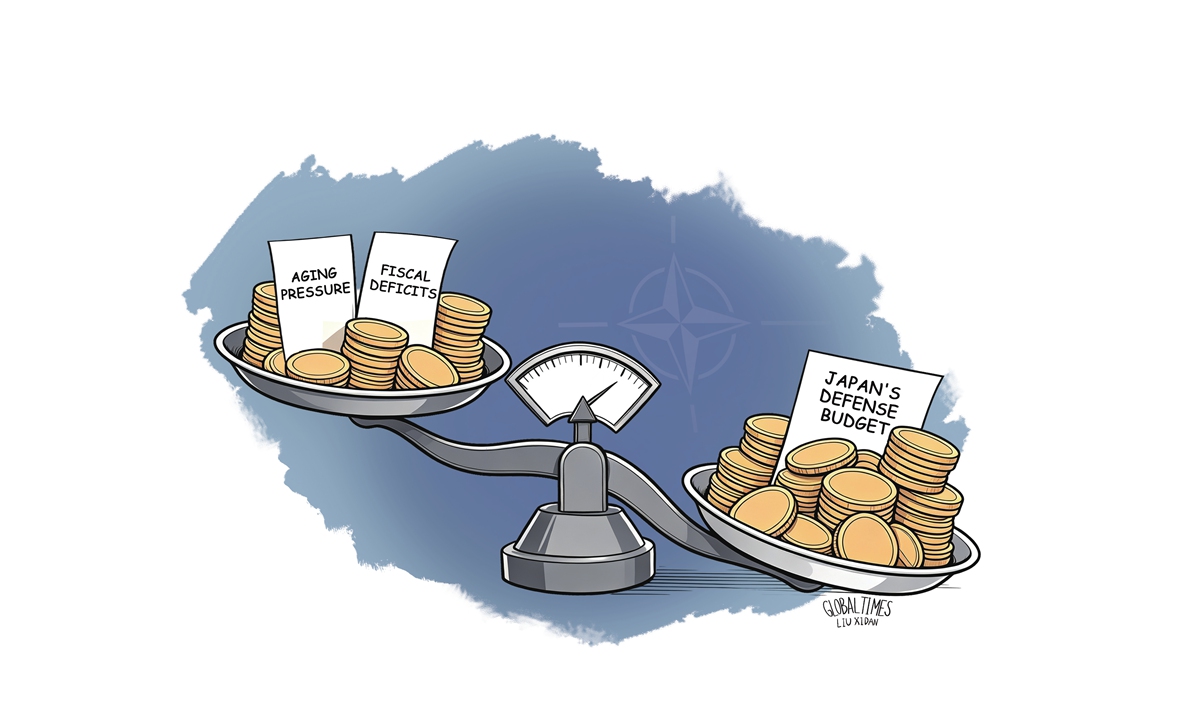
Japan’s defense spending has been climbing fast in recent years. Since fiscal 2023, the budget has blown past 6 trillion yen ($36.8 billion), 7 trillion yen and 8 trillion yen, reaching over 9 trillion yen in fiscal 2026 – a record high. The irony is that Japan’s economy is hardly booming, with mounting aging pressures and large fiscal deficits. Yet defense spending sails through without pushback – a clear sign that the call for prioritizing security is gaining real traction within Japanese politics.
Notably, the policy document mentions “security” 78 times and “defense” 17 times – the sheer frequency is telling. More significantly, it explicitly states the need to “organically integrate capabilities in diplomacy, defense, economy, technology, intelligence and human resources to enhance comprehensive national strength” – with diplomacy and defense ranked ahead of the economy.
For the world’s fourth-largest economy, prioritizing defense over the economy signals a fundamental strategic reorientation. Post-WWII Japan long prided itself on being an “economic power.” Now, this statement sends an unmistakable signal: Tokyo is trying to remake itself into a political-military power. The “organic integration” of diplomacy and defense is merely another term for expansion. Japan’s “exclusive self‑defense” has long been hollowed out in practice; the NATO yardstick is steadily eroding the core of its pacifist constitution.
The promised five-year transformation of defense capabilities, stripped of its veneer, is essentially a systematic overhaul toward offensive capabilities.
Defense budget hikes may not raise many eyebrows elsewhere, but in Japan they always do – because Japan’s history is unique. Its Asian neighbors are instinctively wary, and with good reason: The scars of the past are deep and vivid. Every ambiguous spending formulation and incremental buildup is designed to leave room for Japan to edge past its postwar red lines.
“In essence, Japan’s strategic goal has always been to change the existing system, break through the pacifist constitution and acquire a military capable of waging war – even the ability to initiate conflict. The ‘peripheral threat’ and ‘US demands’ are both pretexts, aimed at deceiving the domestic public and the international community alike, while preserving the facade of a ‘pacifist state’ to conceal its real intentions,” Lü noted.
A nation that once inflicted immense suffering on Asia is now using a “NATO goal” to measure its defense budget. Its neighbors cannot help but wonder: This time, where is Japan heading? Could this prove to be a watershed for East Asian security? East Asia does not need a NATO-style arms race. Japan’s swelling military ambitions are the biggest source of instability in the region today.
The author is a reporter with the Global Times. opinion@globaltimes.com.cn