

Close Menu
Simply Invest Asia
  • Home
  • About us
  • Explore industries/sectors
    • Automobile
    • Aviation
    • Banking
    • Biotechnology
    • Chemical & Fertilizer
    • Entertainment and Media
    • Food Processing
    • Healthcare
    • Iron and Steel
    • Leather
    • Mining
    • Oil and Gas
    • Pharmaceutical
  • Explore by countries
    • China
    • Dubai / UAE
    • Hong Kong
    • India
    • Indonesia
    • Japan
    • Malaysia
  • Explore cities
    • Bangkok
    • Beijing
    • Chongqing
    • Delhi
    • Dubai
    • Guangzhou
    • Jakarta
    • Kuala Lumpur
  • Why Asia
Facebook X (Twitter) Instagram Threads
Trending:
  • DTI to issue new steel safety standards in August – Philstar.com
  • Indonesia opens bioethanol investment as it targets E20 fuel by 2028
  • New Details Emerge on FDA’s GRAS Rulemaking
  • Dubai Police achieves 99.8 per cent compliance rate in answering emergency calls – ARN News Centre
  • India police clash with youth-led protesters near Parliament amidst human rights concerns – JURIST
  • China defends drill in waters near Japan as in line with int’l law
  • Rohingya targeted by disinformation in Malaysia
  • Rethinking Leadership for a Changing World
  • The Real “AI Race” Isn’t With China
  • Ateneo Confucius Institute Explores Beijing, Guangzhou, and Shenzhen for 2026 China Summer Camp | News
  • RSF-aligned gov’t accuses Sudan army of ‘chemical weapons attack in North Kordofan’
  • KL Education Dept to take legal action over viral student brawl
  • ADNOC approves $6.2-billion FID for Umm Shaif Gas Cap development offshore UAE
  • India Awards First 100 MWh Vanadium Flow Battery Project
  • Hong Kong court rejects water heiress appeal over $1.8 billion
  • DMU Dubai awards GCC Impact Scholarships to five students impacted by the regional situation
  • Moody’s Warns Indonesia Risks Grow Despite 2.85% Deficit Target
  • FlyArystan Launches First Almaty to Chongqing Direct Flights, Expanding Kazakhstan China Air Connectivity with Twice-Weekly International Services from September 2026
Tuesday, July 21
Facebook X (Twitter) Instagram
Simply Invest Asia
  • Home
  • About us
  • Explore industries/sectors
    • Automobile
    • Aviation
    • Banking
    • Biotechnology
    • Chemical & Fertilizer
    • Entertainment and Media
    • Food Processing
    • Healthcare
    • Iron and Steel
    • Leather
    • Mining
    • Oil and Gas
    • Pharmaceutical
  • Explore by countries
    • China
    • Dubai / UAE
    • Hong Kong
    • India
    • Indonesia
    • Japan
    • Malaysia
  • Explore cities
    • Bangkok
    • Beijing
    • Chongqing
    • Delhi
    • Dubai
    • Guangzhou
    • Jakarta
    • Kuala Lumpur
  • Why Asia
Simply Invest Asia
Home»Explore cities»Beijing»Why does Beijing want North Korea’s Tumen River?
Beijing

Why does Beijing want North Korea’s Tumen River?

By IslaJuly 21, 20266 Mins Read
Share
Facebook Twitter Pinterest Threads Bluesky Copy Link


Kang Gwiyoung
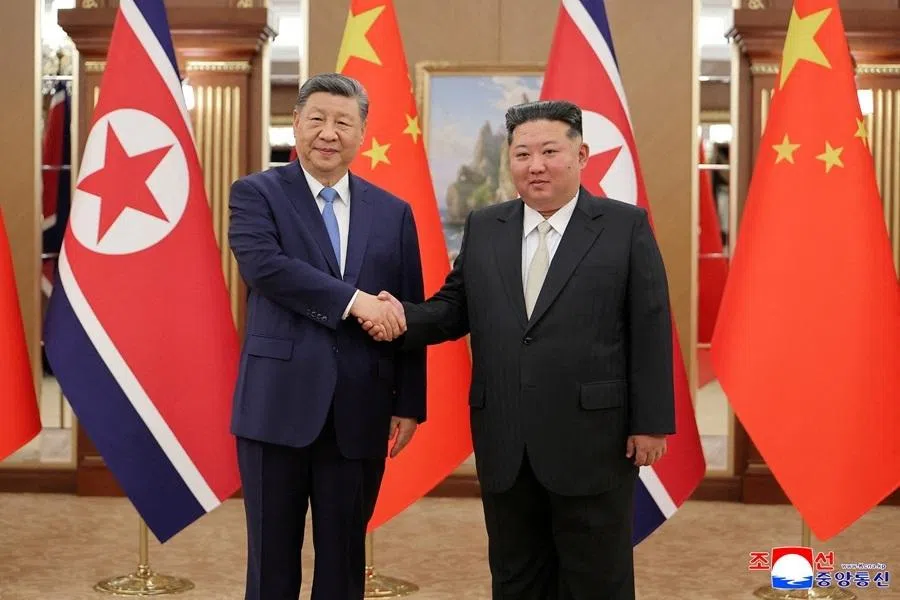
Chinese President Xi Jinping shakes hands with North Korean leader Kim Jong Un during Xi's state visit to Pyongyang, North Korea, on 8 June 2026, in this picture released by North Korea's official Korean Central News Agency.
Chinese President Xi Jinping shakes hands with North Korean leader Kim Jong Un during Xi’s state visit to Pyongyang, North Korea, on 8 June 2026, in this picture released by North Korea’s official Korean Central News Agency. (KCNA via Reuters)

(Edited and refined by Candice Chan, with the assistance of AI translation.)

Following Chinese President Xi Jinping’s first visit to North Korea in seven years last month, North Korean Premier Pak Thae Song promptly travelled to China, while Wang Huning, chairman of the Chinese People’s Political Consultative Conference (CPPCC), led a delegation to Pyongyang. In line with the 65th anniversary of the Treaty of Friendship, Cooperation and Mutual Assistance between China and North Korea, high-level exchanges between the two countries have rapidly resumed after a prolonged lull, ushering bilateral relations into a new phase of intensive engagement.

Most observers believe the warming of China-North Korea ties is reflected first of all in closer economic cooperation. China has long been North Korea’s largest trading partner. Even though United Nations sanctions on North Korea remain in place, Beijing can still support the North Korean economy through areas not fully covered by sanctions, including mineral trade, humanitarian assistance, agriculture, healthcare and tourism. Although North Korea has reportedly earned more than US$10 billion in recent years through arms sales to Russia amid the war in Ukraine, such “war dividends” are ultimately limited. To revive trade and develop its economy, North Korea still depends on China as its largest trading partner and principal source of financial support.

Joo Seong-ha, a senior journalist at South Korea’s Dong-A Ilbo, recently cited a source familiar with North Korean affairs as saying that Xi and the North Korean leadership had reportedly reached an unofficial understanding during Xi’s visit. Under the alleged arrangement, any tests involving weapons of mass destruction, such as nuclear tests or intercontinental ballistic missiles (ICBMs), must be reported to China in advance and may only be carried out with China’s approval. In return, China will allow the normal import and export of goods that are currently subject to embargo under United Nations Security Council sanctions resolutions against North Korea.

Chinese President Xi Jinping sits next to North Korean leader Kim Jong Un as he attends a performance at the Pyongyang Indoor Stadium, during his state visit, in Pyongyang, North Korea, on 8 June 2026, in this picture released by North Korea's official Korean Central News Agency.
Chinese President Xi Jinping sits next to North Korean leader Kim Jong Un as he attends a performance at the Pyongyang Indoor Stadium, during his state visit, in Pyongyang, North Korea, on 8 June 2026, in this picture released by North Korea’s official Korean Central News Agency. (KCNA via Reuters)

If true, such an arrangement would represent a significant diplomatic achievement for North Korean leader Kim Jong Un. On the one hand, Pyongyang would secure more stable economic support. On the other, Beijing would gain greater influence over North Korea’s nuclear and missile activities, giving China more room to shape developments on the Korean Peninsula.

Why, then, is Beijing willing to renew its support for North Korea? The answer may lie in the Tumen River.

Japan’s Nikkei and Sankei Shimbun have previously reported that securing access to the sea via the Tumen River may have been one of the key issues discussed during the summit between the Chinese and North Korean leaders.

Tumen River flowing on Noktundo into Sea of Japan.
Tumen River flowing on Noktundo into Sea of Japan. (iStock)

South Korean television channel Channel A also noted on its programme Now On My Way to Meet You that Chinese Defence Minister Dong Jun, who accompanied Xi on the visit, previously served as commander of the People’s Liberation Army (PLA) Navy. He is China’s first defence minister with a naval command background, a fact many observers interpret as reflecting Beijing’s growing emphasis on maritime strategy.

Insights on China, right in your mailbox. Sign up now.

The Tumen River lies at the intersection of China, North Korea and Russia. From Fangchuan village in Hunchun city, Jilin province, it is only about 15 kilometres to the Sea of Japan. However, since the signing of the Convention of Peking in 1860, China has lacked direct access to the Sea of Japan. For over 160 years, this final 15-kilometre stretch has remained effectively blocked, forcing goods from China’s northeastern provinces to be shipped via ports such as Dalian. For Beijing, the Tumen River is not merely about revitalising its northeast region; it is also closely tied to its ambition of becoming a leading maritime power and to the strategic development of logistics corridors across Northeast Asia.

Although Xi made no public mention of the Tumen River during his visit, he did call for the restoration of border checkpoint operations, international passenger rail services and civil aviation links. Many analysts believe these measures represent an important first step towards rebuilding the China-North Korea logistics network.

Officials attend a ground-breaking ceremony for a new road bridge spanning the Tumen River that will link North Korea to Russia in Rason Municipality, North Korea, 30 April 2025, in this photo released by North Korea's official Korean Central News Agency.
Officials attend a ground-breaking ceremony for a new road bridge spanning the Tumen River that will link North Korea to Russia in Rason Municipality, North Korea, 30 April 2025, in this photo released by North Korea’s official Korean Central News Agency. (KCNA via Reuters)

In recent years, China has steadily advanced cooperation on the Hunchun-Rason project while also holding discussions with Russia on allowing Chinese vessels to reach the sea via the lower reaches of the Tumen River. In May this year, a joint China-Russia statement also pledged to continue trilateral consultations with North Korea, sending a positive signal for the long-stalled Tumen River initiative.

The real obstacle, however, is not the technical feasibility of the waterway but North Korea’s security concerns.

Ryu Hyun-woo, North Korea’s former acting ambassador to Kuwait, believes that Rajin Port is not only an ice-free harbour but also an important military port. Allowing China long-term access to the port, or even permitting Chinese naval vessels to dock there, would directly touch upon Kim Jong Un’s most sensitive concern — the security of his regime. As such, Pyongyang is unlikely to make concessions lightly.

Other experts, however, argue that if China offers sufficiently substantial economic incentives and political assurances, the Tumen River project could well form part of a broader package deal, linked to expanded aid, greater economic and trade cooperation, and even sanctions relief.

Rather than signalling a return to the traditional China-North Korea friendship, the latest warming of bilateral ties is better understood as a fresh round of bargaining centred on security, economic and geopolitical interests. For China, the final 15 kilometres of the Tumen River represent the crucial missing link in securing sea access for its north-eastern region. For North Korea, they constitute a valuable bargaining chip for obtaining aid and political support. If this maritime corridor is eventually opened, it could reshape not only regional logistics but also the strategic landscape of Northeast Asia.

This article was first published in Lianhe Zaobao as “中朝关系升温背后 图们江15公里的战略交易?”.

Related: Xi in Pyongyang: Opening Asia’s frozen northeast frontier | China sidelines denuclearisation to strengthen ties with North Korea


Source link

Related Posts

Opinion | Europe’s incoherent ‘China threat’ posture is a threat to itself

July 21, 2026

‘Dangerous and aggressive’: Washington denounces Beijing after sailor clubbed in violent South China Sea clash

July 21, 2026

US claims 3 China-linked spy sites in Cuba monitoring American military activity

July 20, 2026
Add A Comment
Leave A Reply Cancel Reply

Top Posts

China Scraps 12,000 Degrees in Biggest Academic Overhaul in Years

June 14, 2026

Chinese Wall may stem India tech flows for electronics and automobile

June 1, 2026

Abandoned malls, whispers of nuclear war and young foreigners detained. This is what’s REALLY going on in Dubai… and the chilling warning one taxi driver gave to the Mail’s IAN BIRRELL

April 11, 2026
Don't Miss

DTI to issue new steel safety standards in August – Philstar.com

By IslaJuly 21, 2026

DTI to issue new steel safety standards in August Philstar.com Source link

Indonesia opens bioethanol investment as it targets E20 fuel by 2028

July 21, 2026

New Details Emerge on FDA’s GRAS Rulemaking

July 21, 2026

Dubai Police achieves 99.8 per cent compliance rate in answering emergency calls – ARN News Centre

July 21, 2026
SUBSCRIBE TO OUR NEWSLETTER

Get our latest downloads and information first. Complete the form below to subscribe to our weekly newsletter.


I consent to being contacted via telephone and/or email and I consent to my data being stored in accordance with European GDPR regulations and agree to the terms of use and privacy policy.

Stay In Touch
  • Facebook
  • YouTube
  • TikTok
  • WhatsApp
  • Twitter
  • Instagram
Top Trending

ADNOC approves $6.2-billion FID for Umm Shaif Gas Cap development offshore UAE

By IslaJuly 21, 2026

India Awards First 100 MWh Vanadium Flow Battery Project

By IslaJuly 21, 2026

Hong Kong court rejects water heiress appeal over $1.8 billion

By IslaJuly 21, 2026
Most Popular

Death Toll from Bangkok Bar Fire Rises to 32 as Two More Die

July 15, 2026

13 Unsold Guangzhou Villas Valued at 374 Million Yuan: Kaisa’s Local Asset Disposal Hits a Dead End

July 20, 2026

TCU FTDM launches business of entertainment media major – TCU 360

April 21, 2026
Our Picks

Concourse Media, Matter Entertainment To Rep Sales For ‘Breaking The Code,’ Story Of Indian Immigrant Who Made Silicon Valley History

July 2, 2026

Burj Al Arab Hotel Announces 18-Month Closure For Restoration Work

April 17, 2026

Tourism offers a lifeline to Hong Kong’s dwindling open-air food stalls

May 30, 2026
SUBSCRIBE TO OUR NEWSLETTER

Get our latest downloads and information first. Complete the form below to subscribe to our weekly newsletter.


I consent to being contacted via telephone and/or email and I consent to my data being stored in accordance with European GDPR regulations and agree to the terms of use and privacy policy.

© 2026 Simply Invest Asia.
  • Get In Touch
  • Cookie Policy
  • Privacy policy
  • Terms & Conditions

Type above and press Enter to search. Press Esc to cancel.

SUBSCRIBE TO OUR NEWSLETTER

Get our latest downloads and information first.

Complete the form below to subscribe to our weekly newsletter.


I consent to being contacted via telephone and/or email and I consent to my data being stored in accordance with European GDPR regulations and agree to the terms of use and privacy policy.