
Close Menu
Simply Invest Asia
  • Home
  • About us
  • Explore industries/sectors
    • Automobile
    • Aviation
    • Banking
    • Biotechnology
    • Chemical & Fertilizer
    • Entertainment and Media
    • Food Processing
    • Healthcare
    • Iron and Steel
    • Leather
    • Mining
    • Oil and Gas
    • Pharmaceutical
  • Explore by countries
    • China
    • Dubai / UAE
    • Hong Kong
    • India
    • Indonesia
    • Japan
    • Malaysia
  • Explore cities
    • Bangkok
    • Beijing
    • Chongqing
    • Delhi
    • Dubai
    • Guangzhou
    • Jakarta
    • Kuala Lumpur
  • Why Asia
Facebook X (Twitter) Instagram Threads
Trending:
  • From New York to Dubai, Maker’s Mark Turns Global Cities Into Collectible Bourbon Bottles
  • Malaysia’s nuclear power initiative rests on safety blueprint before any reactor decision | Opinion
  • I Wrote That Healthcare’s Problem Is Us. The Objections Proved My Point.
  • China welcomes U.S. decision not to extend Hong Kong-related national emergency
  • Vikram-1: India's first private space rocket by Skyroot to carry diamond flower – BBC
  • Summer in Japan: 12 Things to Spot This Season
  • This Week’s Fairlife Ransomware Attack: Your Wake-Up Call – foodprocessing.com
  • Jury & Fines Tour de France 2026 Update Stage 13
  • China’s top strategist tours DPRK’s Wonsan resort before returning to Beijing
  • US lifts some Hong Kong sanctions imposed by Trump, autonomy status unchanged
  • Corus to cut dozens of media jobs across Canada
  • BBC Audio | Asia Specific
  • Dubai driver caught speeding over 230k/hr without number plate – Dubai Eye 103.8
  • Opinion | How to stop China from leapfrogging the U.S. in biotech
  • ‘A revolutionary act to watch it’: the film India’s censors do not want you to see | India
  • UAE condemns renewed Iranian attacks on Gulf neighbours
  • Australias agri chemical regulator seeks industry feedback on proposed overhaul of cost recovery model, ETChemicals
  • Bangkok Post – Lessons from the Lat Phrao fire
Saturday, July 18
Facebook X (Twitter) Instagram
Simply Invest Asia
  • Home
  • About us
  • Explore industries/sectors
    • Automobile
    • Aviation
    • Banking
    • Biotechnology
    • Chemical & Fertilizer
    • Entertainment and Media
    • Food Processing
    • Healthcare
    • Iron and Steel
    • Leather
    • Mining
    • Oil and Gas
    • Pharmaceutical
  • Explore by countries
    • China
    • Dubai / UAE
    • Hong Kong
    • India
    • Indonesia
    • Japan
    • Malaysia
  • Explore cities
    • Bangkok
    • Beijing
    • Chongqing
    • Delhi
    • Dubai
    • Guangzhou
    • Jakarta
    • Kuala Lumpur
  • Why Asia
Simply Invest Asia
Home»Explore cities»Bangkok»Bangkok Post – Lessons from the Lat Phrao fire
Bangkok

Bangkok Post – Lessons from the Lat Phrao fire

By IslaJuly 17, 20265 Mins Read
Share
Facebook Twitter Pinterest Threads Bluesky Copy Link


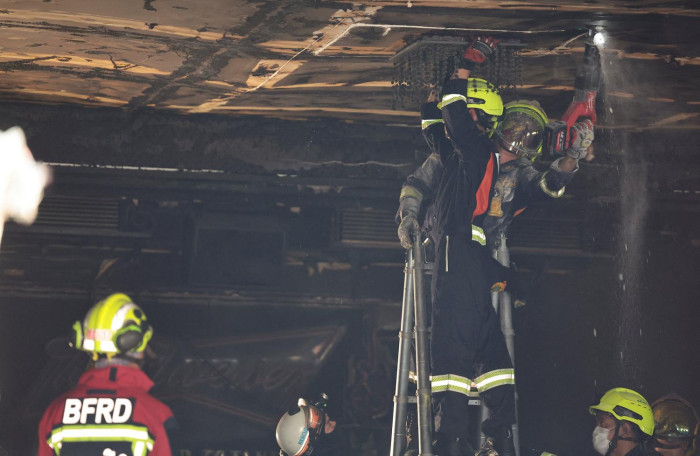
Members of the emergency response team inspect the ceiling of Rong Beer Na Ladprao at the site of a deadly fire in Bangkok on Tuesday. (Photo: Reuters)

The deadly fire at a beer hall in Lat Phrao has left the public with a haunting image: a long jet of flame bursting through the upper part of the main entrance like a fire-breathing dragon, even as people at floor level were still trying to escape.

Preliminary inspection findings, witness accounts, photographs and video evidence support a working hypothesis I formed soon after the incident: the most dangerous phase of the fire may have begun and developed inside the concealed space above the suspended ceiling, particularly near the stage, where electrical wiring and other building services were located above the ceiling near the stage.

The joint inspection by fire-protection engineers and forensic officers subsequently found fire damage involving insulation, electrical systems and other materials within the ceiling cavity. Gypsum ceiling boards were also reported to have fractured with openings at several key locations. Other evidence is equally significant.

Many tables, chairs and belongings in the hall remained recognisable after the incident, and damage across the floor area appeared uneven. During the early stages, some people inside were still able to move and search for exits.

Taken together, these observations suggest that the most severe fire processes may have developed in the concealed ceiling void for a while before breaking into the occupied space below.

Fire requires three elements: a heat source, oxygen and fuel. The initial heat source may have been an electrical fault, arcing or sparking. Possible fuels within the ceiling cavity could have included cable insulation, thermal or acoustic insulation, adhesives and other synthetic materials.

Once a fire begins in a poorly ventilated ceiling cavity, it consumes the available oxygen. As the oxygen concentration falls, the fire becomes ventilation-limited. Visible flames may weaken or reduce to smouldering, but the danger does not disappear.

The remaining heat continues to drive pyrolysis — the thermal decomposition of materials. This process releases flammable vapours and gases even when there is not enough oxygen for complete combustion.

A concealed cavity can therefore become an invisible reservoir containing fuel gases, smoke, soot, products of incomplete combustion and toxic gases. People below, surrounded by music, lighting and normal activity, may have had little warning that a serious fire was developing above their heads.

The critical transition may have occurred when ceiling panels cracked, dropped or otherwise created new openings between the hall and the ceiling cavity. Fresh air from the hall below could then flow upwards.

If the cavity was already hot, oxygen-depleted and filled with accumulated fuel gases, the incoming air might have triggered rapid deflagration and a sudden rise in pressure. This is the classic mechanism of a backdraft.

There is another possibility. If the fuel gases had already mixed with enough air to enter their flammable range and were then ignited by a flame, spark or hot surface, the event would fall more broadly under fire-gas ignition.

If that ignition produced a rapid, pressure-generating deflagration within the smoke layer, it might more specifically be described as a smoke explosion.

Whether investigators ultimately classify the event as a backdraft, smoke explosion or another form of fire-gas ignition, the central engineering issue remains the same: combustible gases appear to have accumulated and ignited rapidly within or around the concealed ceiling space.

The tragedy may not have been caused by flames alone. Even before the ceiling failed extensively, smoke and gases could have leaked downward through panel joints, lighting fixtures, speaker openings, cable penetrations and air-conditioning pathways. Dense smoke could subsequently have flooded the upper level of the hall within moments.

Incomplete combustion generates carbon monoxide, which reduces the blood’s ability to transport oxygen. Nitrogen-bearing materials, including some polyurethane foams, may also produce hydrogen cyanide, which prevents cells from using oxygen effectively.

Together with heat, irritant gases and severely reduced visibility, these substances can cause confusion, weakness, loss of coordination and unconsciousness before flames physically reach a victim.

Weighing the evidence currently available, the following working hypothesis emerges:

The fire began and developed inside the ceiling cavity near the stage under ventilation-limited conditions. Continued heating drove pyrolysis, filling the concealed space with fuel gases, smoke and toxic products. A sudden influx of fresh air, or another change in the flow path, then triggered rapid combustion — possibly in the form of a backdraft, smoke explosion or another type of fire-gas ignition. Flames and smoke subsequently broke through into the hall and vented through the upper part of the main doorway, while fresh air continued to enter below.

Whatever the precise mechanism, the broader policy lesson is already clear.

The most dangerous fire in an entertainment venue may not be the one people can see. It may be the one developing silently above a ceiling, behind a wall or inside a service shaft, where electrical systems, insulation, foam and synthetic materials coexist beyond public view.

Thailand’s inspection system must therefore go beyond checking visible fire extinguishers, exit signs and doors.

Inspectors must be able to open ceiling access panels, examine concealed electrical installations and insulation, verify fire stopping around cable and duct penetrations, and confirm that acoustic and decorative materials meet appropriate fire-performance standards.

The deadliest part of this fire may have developed out of sight. Our system of prevention must learn to look where the public cannot.


Source link

Related Posts

Princess Anne Meets Thailand’s Queen Suthida in Bangkok

July 17, 2026

Autopsies find most Bangkok bar fire victims died within minutes – The Independent

July 17, 2026

MONA unveils concept for new Bangkok museum

July 17, 2026
Add A Comment
Leave A Reply Cancel Reply

Top Posts

China Scraps 12,000 Degrees in Biggest Academic Overhaul in Years

June 14, 2026

Chinese Wall may stem India tech flows for electronics and automobile

June 1, 2026

Abandoned malls, whispers of nuclear war and young foreigners detained. This is what’s REALLY going on in Dubai… and the chilling warning one taxi driver gave to the Mail’s IAN BIRRELL

April 11, 2026
Don't Miss

From New York to Dubai, Maker’s Mark Turns Global Cities Into Collectible Bourbon Bottles

By IslaJuly 18, 2026

Maker’s Mark is giving travelers a new reason to browse duty-free shops this summer with…

Malaysia’s nuclear power initiative rests on safety blueprint before any reactor decision | Opinion

July 18, 2026

I Wrote That Healthcare’s Problem Is Us. The Objections Proved My Point.

July 18, 2026

China welcomes U.S. decision not to extend Hong Kong-related national emergency

July 18, 2026
SUBSCRIBE TO OUR NEWSLETTER

Get our latest downloads and information first. Complete the form below to subscribe to our weekly newsletter.


I consent to being contacted via telephone and/or email and I consent to my data being stored in accordance with European GDPR regulations and agree to the terms of use and privacy policy.

Stay In Touch
  • Facebook
  • YouTube
  • TikTok
  • WhatsApp
  • Twitter
  • Instagram
Top Trending

Dubai driver caught speeding over 230k/hr without number plate – Dubai Eye 103.8

By IslaJuly 17, 2026

Opinion | How to stop China from leapfrogging the U.S. in biotech

By IslaJuly 17, 2026

‘A revolutionary act to watch it’: the film India’s censors do not want you to see | India

By IslaJuly 17, 2026
Most Popular

CreatorsArk Launches to Build India’s Next Generation of Media and Entertainment Talent

April 9, 2026

China’s space station lands new batch of samples for experiments

May 30, 2026

India’s growing Gen Z protest movement

June 19, 2026
Our Picks

Young fighters take center stage as Beijing tournament breaks records

April 20, 2026

Vedanta Demerged Entities Debut: Vedanta Aluminium, Vedanta Oil & Gas Hit Lower Circuits, Vedanta Iron & Steel Hits Upper Circuit, Power Rallies

June 15, 2026

Earnings call transcript: Evolution Mining posts record cash flow in Q4 2026, shares fall By Investing.com

July 15, 2026
SUBSCRIBE TO OUR NEWSLETTER

Get our latest downloads and information first. Complete the form below to subscribe to our weekly newsletter.


I consent to being contacted via telephone and/or email and I consent to my data being stored in accordance with European GDPR regulations and agree to the terms of use and privacy policy.

© 2026 Simply Invest Asia.
  • Get In Touch
  • Cookie Policy
  • Privacy policy
  • Terms & Conditions

Type above and press Enter to search. Press Esc to cancel.

SUBSCRIBE TO OUR NEWSLETTER

Get our latest downloads and information first.

Complete the form below to subscribe to our weekly newsletter.


I consent to being contacted via telephone and/or email and I consent to my data being stored in accordance with European GDPR regulations and agree to the terms of use and privacy policy.