
Loading the Audio Player…
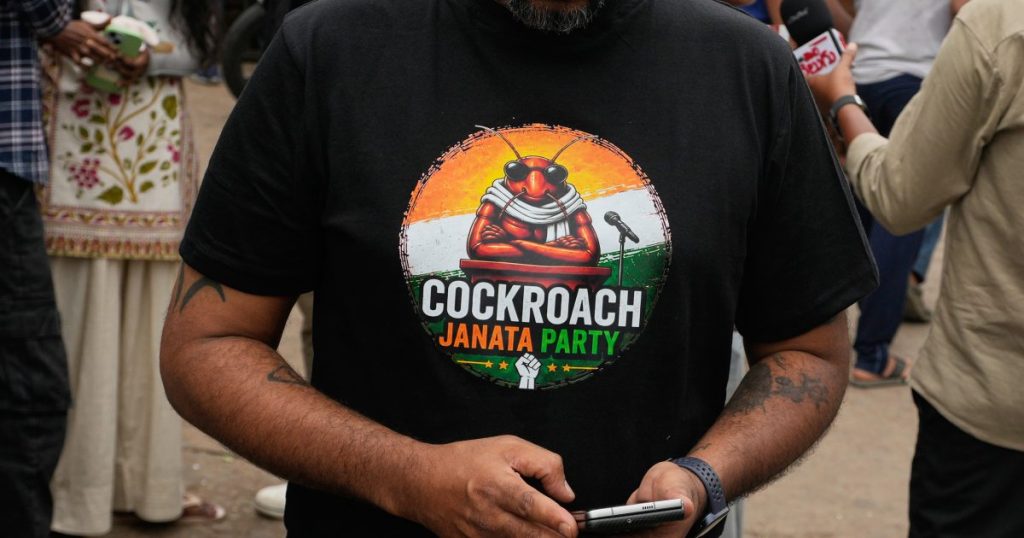
Early this month, young protesters referring to themselves as cockroaches gathered across India for protests organized by the Cockroach Janta Party. Demonstrators displayed signs with cockroach images and sported t-shirts depicting the insect while demanding the resignation of Education Minister Dharmendra Pradhan over a recent national exam leak.
The CJP, a mock political party, is leading a protest movement that is gaining widespread support especially from youths discontented with broken political and education systems and bleak employment opportunities. But some experts expect Prime Minister Narendra Modi’s Hindu nationalist government to continue its pattern of curbing dissent by cracking down on the growing youth-led movement.
“I would say there are millions of citizens who are very supportive of this movement,” said Akashan Paul, an Indian Christian lawyer. (WORLD is not using his real name due to the sensitive nature of his work with clients who face religious persecution.) The movement “gives me hope because the political system in India has largely excluded good young leadership to really bring change in the country,” said Paul, who said India’s existing political parties are mired in corruption and lack competence and vision to improve the nation.
The CJP’s name parodies that of Modi’s ruling Bharatiya Janata Party. The CJP is also a satirical response to Chief Justice Surya Kant’s comparison of unemployed youths to cockroaches during a Supreme Court hearing on May 15. “There are youngsters like cockroaches, who don’t get any employment or have any place in profession,” said Kant. His comments ignited public outrage in India, where many youths struggle to find work.
“Even lawyers like us felt the chief justice being very insensitive,” said Paul.
The day after Kant’s comment, 30-year-old Abhijeet Dipke launched the CJP, writing in an X post, “What if all cockroaches come together?” Dipke, a former volunteer for India’s anti-corruption Aam Aadmi Party, graduated from Boston University last year with a master’s degree in public relations.
Dipke flew back to India to lead the CJP’s first rally on June 6. Hundreds of mostly young demonstrators gathered at Jantar Mantar, New Delhi’s protest area near Parliament.
Kant tried to walk back his comments, saying later he was only criticizing people with fraudulent credentials as opposed to India’s youths in general. But citizens have channeled their anger over Kant’s earlier remark into support for the CJP. The group has now amassed over 22 million followers on Instagram.
Frustration over national exam leaks has fueled the protests. On May 3, more than 2 million students took the highly competitive National Eligibility cum Entrance Test, an annual exam for students aspiring to enroll in undergraduate programs in medicine, homeopathy and nursing. Authorities later said students would have to retake it on Sunday because the exam had previously leaked and reportedly sold for nearly $31,500.
“Due to corruption, every other year the papers leak,” Paul said about the national exam. “There’s no accountability in the system for people who get away with this kind of corruption.”
Last month’s exam score cancellation devastated 18-year-old Akanksha Chaturvedi. Her family found her dead of an apparent suicide inside her room in Maharashtra state on May 20. Chaturvedi left a handwritten note saying that she did well in the exam, but doubted she would succeed in a retake. “I do not have the courage to appear for a retest,” it read. At least 10 other students facing the rescheduled exam have also reportedly committed suicide.
Dipke demanded that Modi’s administration provide about $106,000 in compensation to each family of a student who committed suicide over the exam leak.
While Paul applauds that the CJP movement is mobilizing citizens who are “keen to see a different country and keen to see a different kind of politics,” he doubts the protests will oust the education minister. He said he believes Pradhan will only step down if the ruling BJP deems it a necessary move for maintaining political power or if opposition parties ramp up attacks against Pradhan by exerting judicial pressure.
Paul also said it is only a matter of time until the BJP government stamps out the CJP movement like it eventually did with the 2019 protests over the controversial Citizenship Amendment Act. During the crackdown on the 2019 demonstrations, authorities detained two prominent student activists who still remain in custody despite not receiving a trial. Paul believes the government allows protests to continue for a limited time because an immediate heavy-handed clampdown might cause further uprising and make the country look like “an anti-democratic republic.”
He said the government might work to suppress the current protest movement by using the media to discredit the CJP, mobilizing investigative agencies to hamper the CJP’s operations, and choking off its funding.
Dipke has already faced hostilities since launching the CJP. On Monday, at least two men grabbed and hit him several times during the CJP’s protest in the northern city of Jaipur while Dipke was surrounded by a crowd of CJP supporters. Dipke also said that he has received “numerous death threats” via WhatsApp from unknown phone numbers. CJP last month accused Indian authorities of blocking the CJP’s website and X pages.
Yet Dipke refuses to give in to the scare tactics. “Whenever you take up a cause, challenge powerful interests, or speak against the establishment, there is always a possibility that people will try to intimidate you into silence,” he told Boston University’s College of Communication earlier this month.
While the CJP continues to demand government accountability, Paul maintains a pragmatic view of the movement. “The road to actually move this towards a[n actual] political party that’s able to carry out some socio-political transformation is very long and seemingly close to impossible,” he said.