
It’s 7:30 A.M. on January 27, and I’m at I Gusti Ngurah Rai International Airport in Bali, about to board a chartered flight. It will land two hours later at the private airstrip on Tomia, an island near the southeastern tip of Sulawesi, part of the equatorial archipelago of Indonesia, and renowned for its majestic diving.
The only people at the check-in counter are heading to Wakatobi, a high-end dive resort. I’m eager to see for myself if the house reef, just offshore from the property, is as vibrant in real life as it is on the website.
Spoiler alert: it is.
Frédéric Lagrange
For most of my childhood, I would fly halfway across the planet every year from New York to Southeast Asia. My father moved to Thailand in 1973, when I was six; I’m an only child, and I got used to a bifurcated existence, adapting to living nearly 10,000 miles away from the person I loved most in the world. The anticipation of going to see him gave me something to look forward to. When I was in high school, my father moved to Indonesia, and from that point on, traveling to Bali once a year became part of the rhythm of my life.
On one of those trips, a week after my 45th birthday, in 2013, I took a stroll along the beach in the town of Sanur and made an impulsive decision to stop at the Rip Curl School of Surf. I had never been diving before, but I signed up to learn with Mario, a watersports trainer. On my first dive, he took my hand and didn’t let go. Once we were underwater, my grip softened; I was calm. Mario monitored the air in my buoyancy-control device as I held on, observing the scenery, weightless and gliding through water.
I decided to extend my stay. Coincidentally, Mario lived 10 minutes away from my aging father. Before long, I became a stepmother figure to Mario’s six-year-old twin daughters. I embedded myself in Bali and had, for the first time, a family.
I tend to evaluate life rather than be in it: hovering above, never having to land. But diving was different. All the emotional calculus, obsessive analysis, and self-recrimination I was used to disappeared. It was put on a shelf that remained, blissfully, out of reach.
Frédéric Lagrange
Back in New York, my friends couldn’t believe I’d gone scuba diving. Yes, I’d gone diving, but I wasn’t a diver. I didn’t really know what to do, and I hadn’t even considered whether I enjoyed it or not. But it was something Mario and I did together as a couple, and I stayed tethered to him. He made sure I didn’t drift away.
Five years later, halfway into our decade-long partnership, I began to have panic attacks. I would bob up and down on the choppy surface, afraid to descend. Now I felt in the water the same way I felt above it: unsettled, unable to get out of my head.
As I waited at the check-in counter, I thought, How much does chance shape our lives? Had I not taken that walk along the beach, I would likely never have ended up at Wakatobi, in southeast Sulawesi, 11 years later, about to go diving again—but for the first time on my own.
A massive sea turtle appears out of nowhere; her elegance is startling. She looks like she’s flying, front flippers acting as wings, and then she vanishes, as if in a magic trick.
I am kneeling in the shallow part of the house reef on a carpet of white sand and seagrass, surrounded by coral. Six feet above, the surface of the water is visible. There is daylight and a luminous blue sky. I find this comforting. We’re in the necessary part of the training before the first dive. Kristian Gaeckle, my amiable instructor, is kneeling across from me.
We practice the three required exercises: I take out the regulator and put it back in. Check. Clear the mask. Check. Then he gives me the sign that he is out of air: a “cut” gesture, a flat-hand slicing motion across his throat. It’s my cue to reach for the “octopus,” the long yellow hose connected to the emergency backup air source. I pass it in his direction. He breathes in. I’ve saved his life. Check. We’ve done the rehearsal, and now that training is complete, I’m ready to dive. Or am I?
Indonesia is the world’s largest archipelago, made up of approximately 17,500 islands. Jacques Cousteau, the famous underwater explorer, is said to have called this area of Sulawesi and its dive sites an “underwater nirvana.”
Frédéric Lagrange
In the mid-1990s Lorenz Mäder, a taciturn Swiss visionary with a history of diving in the Maldives and the Red Sea, took inspiration from Cousteau and visited this wonderland of coral reefs. Mäder set about building a model of conservation tourism and called it “Wakatobi,” an acronym taken from the names of a cluster of four remote islands that are now their own district within Indonesia: WAngi-wangi, KAledupa, TOmia, and BInongko. It is recognized as a rare beacon of coral-reef biodiversity, and its privately funded marine preserve, which has been designated a national park, contains 590 species of fish and 396 types of coral.
I left Bali on New Year’s Eve 2019 for work, and a few months later Indonesia implemented social restrictions and quarantines for foreign arrivals because of COVID-19. A few years later, in March 2022, my father passed away. By the time I was finally able to return, it was not on good terms. I dismantled his life, and a little over a year later, life with Mario was dismantled as well.
Even though I was no longer living in Bali, I couldn’t let go. It held history and family, both of which were a source of comfort and belonging. My father and Mario had always felt at home in Southeast Asia, but it had been a complicated place for me to live full-time. I’d existed in limbo, straddling East and West.
But on my return, I slowly began to fall in love with it again—which took me by surprise. The landscape hadn’t changed, but I was seeing it through new eyes. I walked alone along a familiar beach path at sunrise, struck by the pastel colors that framed the pagoda at the end of a pier. Had it always resembled a Monet painting? Several months after my father died, his friend Wayan, who had worked for him for 30 years, placed her hand on the trunk of the suar rain tree outside his house. “Your father loves this tree,” she told me. In the Indonesian language, there is no past tense as we use it in English.
After the short boat ride from the airstrip, I’m greeted by welcoming Wakatobi staff waiting on the white stone jetty. There are times I get to a destination and immediately feel a need to prepare myself for the heartache of leaving. Arriving at Wakatobi is one of those times.
Frédéric Lagrange
“Your luggage is already in the bungalow,” Gaeckle says, leading the way along white sandy footpaths that have circular patterns resembling labyrinths imprinted in them. The gardeners rake these in twice a day to keep the sand flies away—the insects lay their eggs in moist, undisturbed sand, so regularly turning it disrupts their breeding ground. The perimeters of these paths are lined with uniform clamshells, and there is no pavement anywhere in sight. For the next week, I will forget I own shoes.
I’ve arrived in time for lunch, but the beachfront bungalow has given me reason to stay put. Through one window I see lush greenery, and through the other, a view of translucent, aquamarine water—so close that from certain angles, I could be on a cruise. There are swaying coconut palms with a hammock between them, a chaise longue where I will park myself with a book, and a set of stone steps that lead directly into the sea.
One of the main topics of conversation among guests is that the resort staff, 95 percent of whom are Indonesian, remember everyone’s name. When it’s full, there can be up to 70 guests at a time.
“Good evening, Ariel,” Ibram Taufik, the restaurant manager, greets me. “Gluten-free vegan, but you eat fish!” He’s proudly memorized my dietary preferences. The open-air restaurant looks out over the water, and I’m given the option to sit outside. As I gaze up at the radiant display of stars, I hear my father say, “I love you more than all the stars in the sky.”
In preparation for my dive, I do breathing exercises to ease the anxiety, consider taking an Ativan, and remind myself it will be over quickly.
“You can cancel the dive anytime,” Gaeckle tells me.
“I can? Even once we are underwater?”
Frédéric Lagrange
“Yes,” he says in his upbeat German accent. “You simply do this.” He crosses his arms to form an X across his chest. How did I not know that?
He explains we won’t need the safety stop—pausing at a certain depth for three minutes to release nitrogen—because it’s a shallow dive, basically the sort a child would go on. While he continues talking about how air gets compressed and how many minutes I can stay, I feel suddenly liberated. Knowing that I can escape changes everything.
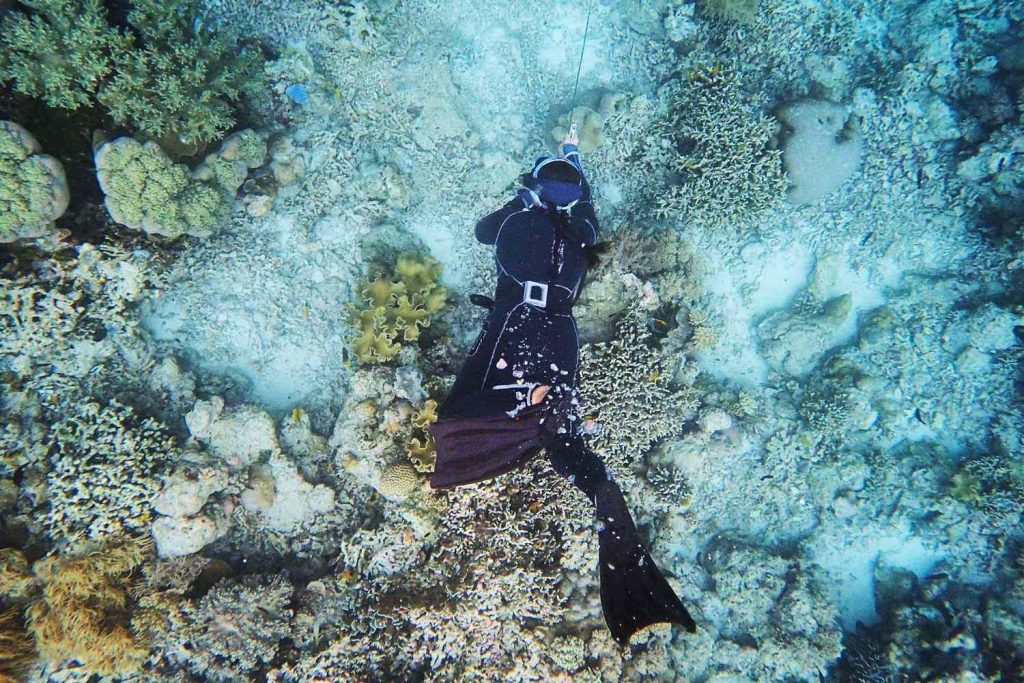
None of what I thought would happen on my first dive happens. I expect to change my mind when we get in the water. But I keep going. I expect to cancel just as we are about to descend. But I don’t. I expect my heart rate to accelerate, but I focus on my breathing and the sound of bubbles, and there is equanimity rather than angst. The second I am underwater, I begin to relax. A yellowmask angelfish swims by. I get used to breathing through the regulator. We stay submerged for 31 minutes, at a maximum depth of 36 feet.
I am kneeling in the shallow part of the house reef on a carpet of white sand and seagrass, surrounded by coral. Six feet above, the surface of the water is visible. There is daylight and a luminous blue sky.
Julia Mellers is Wakatobi’s resident marine biologist. She spends her days researching the “rainforest of the sea,” as the biodiverse ecosystem of coral reefs is often called.
“The data shows that the reefs in the protected area are much healthier than the unprotected reefs nearby,” she says. She is 24 years old and a self-described “fish nerd.” To get to the epicenter of Indo-Pacific biodiversity, she had to relocate part-time from England, where she got her master’s in marine biology at Oxford University. It’s not always easy, she says, to be away from family and friends and her partner, but she can work on her laptop and goes home for long stretches. “I have the best of both,” she tells me.
The following day, I’m told my nitrogen levels are good as I descend on dive number two. I’m becoming confident with the hand signals for communicating underwater. Every five minutes Gaeckle makes the “okay” sign and tilts his head, so that I can tell it’s a question. I make the sign back. We continue. He points out an oval spot butterfly fish, then a pink anemonefish. A massive sea turtle appears out of nowhere; her elegance is startling. She looks like she’s flying, front flippers acting as wings, and then she vanishes, as if in a magic trick.
We equalize our ear pressure and descend even farther. I am eye-to-eye with a raccoon butterfly fish. There is swaying soft coral and brain coral and rigid table coral with fused branches. All of it flourishing.
I feel confident enough to release my grip on Gaeckle’s arm. He extends his fist in my direction. What signal is this? It takes a second before I understand. We fist-bump, and he makes the gesture of boom! Underwater enthusiasm in slow motion.
Frédéric Lagrange
Later that afternoon, I skip the sunset cocktail party with other guests and stay at my villa, embracing the quiet and gazing out at the lagoon, where the water turns from light blue to indigo. The demarcation line from shallow to deep is precise.
What I appreciate about hand signals is that there is no room for misunderstanding. I need help. I’m out of air. Without words, it has to be clear.
Life has never been the same after my father died. I lost the person who knew me better than anyone. Without him, an entire universe disappeared. I couldn’t access the words to explain the grief, and there is no hand signal for loss.
“What’s the most important asset in the dive industry?” Mäder looks me in the eye, challenging me to guess the answer, but before I do, he provides it: “Water.”
We’ve just finished lunch and are lingering over iced tea. Dressed in all white and barefoot, Mäder tells me that protecting this marine asset is his mission. The reefs surrounding Wakatobi are now among the healthiest in the Coral Triangle, a marine region around six countries: Indonesia, Malaysia, the Philippines, Papua New Guinea, Solomon Islands, and East Timor.
He describes the uphill battle of logistics: generating power and water, getting food and supplies to this remote location. Mäder developed the resort on the island of Onemobaa, close to the larger sister island of Tomia. His background in engineering and physics allowed him to provide infrastructure to a remote location; Wakatobi has its own airstrip on Tomia and its own airplane and flight crew.
The hardest thing to build, though, was trust with the local communities. Reef lease agreements were made in 1997 with nearby villages and local fishermen. They created designated no-fishing zones, in exchange for direct compensation generated by the resort.
The result is an ambitious private marine conservation program, with an area of 37 miles now patrolled by more than 150 former fishermen who have become reef guardians. A healthy ecosystem supports their financial well-being. “It’s a win-win-win,” Mäder says. The third win in that string? Guests who visit the resort are actively contributing to the sustainability model and ecotourism.
Frédéric Lagrange
I excuse myself from our chat so that I can make the boat that leaves at 2:30 p.m. Several dive boats go out to various reefs each morning and afternoon. Kitesurfing is also available during windy season, June through September. Other activities at Wakatobi include paddleboarding, kayaking, bird-watching, and guided tours.
The boat I’m getting on is headed to a nearby dive site known as the Zoo. On board are a couple in their seventies, doctors from Berkeley, California, who hope to see puffer fish and triggerfish. I also speak to Janette, a retired microbiologist in her sixties from Sydney traveling alone, her gray hair in braids. “It’s my fourth time at Wakatobi,” she says with a twinkle in her eye. Sixty percent of the clientele are returning guests. Five days in, I can understand why.
Once underwater, I swirl around, immersed in a school of neon-yellow boxfish as two green sea turtles glide past. A bumphead parrotfish leaves puffs of light-gray dust in its wake: she’s digesting the algae and minerals from corals and depositing crushed-up limestone into the sand. Gaeckle is close by. I can see how pleased he is that I’ve become more independent. He points to a female squarespot anthias in transition, becoming a male and shifting from yellow to orange.
Frédéric Lagrange
The past few years have shifted the way I make sense of the world, and myself in relation to it. I realize this as I drift through this galaxy of fish. My dive time is 38 minutes at a maximum depth of 77 feet. A new record for me.
In the end, the story starts here, when I discover that I do, in fact, enjoy diving. That I can be responsible for my own safety and do things that frighten me. I’m often quick to name things that aren’t “me,” but what about things that are? I could be a diver. I could be anything.
I go for one last dive and slip silently underwater, at ease with new beginnings.
Bungalows at Wakatobi from $415 per person, all-inclusive.
A version of this story first appeared in the August 2026 issue of Travel + Leisure under the headline “Under the Sea.”