
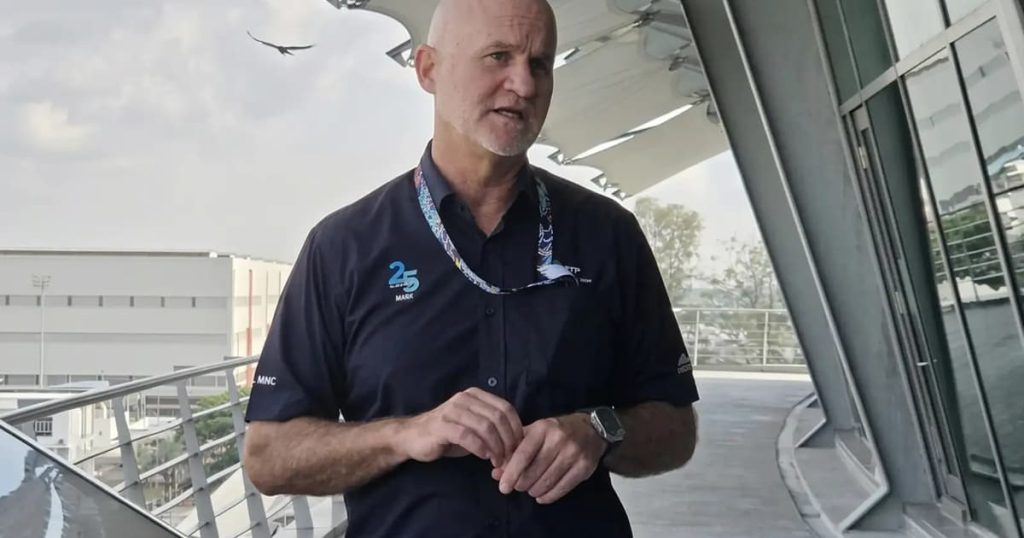

Port of Tanjung Pelepas has set a target of annual throughput of 16 million containers by 2029, up from a record 14 million last year, as it expands capacity to meet surging demand driven by a major global shipping realignment.
The CEO, Mark Hardiman, said the port handled nearly 1.3 million twenty-foot equivalent units (TEUs) in May alone, the highest monthly throughput in its history.
He said the growth was largely driven by changes in global shipping networks, particularly after the formation of the Gemini Cooperation between shipping giants Maersk and Hapag-Lloyd in 2025.
“PTP became the main global hub for the Gemini lines, and that has really been what’s behind our volume growth,” he told reporters during a media visit organised by the Australian High Commission.
To support the 2029 target, Hardiman said PTP would complete Berth Zero, adding 360 metres of berth space and four additional cranes to the port’s existing infrastructure.
He said the port’s free zone is now about 95% occupied, with future expansion expected to align with opportunities from the Johor-Singapore Special Economic Zone.
Electrification and net zero push
Hardiman said PTP is pressing ahead with decarbonisation efforts as recent geopolitical tensions and rising fuel prices have strengthened the business case for electrification.
He said the port has set a target of reducing emissions by 45% by 2030 and achieving net zero by 2050.
PTP has fully electrified its 67 quay cranes and 234 rubber-tyred gantry cranes, making it the first port in Malaysia to operate such a fully electric fleet.
The port also operates more than 600 prime movers, which was being electrified, with 52 electric units expected by September, while 76 more units may also be fully electric.
The port has also signed up for Tenaga Nasional Bhd’s Green Energy Tariff programme and has secured renewable electricity allocations through the end of next year, while expanding rooftop solar installations across its facilities.
Hardiman said PTP was also working with the Port of Melbourne under a memorandum of understanding signed last year to share best practices on decarbonisation, alternative fuels and port operations.
Women in the port
Hardiman said PTP was also pushing to improve gender diversity in a heavily male-dominated industry. The port now employs five women marine pilots out of a total of 45, while women make up around 10% of its prime mover operators.
PTP is also home to Malaysia’s first woman to operate a rubber-tyred gantry crane and has increased the number of women in technical operations, he added.
“This is something that is driven across all the divisions of PTP,” he said, adding that diversity targets have been introduced for both operational and management-level positions.