
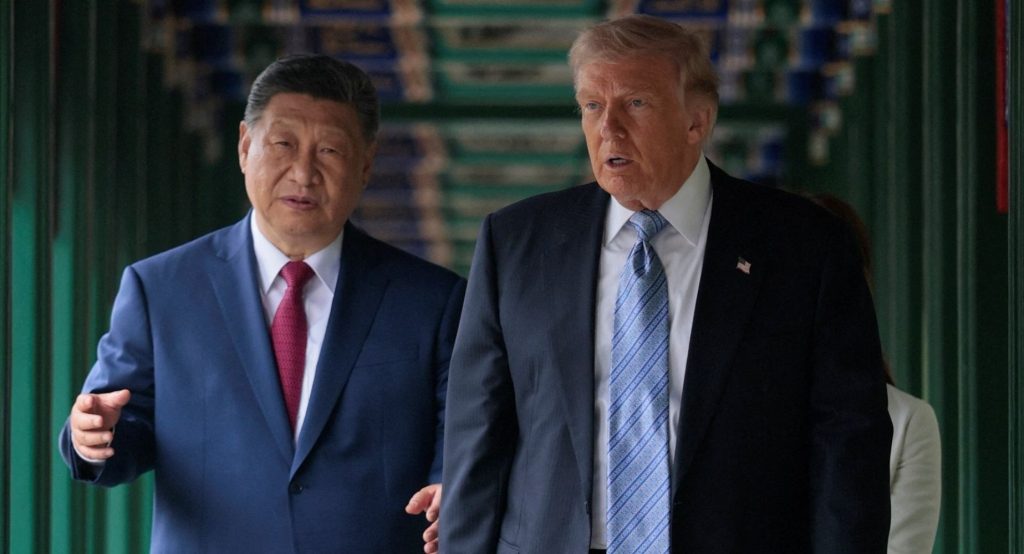
When US President Donald Trump publicly thanked Chinese President Xi Jinping in an interview with The New York Times for helping create the conditions that led to a ceasefire between the US and Iran, many observers were surprised. China and Iran have developed increasingly close economic and strategic ties over the past decade. Beijing has become Tehran’s largest trading partner, a major purchaser of Iranian oil, and an important diplomatic partner in international forums. Under such circumstances, one might have expected China to oppose American pressure on Iran rather than facilitate it.
Nevertheless, Trump’s remarks suggest a different reality. According to the American president, China contributed to the diplomatic outcome not through active mediation but through restraint. As Trump put it, Xi Jinping “was a total gentleman” because he did not send tankers escorted by destroyers through the Strait of Hormuz to challenge the American naval blockade. While the precise details behind Trump’s statement remain unclear, the broader strategic significance is worth examining. If the account is accurate, China’s contribution to de-escalation did not stem from intervention but from a conscious decision not to intervene.
This distinction matters because it reveals an important aspect of China’s evolving role in the Middle East. For years, analysts have debated whether Beijing seeks to replace the US as the region’s dominant external power. The prevailing narrative of great-power competition assumes that every crisis becomes another arena in which Washington and Beijing compete for influence. However, the recent US-Iran confrontation suggests a more complicated picture. Rather than exploiting the crisis to challenge American power, China appears to have prioritized regional stability.
At first glance, such behavior may seem surprising. China has repeatedly criticized American sanctions policies and has often opposed what it perceives as unilateral uses of force. Beijing has also invested considerable political capital in its relationship with Tehran. In 2021, the two countries signed a 25-year cooperation agreement covering energy, infrastructure, and investment. Chinese firms have maintained extensive commercial links with Iran despite Western pressure, and Chinese diplomats have frequently defended Iranian interests in international institutions.
However, China’s broader interests in the Middle East extend far beyond Iran. Beijing’s economic footprint now stretches across the Gulf region, Israel, Egypt, and North Africa. Chinese companies operate ports, industrial parks, logistics hubs, telecommunications networks, and energy facilities throughout the region. The Belt and Road Initiative has transformed the Middle East into one of China’s most important external economic corridors.
These growing interests have fundamentally altered Beijing’s strategic calculations. Unlike the Soviet Union during the Cold War, China is not primarily seeking ideological influence or military alliances. Instead, its power increasingly derives from connectivity. Chinese prosperity depends on the uninterrupted movement of goods, energy, data, and capital across global networks. Consequently, Beijing has developed a strong stake in preserving regional stability.
The Strait of Hormuz illustrates this reality perfectly. Roughly one-fifth of the oil traded globally passes through this narrow waterway. Any prolonged disruption would have immediate consequences for international energy markets and, by extension, for China’s economy. Beijing remains heavily dependent on imported energy, with the Middle East supplying a substantial share of its oil imports. A major military confrontation in the Gulf would therefore threaten one of China’s most critical strategic interests.
This helps explain why Beijing may have exercised restraint despite its close ties with Tehran. Supporting Iran in a confrontation with the US would have carried enormous risks. Chinese efforts to challenge an American naval blockade, escort Iranian shipping, or otherwise demonstrate military backing for Tehran could have transformed a regional conflict into a confrontation between major powers. Such a scenario would have endangered shipping routes, disrupted energy supplies, and threatened China’s broader economic interests.
In this sense, China’s behavior reflects a paradox of globalization. The deeper a state becomes integrated into international economic networks, the greater its interest in maintaining stability. China’s rise has often been interpreted as evidence of a revisionist challenge to the existing international order. However, its extensive investments in infrastructure, trade corridors, and supply chains have also made Beijing increasingly dependent on the smooth functioning of that order.
The Middle East offers a particularly striking example of this dynamic. Chinese investments in Saudi Arabia, the United Arab Emirates, Egypt, and other regional states have created what might be called a geography of strategic restraint. Ports cannot turn a profit during wars. Industrial zones do not flourish amid missile exchanges. Supply chains cannot function when maritime chokepoints are threatened. The very infrastructure that extends Chinese influence simultaneously increases China’s vulnerability to instability.
This reality may produce an unexpected convergence between Beijing and Washington. The two powers remain strategic competitors in many domains, from advanced technology and trade to military modernization and regional influence. Nevertheless, both increasingly share an interest in preventing large-scale disruptions to the Middle East’s economic artery.
The US and China approach this objective from different directions. Washington traditionally views regional stability through a security lens. Its military presence, alliances, and naval deployments are intended to deter aggression and maintain freedom of navigation. China, by contrast, approaches stability through an economic lens. Its priorities center on protecting trade routes, securing energy flows, and safeguarding overseas investments. Despite these differences, both powers often arrive at the same conclusion: a stable Gulf is preferable to a region engulfed in conflict.
This does not mean that China has become a strategic ally of the US. Nor does it suggest that Sino-American rivalry has disappeared. Beijing continues to expand its influence across the Middle East, often in ways that generate concern in Washington. Chinese technology companies remain active in sensitive sectors throughout the region. Infrastructure projects continue to raise questions about long-term strategic implications. Competition between the two powers remains real and likely to intensify.
However, the recent US-Iran ceasefire episode highlights an important limitation on that rivalry. China’s growing presence in the Middle East creates incentives for caution as well as influence. The more deeply Beijing becomes embedded in the region’s economic architecture, the more it must lose from instability. This structural reality may encourage China to act as a stabilizing force even when doing so indirectly benefits American objectives.
Indeed, one could argue that Beijing’s most significant contribution to regional security today lies not in diplomacy or military power but in the incentives created by economic interdependence. China increasingly functions as a stakeholder in the existing regional order because that order underpins its own prosperity. Its influence is exercised less through coercion than through participation in the networks that connect markets, producers, consumers, and governments.
Trump’s comments, therefore, deserve attention not because they reveal a dramatic diplomatic breakthrough but because they may illuminate a broader transformation in international politics. The traditional image of great-power competition assumes that rising powers seek advantage whenever opportunities emerge. However, the contemporary global economy creates situations in which restraint can be more valuable than confrontation. In some cases, the most consequential exercise of power may involve choosing not to use it.
If China’s role in the ceasefire was indeed rooted in restraint rather than mediation, the implications extend beyond the immediate crisis. The episode suggests that Beijing’s expanding economic presence in the Middle East may be creating new incentives to preserve stability rather than challenge it. Far from encouraging confrontation with the US, China’s regional investments may be encouraging caution.
The ultimate irony is that the very networks often portrayed as instruments of Chinese influence may also be transforming China’s behavior. Infrastructure, trade corridors, energy partnerships, and logistics systems certainly expand Beijing’s reach. However, they also create dependencies and vulnerabilities that make regional stability increasingly indispensable.
For decades, the US served as the principal external guarantor of order in the Middle East. China is unlikely to assume that role in military terms anytime soon. However, it may emerge as something different: an economic stakeholder whose interests increasingly align with preventing regional upheaval. Trump’s unexpected praise for Xi Jinping may therefore reveal an overlooked reality. China’s growing power in the Middle East is not only a source of influence. It is also a source of restraint.