
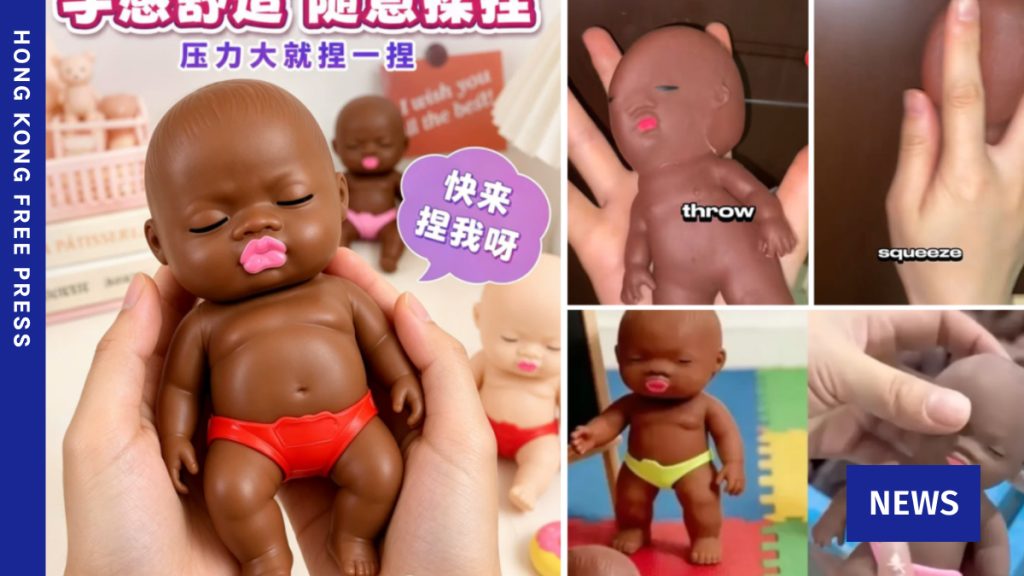
A viral stress-relief “Natasha” doll trending on Chinese social media has been deemed “absolutely diabolical” by members of Hong Kong’s Black community.
Resembling a small child, the most popular version is dark-skinned and features exaggerated racial characteristics. Buyers have filmed themselves beating, stretching, boiling and stomping on the toy.

“No design is created, marketed, and sold in isolation of thought and purpose. The design, manufacturing, and selling of a Black baby doll to abuse at one’s whims is at the root of the existence of movements like Black Lives Matter,” Monique Franz, a writer and founder of Kinsman Avenue Publishing – a non-profit which advocates for underrepresented voices – told HKFP.

“By inviting people to take out their stresses on a Black body, we invite populations to abuse our Black bodies at their whims, robbing us of our actual humanity. While this is a game to others, Black people are experiencing widespread global abuse, which is the result of portrayals of us in such degrading ways,” added Franz, who is African-American.

Made from slow-rising memory foam or soft thermoplastic rubber, the dolls remain freely available on e-commerce sites such as Taobao, and have been trending on social media platforms like RedNote and Douyin.
Jayne Jeje, an African-American entrepreneur, advocate, and long-term Hong Kong resident, told HKFP that such trends do not come out of nowhere. “There seems to be an endless fascination with Black hair, Black skin, Black lips, Black bodies, and Black culture, yet people are shocked when we speak up,” she said.
“Some of the viral videos are absolutely diabolical. I’d find them offensive no matter who was being depicted, but this is deeply personal because I am proud of my beautiful dark skin. I refuse to accept the idea that it is something to be squeezed, slapped, mocked, or turned into entertainment for the masses,” she added.
Spotted in Hong Kong
Londiwe Ngubeni – a South African actress and vocalist who lives on Lantau – told HKFP that she spotted a child with a Natasha doll at a Mui Wo supermarket. “At first, I thought she simply liked the toy. Then she began stretching, squeezing, poking the eyes and hitting the doll. When I asked why, she said it was a ‘stress reliever.’ How is relieving stress by hurting a brown baby doll acceptable?”

Ngubeni said she was furious and disappointed. The child “said her friend had given it to her. What message are we teaching children when dehumanising a Black child becomes a plaything?”

She urged manufacturers and retailers to be held to account over “products that reinforce racist attitudes.”
Innocent Mutanga of NGO Africa Center Hong Kong said the trend “risks normalising the dehumanisation of Black bodies… This is particularly disturbing as this dehumanization is directed towards Black children, demonstrating a lack of empathy for Black people, no matter the age.”
He said the China Consumers Association and State Administration for Market Regulation had stepped in to remove violent videos, with schools in mainland China banning the doll.
Although Mutanga said guidance was issued to e-commerce sites in mainland China, the product was still available on Taobao when HKFP checked on Thursday.

Mutanga urged teachers, parents and community leaders across the Greater Bay Region to link up with the Africa Centre to step up education, as people may lack “exposure to African cultures and histories.”

Chinese social media has played host to similarly abusive trends involving Black children before.
In 2022, a BBC investigation found that children in sub-Saharan Africa were being paid to perform in Chinese online videos that often involved degrading or abusive content.


