
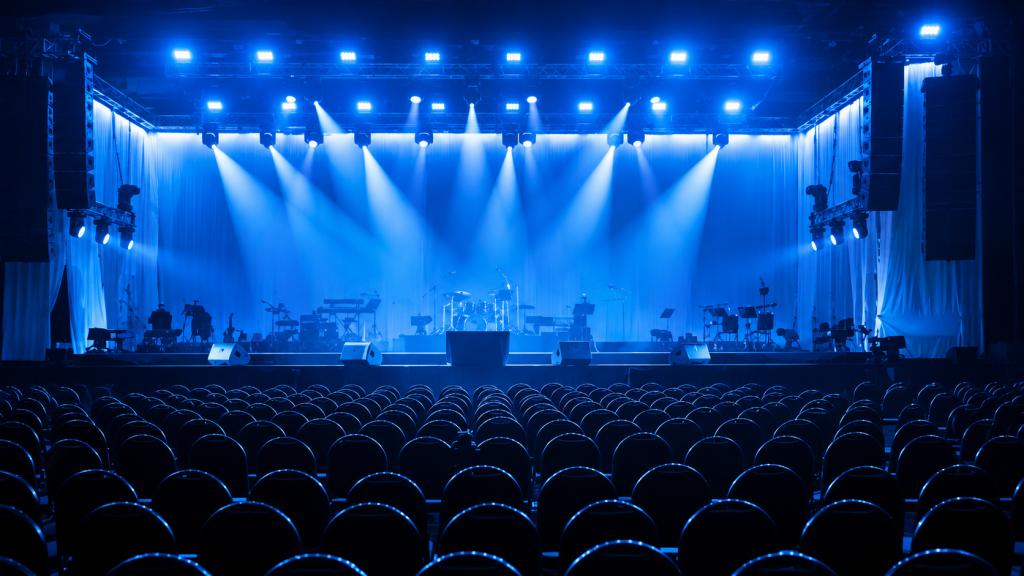
For millions of Americans scrolling through social media over the past several months, the phrase “blue dot fever” has appeared with increasing frequency, often attached to screenshots of empty arenas, concert seating charts, and canceled tour announcements. The unusual expression has sparked confusion nationwide, with many people initially assuming the term had something to do with politics, election maps, or partisan culture wars. In reality, the phrase has little to do with government at all. It is rooted in the modern concert business and the growing visibility of unsold tickets in the digital age.
The term “blue dot fever” refers to the appearance of large numbers of available seats on online ticketing platforms such as Ticketmaster and SeatGeek. On many of these interactive venue maps, unsold seats are represented by small blue circles or dots. When a concert or event has poor ticket sales, entire sections of venues can appear covered in blue, creating a visual that quickly became a source of online commentary, criticism, and humor.
As more tours struggled to fill arenas in 2025 and 2026, social media users began referring to the phenomenon as “blue dot fever,” almost as if it were a contagious condition spreading through the live entertainment industry. The phrase gained traction across TikTok, Facebook, Instagram, Reddit, and entertainment blogs, where screenshots of sparsely sold concerts were frequently posted alongside sarcastic commentary about ticket prices, economic pressures, and changing audience habits.
The rise of the phrase reflects a major shift in how the public views concert success. In previous decades, ticket sales numbers were often difficult for everyday consumers to see in real time. Today, however, fans can open ticketing apps and instantly view which seats remain unsold just days or even hours before a performance. This transparency has transformed ticket maps into a public scoreboard for the entertainment industry.
Several major tours over the past year fueled the popularity of the term after cancellations, postponements, or venue changes became public. In many cases, online observers pointed to “walls of blue dots” on seating charts as evidence that demand may not have matched expectations. The phrase soon evolved into shorthand for concerns surrounding the modern touring business itself.
Industry analysts say a combination of factors is contributing to the trend. High ticket prices, added service fees, inflation, travel expenses, hotel costs, and general economic uncertainty have made attending large concerts increasingly expensive for average consumers. In some cities, fans have reported that attending a single major arena show can cost hundreds or even thousands of dollars once parking, food, merchandise, and lodging are included.
At the same time, the live entertainment market has become saturated. Since pandemic shutdowns ended, artists across nearly every genre have returned to touring aggressively, leading to fierce competition for audiences and entertainment dollars. Consumers now face a nearly nonstop stream of concerts, festivals, comedy tours, and sporting events competing for attention.
The phrase also highlights the growing influence of internet culture in shaping public narratives. A single screenshot of unsold seats can spread across social media within minutes, often creating perceptions about a tour long before official sales data is released. In some cases, online discussions surrounding “blue dot fever” have become powerful enough to influence public opinion about an artist or event.
Despite the viral nature of the term, industry experts caution that visible blue dots do not always tell the full story. Promoters sometimes release tickets in phases, adjust seating configurations, or hold blocks of seats for sponsors and VIP sales. Even so, the phrase has firmly entered modern entertainment vocabulary.
For many Americans hearing the term for the first time, “blue dot fever” is not a political movement, a medical condition, or a conspiracy theory. It is simply a modern nickname born from digital ticket maps, rising entertainment costs, and a social media culture that now watches the live entertainment industry in real time.