
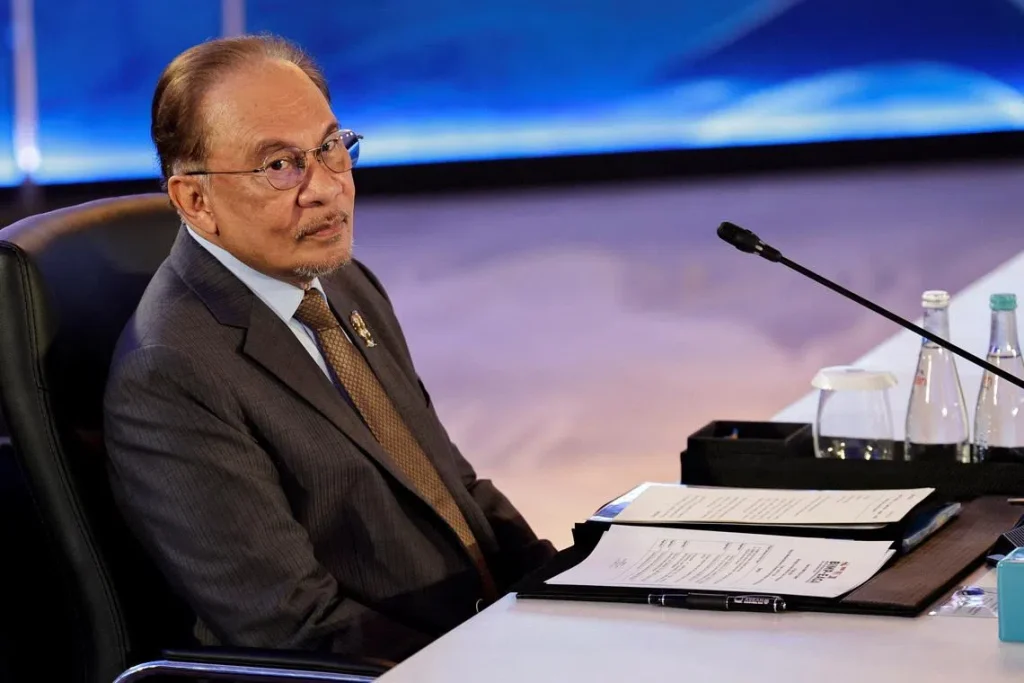
When Prime Minister Anwar Ibrahim finally took office after Malaysia’s 2022 General Election, it appeared to mark the triumphant conclusion of a political journey spanning nearly three decades.
His coalition, Pakatan Harapan (PH), did not win an outright majority but emerged as the largest bloc in Parliament, secured royal backing and was able to stitch together an unlikely unity government with former rivals, including UMNO.
Anwar’s long-suffering efforts had paid off – specifically the four years since his 2018 pardon spent cultivating Malaysia’s royal households (nine different families that rule their respective states and whose heads rotate to be the federation’s Agong or King) and UMNO president Zahid Hamidi despite their parties’ stated enmity towards each other. Even the Islamist Parti Islam SeMalaysia (PAS) wanted to join his government until then Perikatan Nasional (PN) chief and Parti Pribumi Bersatu Malaysia president Muhyiddin Yassin insisted the coalition stayed in opposition.
And for a while, it was nice for Anwar – having not been everyone’s cup of tea while rising through the ranks in UMNO, after stepping on several toes in the 1990s as deputy prime minister, getting sacked by then Prime Minister Mahathir Mohamad in 1998, and then thrown into jail on charges of abuse of power and sodomy in the span of two decades.
Yet, less than four years later, the mood around Anwar has shifted markedly.
Among the Malay-Muslim majority, PN – driven largely by PAS and Bersatu – remains dominant. PN made huge gains across six states during the 2023 state elections and continues to frame itself as the authentic defender of Malay-Muslim interests.
Pandering to this group has failed abysmally, in part because the Chinese-dominated Democratic Action Party (DAP), Anwar’s key ally and the largest party in the coalition government, has long been demonised as anti-Malay and anti-Islam; and in part because UMNO is starting to distance itself from PH to reposition the party ahead of the next general election to win wards ceded to PAS and Bersatu over the past decade.
At the same time, frustration has been growing within PH’s traditional support base. Anwar is now estranged from his base of non-Malay minorities, urban progressives and moderates. Early optimism of PH gains at the Sabah polls in November was clearly misguided as the easternmost state handed the PM’s coalition a brutal hiding, winning just one of the 22 votes it contested.
The huge losses set off alarm bells within DAP, which had lost two-thirds of its vote share compared with the 2020 Sabah elections, compelling its leadership to bring forward its annual congress to July to decide on its future in the Anwar administration.
Add to that the stinging rebukes from two palaces, including his Parti Keadlian Rakyat’s (PKR) stronghold of Selangor, and it is starting to look very lonely at the top for the prime minister.
And yet, Anwar’s loneliness is for the most part self-inflicted, having overpromised but underdelivered to his PH colleagues – many of whom have supported him since 1998 – and other political interests ranging from the royals to religious and race-based ginger groups.
Case in point: the controversial pig farming ban in Selangor triggered by the state government’s plan to allow 114 farms in Tanjung Sepat to continue operations until an export-oriented large-scale farm in Bukit Tagar is ready.
Sultan Sharafuddin Idris Shah had disagreed with the proposal in a January rebuke of the state administration led by PKR vice-president Amirudin Shari, citing foul odour, pollution, flies and the possibility of corruption in the deal.
Instead of supporting his own party’s chief minister, Anwar backtracked, suggesting a halt to the Bukit Tagar project citing objections from local Malays and the sultan’s concerns. This had the effect of emboldening the palace to decree an outright ban on pig farming in the state and consequently required the Cabinet to step in and allow pig farming to proceed away from residential areas and waterways.
This back-and-forth left multiple sides dissatisfied, including the palace, pig farmers who still faced major losses, and PH supporters who saw the government as retreating under political pressure – especially ethnic Chinese, who make up a third of the electorate in Selangor and have been key to PKR securing the state government in Malaysia’s richest state for four consecutive terms.
Official PKR sources have also told The Straits Times that Amirudin has twice mulled over resigning from his position in frustration.
The controversy might once have been dismissed as a one-off localised dispute had it not come on the back of repeated episodes that have cast doubt over the leadership of a man who spent over two decades positioning himself as a reformist icon, a Muslim democrat and a champion for racial harmony.
Just as the pig farm debacle was unfolding, the Prime Minister waded in on “illegal Hindu temples”, instructing local councils to “clean up” such structures, after police moved to stop planned protests in Kuala Lumpur over unauthorised houses of worship. It was this call that religious-right vigilante Tamim Dahri invoked after being arrested for demolishing such a temple in Selangor.
Meanwhile, Anwar had in January reaffirmed PH’s electoral pledge to allow Unified Examination Certification – an A-level equivalent offered at independent Chinese-medium high schools – qualifications for entry into public universities, only for the government to announce in May that it would be limited to four Chinese studies programmes.
The repeated expansion of the sales and service tax under Anwar’s administration, along with stricter tax compliance with e-invoicing, also brushes up concerns by small business owners and entrepreneurs over Barisan Nasional’s (BN) 2015 introduction of a goods and services tax – a key issue at the 2018 General Election.
Taken individually, none of these grouses is politically fatal. Together, however, they reinforce a growing sense of disillusionment among parts of PH’s traditional base.
Senior PH leaders and long-time supporters alike have complained to ST of being “scammed” by the decisions made by the administration.
Former PKR deputy president Rafizi Ramli and former vice-president Nik Nazmi Nik Ahmad both quit the Cabinet after losing party positions in divisive internal elections. Their departures – alongside criticism over alleged vote-rigging and nepotism following Anwar’s daughter Nurul Izzah’s rise within the party leadership – exposed deeper anxieties about PKR’s direction and reform credentials.
The most egregious incident involved shocking revelations that anti-graft enforcers up to the very top at the Malaysian Anti-Corruption Commission (MACC) were key actors in the “corporate mafia” scandal, abusing their powers to intimidate, manipulate and blackmail business figures outright.
The Prime Minister was forced to let MACC chief Azam Baki go in May, having ignored calls to sack him for three years, but not before the graft-busters investigated former economy minister Rafizi over an RM1.1 billion (S$354 million) government deal with semiconductor giant ARM Holdings.
PKR appears increasingly willing to pick fights with constituencies once central to its rise – including journalists, civil society groups and activists who championed the same democratic reforms it once fought for from the opposition benches.
At the PH convention in Johor, PKR security personnel were involved in a scuffle with reporters seeking to question the Prime Minister, reinforcing concerns about the government’s growing discomfort with scrutiny. Around the same time, PKR Youth chief and Anwar’s political secretary Kamil Munim accused youth activist group Mandiri of acting as a vehicle for foreign interference and called for an investigation into its funding.
While being allies of the coalition government does not mean non-governmental organisations get a free pass, many of the same civil society groups were previously regarded as partners in the struggle for greater accountability and democratic reform. Foreign-funded grants, common among advocacy organisations, attracted little criticism when these groups were directing their pressure at previous governments.
Taken together, these incidents risk reinforcing a broader perception: that PKR has become less tolerant of criticism now that it occupies the centre of power. In doing so, it may be alienating some of the very constituencies that supported its agenda.
In some cases, Anwar deserves sympathy as allies begin to jockey for positions ahead of the next national polls which some believe could be held as soon as the second half of 2026.
UMNO, whose once-dominant BN coalition recorded its worst-ever electoral performance in 2022, has enjoyed a disproportionately large share of Cabinet and other government positions after backing Anwar’s prime ministership.

UMNO, a key ally of Anwar’s coalition government, is distancing itself from PKR.
PHOTO: BERNAMA
Yet the partnership is already fraying. In April, UMNO withdrew support for Negeri Sembilan chief minister Aminuddin Harun and sought to form a state government with PN under the pretext that the PKR vice-president interfered in a palace dispute involving the state ruler and royal court.
UMNO has also unilaterally decided to end a longstanding electoral pact with PH – dating back to when they joined hands in the unity government in 2022 – by contesting all 56 wards at the Johor state polls expected as early as July.
In East Malaysia, the Gabungan Parti Sarawak (GPS) coalition has likewise declared its intention to eliminate the DAP currently the only PH component represented in the Sarawak assembly – at state elections due by April 2027.
With friends like these, who needs enemies?
Anwar may yet be able to rebuild some of these strained relationships.
Ironically, another royal rebuke may offer the clearest political lesson.
On May 8, just a day after the Selangor sultan decreed a “full stop” to pig farming, Pahang’s palace called for greater fiscal attention, including restoring the eastern state’s right to export river sand.
When Anwar responded that federal allocations to Pahang were “substantial, not small”, Crown Prince Hassanal Ibrahim Alam Abdullah Shah issued a curt response, accompanied by a Malay poem reminding readers that “debts of gold (“hutang emas”) can be repaid but “debts of deed” (“hutang budi”) endure for life.
The message was widely interpreted as a reminder of how Anwar became prime minister in the first place.
Following the 2022 polls, the then Agong, Sultan Abdullah Ahmad Shah of Pahang, rejected former prime minister Muhyiddin’s claims of possessing a simple majority and instead pushed for a unity government that resulted in Anwar taking power.
Nearly four years into a five-year term that ends in 2027, Anwar may have to accept that chasing new constituencies has yielded diminishing marginal returns. A more viable strategy is to reconnect with the coalition that stood by him through decades of being in opposition: the minorities, moderates and civil society groups that once saw PH as a vehicle for institutional change.
This was the same group that earned PH 38 per cent of the popular vote in 2022. In Malaysia’s fragmented three-way political landscape, consolidating that base could still give Anwar a pathway to electoral success.
For a leader whose political career was built on loyalty and endurance, “mengenang budi” – remembering those who stood by him – may now matter more than winning over voters who were never likely to support him in the first place.
-
Sign up for our weekly Asian Insider Malaysia Edition newsletter to make sense of the big stories in Malaysia.