
Phones across Delhi and the National Capital Region (NCR) buzzed with alerts on Saturday evening. The text on screen, part of a new government system, for some people in Noida was titled ‘Extremely severe alert’.

Received around 5 pm, it said: “Thunderstorm accompanied by lightning and fast winds (speed 60-80 km/h, to increase to 90 km/h) and moderate to heavy rain and hailstorm are likely at some places in your district during next 3 hours.” Some got it in Hindi while others got a translated English version with it.
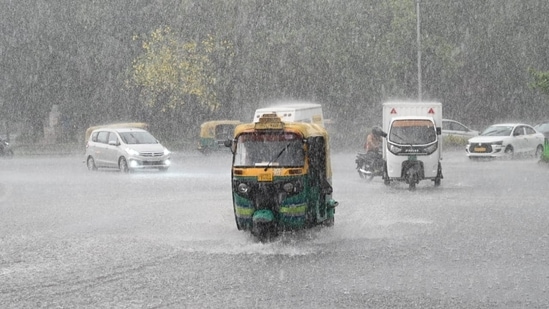
This came just as Delhi-NCR residents on Saturday received some relief from the scorching heat in the form of light rain, while the India Meteorological Department (IMD) placed parts of the city and its adjoining areas under a red alert for thunderstorm as well as dust storms.
According to the IMD forecast seen at 4:30 pm on Saturday, north, northwest, west and southwest Delhi districts were on red alert, while the rest of the city was placed under an orange alert.
The red warning was for “severe thunderstorm” with maximum surface winds of up to 100 km/h and hail, along with dust storm as well as rain.
Along with Delhi, Uttar Pradesh’s Noida and Ghaziabad were also under a red and an orange warning, respectively, while a yellow warning was in effect in Haryana’s Gurugram, according to the IMD nowcast.
Meanwhile, visuals of a massive dust storm engulfing parts of Rajasthan also surfaced on social media on Saturday.
A temporary relief from heat was predicted by the IMD over the weekend, which issued a yellow alert earlier for rain and thunderstorms. Very light to light rain and thunderstorms were predicted for Sunday as well, with wind speeds of around 40–50 kmph in the morning. The IMD has forecast partly cloudy skies for Monday and Tuesday, while mainly clear skies will persist from Wednesday to Friday.
The city reported a minimum temperature of 24.6°C on Friday, with the maximum expected to be between 35°C and 37°C. Temperatures are expected to rise again from June 1 and are likely to reach 40°C to 42°C by Thursday, June 4.
Videos purportedly from Churu and Bikaner showed a thick moving sand storm covering parts of the city.
What’s the alert system
The akert system carries a message that show up on your phone screen, unline SMS. It was tested on May 2, when mobile phones across India beeped simultaneously. That test alert came with a message: ‘Extremely severe alert! India, launches Cell Broadcast using indigenous technology, for instant disaster alerting service for its citizens. Alert citizens, safe nation. No action is required by the public upon receipt of this message. This is a test message. – Government of India.”
In a post on X later, the Department of Telecommunications (DoT) informed citizens about the launch of an advanced public alerting framework on May 2, aimed at enabling timely communication during critical situations.
The DoT, in collaboration with the National Disaster Management Authority (NDMA) and Ministry of Home Affairs, is coordinating on this system. “If you receive an alert message on your phone, do not panic. This is part of testing the Emergency Alert System so that accurate information can be delivered on time during disasters. During testing, this message may appear repeatedly. Ignore it; you do not need to do anything,” the DoT said then.