
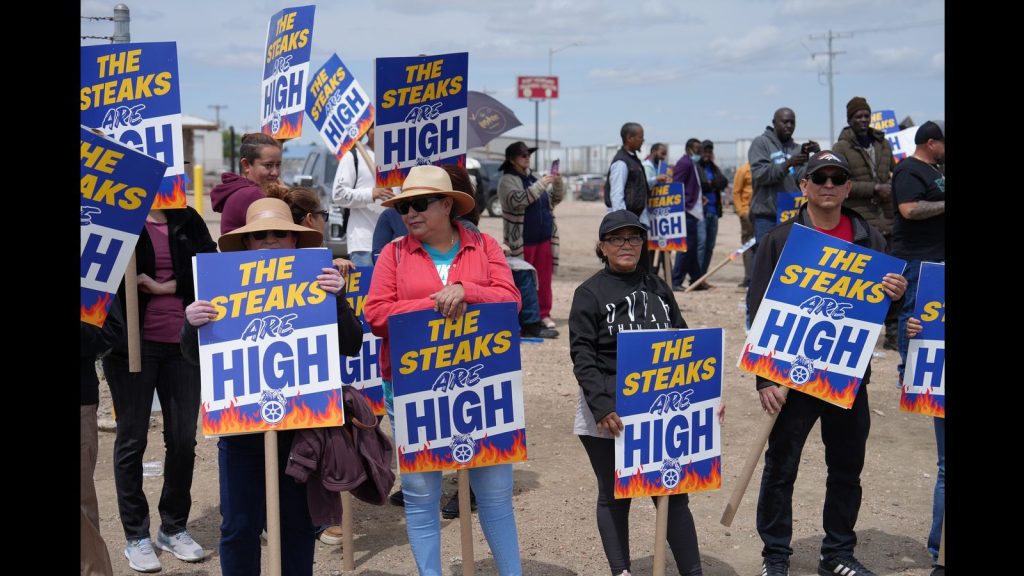
Cargill, the multinational food processing conglomerate, last week locked out workers at its beef processing plant in Fort Morgan, Colorado. The lockout follows months of talks with Teamsters Local 455, which had raised the potential for a plant-wide strike. The Fort Morgan workers earlier rejected the company’s latest agreement by a resounding 85 percent majority.
“The lockout was initiated because continued uncertainty around a potential work stoppage creates challenges for operating safely, responsibility and reliably,” a Cargill spokesperson claimed. “We respect employees’ right to vote and remain committed to reaching a ratified agreement with the union.” In other words, the company will accept no outcome other than workers ratifying an agreement reached entirely on its and the union’s terms.
The company, the largest privately-held company in the US, is also part of what is known as the “big four” of US meat processing companies, along with Tyson Foods, JBS USA and National Beef Packing. Together they account for 80 to 85 percent of US meat production. The Fort Morgan plant by itself accounts for nearly 5 percent of all US beef production.
Currently 1,700 workers are employed at the plant, equivalent to nearly 15 percent of Fort Morgan’s entire population of 11,597 people. The lockout will also have immense economic repercussions throughout the Northeast Colorado area.
Although precise demographic figures are not available, the plant’s workforce is between 70 to 85 percent immigrant, with most of those hailing from Somalia, Mexico, Guatemala and Myanmar. The risk of ICE raids and other heavy-handed actions by the Trump administration have been a very real threat faced by these workers during the course of their struggle.
The company’s deal included a mere 70 cents per hour increase in the first year of the contract and a 30 cents increase in the fifth year. The base hourly wage at the plant is currently only $23.50 per hour, putting these workers at a near-poverty level wage in the state of Colorado.
Notably, the proposed agreement terms are nearly identical to those reached last month between UFCW Local 7 and JBS at the Greeley, Colorado beef processing plant, a fact that even Local 7 itself acknowledged in a May 21 press release ostensibly in support of the locked-out Fort Morgan employees. In rejecting the latest Cargill offer, the Fort Morgan workers were therefore also effectively rejecting the UFCW’s Greeley agreement which the union had labeled as “powerful” and “historic.”
That agreement followed a powerful three-week strike of the Greeley plant’s nearly 4,000-person work force. It was the largest US meatpacking strike in 60 years and the first large meatpacking strike since the Hormel strike of 1985-86. The UFCW and Teamsters did nothing to mobilize members at other plants in support of the strike, even at those facilities processing beef diverted from the Greeley plant, and Local 7 was able to push a concessionary contract down workers’ throats as a result.
Also like the agreement reached at Greeley, Cargill’s most recent proposal made no concessions on overall working conditions, including better safety regulations or more breaks, both major concerns among plant workers. Strict time constraints at the facility have led to numerous instances of workers soiling themselves to make rate, while severe injuries in the plant work force have become the rule rather than the exception.
Overall the company’s so-called concessions in the agreement will result in a mere “$33.4 million investment over five years,” according to its own publicly released statements.
To put this figure into perspective, it is equivalent to only 0.9 percent of the company’s $3.57 billion in 2025 profits or 0.02 percent of the company’s $154 billion in revenue that same year.
The overall 5-year amount also represents just 2.3 percent of the $1.46 billion paid out last year in stock dividends to the billionaire Cargill-MacMillan family alone. The family members had a combined net worth of $65 billion in 2025. The richest of them, Pauline MacMillan Keinath, who has a 9 percent ownership stake in the company, has a net worth of $10.1 billion. An average Fort Morgan worker would have to work 49,197 years without stopping to earn this amount.
The lockout also comes as JBS workers at the Denver plant voted by 97 percent in favor of strike action. However, the UFCW International refused to sanction a possible work stoppage. This provoked outrage among workers on social media. This mood of opposition in Denver doubtless played a role in the latest contract rejection at Fort Morgan.
Given these developments, the meatpacking conglomerates are not simply concerned about the effect of a possible work stoppage at Fort Morgan plant but that such an action could spread to other locations either at Cargill or the other large meat processing concerns.
By all indications, the company had prepared for the lockout well in advance of the contract vote, as it had already shifted production to other plants.
But this will only be effective to the extent that the struggles of meat packing workers are kept isolated and atomized, which is what the union bureaucracy is attempting to do.
The Fort Morgan plant processed approximately 4,000 to 4,700 head of cattle per day or over 25,000 per week prior to the shutdown. While the specific locations Cargill diverted production to have not been released, it is believed that sufficient capacity was available at its Schuyler, Nebraska; Dodge City, Kansas; Friona, Texas and Fresno, California locations.
Workers at Schuyler are represented by the United Food and Commercial Workers (UFCW) Local 293; those in Dodge City by UFCW Local 2; Friona by UFCW Local 540, while the Fresno plant is non-unionized.
None of these locals have done or will do anything to unite their members in struggle with their brothers and sisters at Fort Morgan. A united struggle, if it is to take place at all, can only come from the independent initiative of the rank and file.
Meat packing workers in Denver, Fort Morgan, Greeley and throughout the US and internationally must organize a united struggle, form lines of communication with their fellow workers outside of the straitjacket of the trade union bureaucracy and form genuine rank-and-file committees to take the struggle forward.