
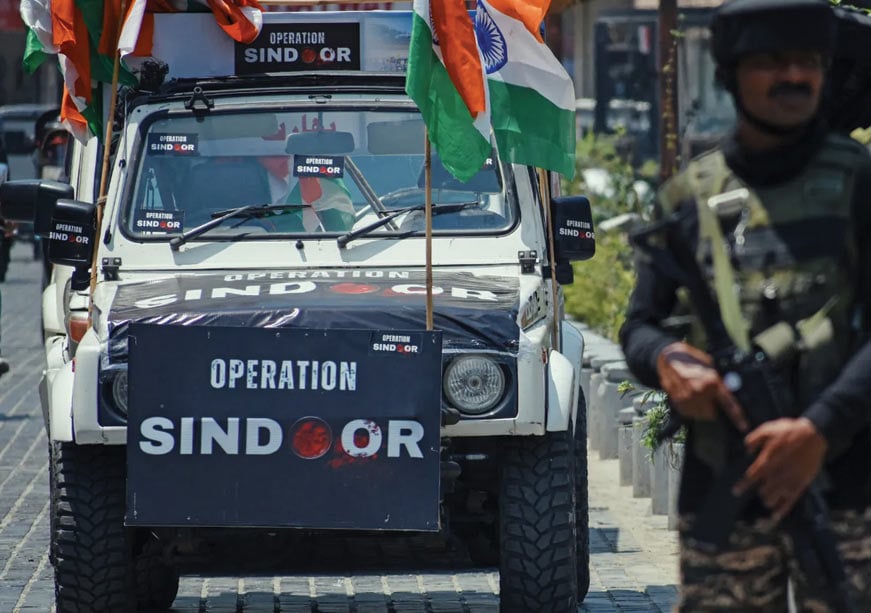

This article is part of the essay series: From Response to Reorientation: One Year of Operation Sindoor
In the evolving theatre of modern conflict, the most momentous battles are no longer fought solely on battlefields. They unfold through social media feeds, hashtags, WhatsApp forwards, and coordinated bot networks, shaping public perception across continents before a single bullet is fired. Pakistan, driven by a decades-old institutional obsession with undermining India’s strategic coherence, has built a sophisticated information warfare apparatus that operates with speed, deniability, and deliberate malevolence. India, by contrast, remains ensnared in a reactive posture: institutionally fragmented, doctrinally unprepared, and perpetually fighting the last information battle rather than anticipating the next. This is not merely a deficit of tools or technology. It is a deficit of strategic imagination.
The Adversary’s Playbook
Pakistan’s approach to information warfare is neither unpremeditated nor incidental; it is institutionalised. The Inter-Services Public Relations (ISPR) directorate, formally the media wing of the Pakistan Armed Forces, functions in practice as a full-spectrum narrative-management enterprise, producing films, television dramas, press briefings, and coordinated social media campaigns, all calibrated to serve strategic objectives. What makes it particularly dangerous is its integration within the socio-political fabric of society. Bot networks amplify ISPR campaigns, which are then laundered through diaspora intermediaries across the United Kingdom, Canada, and the Gulf, and subsequently gain international credibility through coverage in international media outlets influenced by diasporic involvement.
Pakistan’s approach to information warfare is neither unpremeditated nor incidental; it is institutionalised.
This ecosystem is structurally corrupt and designed to seed falsehoods at scale, on the understanding that refutations never travel as far as the original accusations. Its tactic involves treating India’s internal social diversity as a weakness and exploiting it against the country’s strengths. It also operates with a long-term tactical vision, understanding that the goal is not to win a single news cycle but to consistently erode institutional trust, fracture social cohesion, and position India as an aggressor rather than a victim in the international sphere. It is this kind of adversary that India faces—one that India neither can nor should seek to emulate, given the fundamentally distorted ideological foundations on which Pakistan was created.
Why Symmetry Is the Wrong Answer?
The innate response among strategists is to argue that India must develop equivalent capabilities: state-run bot networks, coordinated disinformation campaigns, and aggressive psychological operations targeting Pakistani domestic audiences. This argument, however appealing as a solution, is fundamentally not aligned with India’s strategic interests or structural constraints.
India’s power rests on the foundation of being the world’s largest democracy, which plays to the strength of diversity, unlike Pakistan, where diversity is considered a bane. As an emerging great power, India’s standing in multilateral forums, its appeal as an economic partner, and its capacity to build partnerships on issues ranging from Indo-Pacific security to global governance all depend on perceptions of and realities about its being a responsible, rule-respecting nation. A demonstrably state-run disinformation apparatus would undermine this image and the moral high ground that constitutes one of India’s most durable strategic assets.
Moreover, India’s domestic ecosystem—with its press, active civil society, judiciary, and vocal opposition—makes sustained state-directed disinformation unsustainable domestically. What Pakistan conceals behind military opacity, India cannot hide. The cost of exposure would be catastrophic, both domestically and internationally. India, therefore, cannot be Pakistan. But the answer is not inactivity; rather, it requires a fundamentally different strategic posture.
Four Fault Lines India Must Confront
Four structural vulnerabilities define the challenge of overwhelming information operations: first, speed asymmetry. Coordinated bot networks establish false narratives even before the adversary executes an action and launch propaganda campaigns within hours, while India’s official response machinery operates only after the first-mover advantage has been lost to the hostile nation. By the time a rebuttal is issued, the original falsehood has already been reported as fact and circulated globally through diaspora networks, even when India has won the underlying conflict.
Second is the problem of deniability, as Pakistan uses its allied technological infrastructure rather than visible content, and its own ISPR operations are directed through a layered combination of verified handles, anonymous bots, and diaspora intermediaries. Attribution is slow and contested, making it difficult to mobilise diplomatic counter-pressure.
What India requires is not a disinformation machine but a strategic communications architecture, one built on truth, pre-emptive framing, but deployed with the speed, coordination, and institutional discipline that currently only adversaries possess.
Third is the domestic dimension, as campaigns targeting communal tensions and seeding narratives of majoritarian violence are aimed not merely at international audiences but at Indian citizens themselves, with the deliberate objective of eroding social cohesion from within.
Fourth, and most deceptive, is the defender’s dilemma: India must maintain its international image as a responsible power while facing asymmetric, non-contact threats designed to fracture society, disrupt critical infrastructure, and alter the status quo below the threshold of war. Pakistan’s sponsored terror proxies along the borders are the kinetic manifestation of this dynamic.
Despite many hard lessons, India’s response architecture remains fragmented. Information warfare exists as a concept but lacks integration with electronic warfare, cyber operations, psychological operations, and strategic communications. The absence of a unified national doctrine means that each crisis episode sees different ministries responding in isolation rather than through a coordinated narrative.
Towards an Indian Doctrine: Strategic Truth at Speed
What India requires is not a disinformation machine but a strategic communications architecture, one built on truth, pre-emptive framing, but deployed with the speed, coordination, and institutional discipline that currently only adversaries possess.
This means three concrete things. First, pre-emptive narrative positioning: India must move from reactive denial to proactive framing, establishing its version of events before adversaries define the context. This requires real-time intelligence integration with communications strategy and structural reform that begins at the level of the National Security Council. Furthermore, adversaries often exploit the communication gap between citizens and leadership, which must be managed effectively and in real time.
Second, institutional integration: the current siloing of cyber, electronic warfare, psychological operations, and public diplomacy across different ministries and commands is a susceptibility India can no longer afford. A unified Information Warfare Command with clear doctrine, clear accountability, and clear escalation pathways is a necessity, not an ambition.
A unified Information Warfare Command with clear doctrine, clear accountability, and clear escalation pathways is a necessity, not an ambition.
Third, societal resilience as a strategic asset: since India’s domestic audience is a primary target of adversarial information operations, building media literacy, supporting independent fact-checking ecosystems, and ensuring that citizens possess the cognitive tools to identify coordinated manipulation are themselves forms of national defence.
The Strategic Case for Truth
Pakistan’s information warfare apparatus is built on deception, deniability, and the exploitation of India’s openness as a vulnerability. India’s response cannot mirror what it seeks to counter. India must instead transform its openness, democratic legitimacy, and institutional depth into strategic assets by ensuring that truth travels faster, more coherently, and with greater international resonance than adversarial falsehoods. The battlefield has changed. India’s doctrine must change with it.
Soumya Awasthi is a Fellow with the Centre for Security, Strategy and Technology at the Observer Research Foundation.
The views expressed above belong to the author(s). ORF research and analyses now available on Telegram! Click here to access our curated content — blogs, longforms and interviews.