
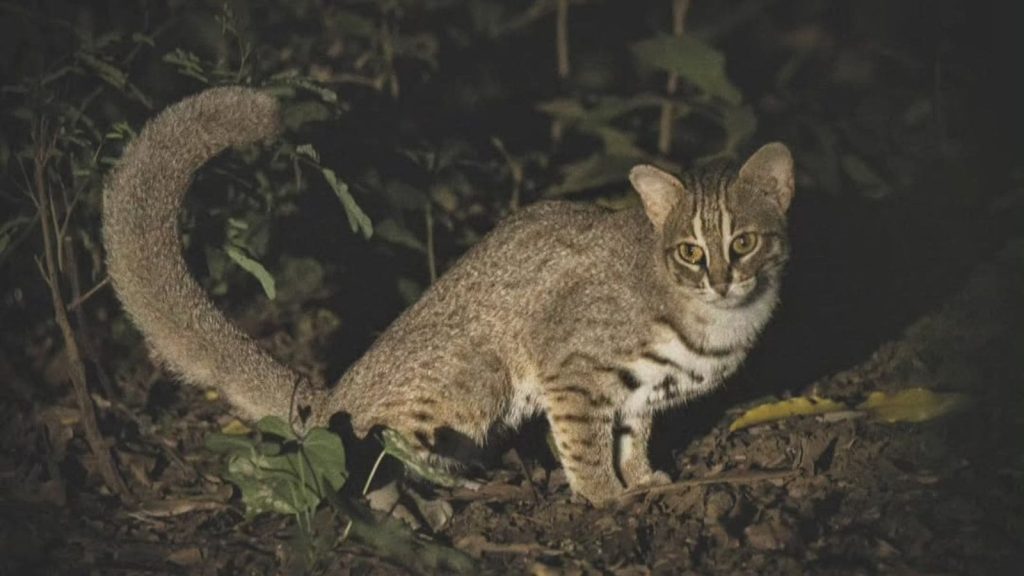
They were sighted for no more than 10-15 seconds – a mother, followed a few steps behind, by her tiny offspring. But it was enough to establish that an elusive species of the cat family was alive and breeding in the Aravalli scrublands at the doorstep of Delhi.
Photographic evidence for the presence of the rusty-spotted cat (Prionailurus rubiginosus), one of the world’s smallest species of wildcat, was reported last week in the peer-reviewed journal Zoo’s Print.
The female adult and her dependent kitten were photographed in July 2025 in Kot village of Faridabad district during field surveys by researchers affiliated with the Department of Zoology at Indira Gandhi University in Meerpur, Haryana.
The finding, reported by Amit Kumar, Tejveer Mavi, Yatin Verma, Ram Kumar Rawat, and Sohail Madan, indicates the presence of a resident population of the species in the Aravalli landscape in Faridabad and Gurgaon.
The rusty-spotted cat is classified as ‘Near Threatened’ on the IUCN Red List, and is protected under Schedule I of the Wildlife (Protection) Act. The International Union for Conservation of Nature (IUCN) is an organisation of 160 member countries and hundreds of civil society groups that work together for the protection of biodiversity, and to examine the health of species and their extinction risk.
The rusty-spotted cat measures no more than 35-48 cm in length, about half of which is bushy tail. It has short, reddish grey fur, with rusty spots on the back and sides.
The cat is native to India, Nepal and Sri Lanka, where almost 75% of its habitat is believed to be under threat from land-use change, including agriculture and urban expansion. The animal is rarely documented due to its secretive nature and low density.
Story continues below this ad
“The rusty-spotted cat is one of the world’s smallest cat species. It is found in virgin forest, where there is no disturbance. But here, we have recorded it very close to the city in the Aravallis. This is the first time anybody has recorded the breeding. It is proof that Aravallis is still home to very sensitive wildlife,” Yatin Verma, one of the researchers, told The Indian Express.
Until now, the species had only been recorded sporadically in Delhi-NCR. “In September 2023, from Manger Bani…, before that from Haryana, only three-four instances were recorded in the past few years. It was all through a camera trap and there was no live sighting. But we were able to recently get live sightings as well,” he said.
Verma said he had recorded three live sightings of the cat so far, including one made as recently as this week. The first live sighting was reported in Bhondsi in Gurgaon in 2023, followed by the mother-and-kitten sighting in Kot village in 2025, and a third in Tikri just days ago, he said.
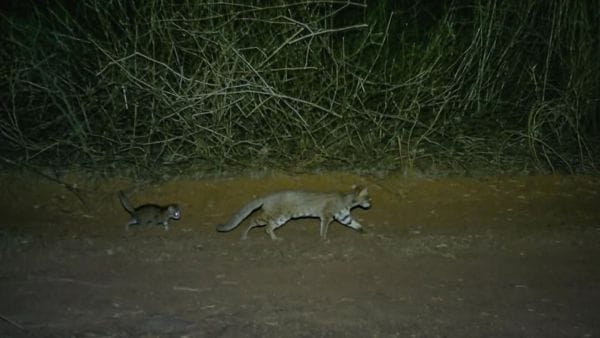 Photograph of the rusty-spotted cat with its kitten, in Kot village in 2025 (Photograph by Yatin Verma, researcher)
What the study shows
The researchers said the presence of the species across 20-30 locations in the Aravallis suggests a potentially stable population. They are now undertaking a larger study to assess the feeding behaviour of the animals, population estimates, and their interaction with humans.
Story continues below this ad
The study area in the northern Aravalli range, is a scrub-agriculture-settlement mosaic that continues to support biodiversity despite pressures such as quarrying, grazing, and urbanisation, the paper says. Vegetation includes dry deciduous and thorn scrub species such as Vachellia, Prosopis, and Ziziphus, which provide both cover and prey base for small carnivores.
Interestingly, the observations challenge the belief that the species avoids human presence.
“The cat is generally believed to be shy, but here we found it was aware of human presence. Two times in live sighting, it stayed for three to four hours with us since it was hunting… When it was with the kitten, the sighting was only for 10 to 15 seconds,” Verma said.
The feline was found to be most active at dusk and dawn — after around 7.30 pm and around 4 am in the summer — which is consistent with the behaviour of many small wildcats.
Story continues below this ad
During an earlier documented instance on September 16, 2023, the cat was seen using a False Ashoka tree, an ornamental species commonly planted near human settlements, suggesting a degree of adaptation to modified urban habitats.
According to the researchers, the findings add to growing evidence that fragmented green spaces within highly urbanised landscapes can support rare and threatened species.
They also underline the ecological importance of the Aravallis, often described as the last remaining natural barrier against desertification in the region.
“Previously, none of the sightings established breeding,” the paper notes. “This record, therefore, marks a significant extension of the species’ documented breeding range and highlights the conservation importance of fragmented green spaces within the highly urbanised NCR landscape.”
Story continues below this ad
“There is a need”, the researchers have said, “to formulate management plans that encompass both protected and non-protected landscapes, as viable populations of Rusty-spotted cats may be persisting beyond reserve boundaries”.