
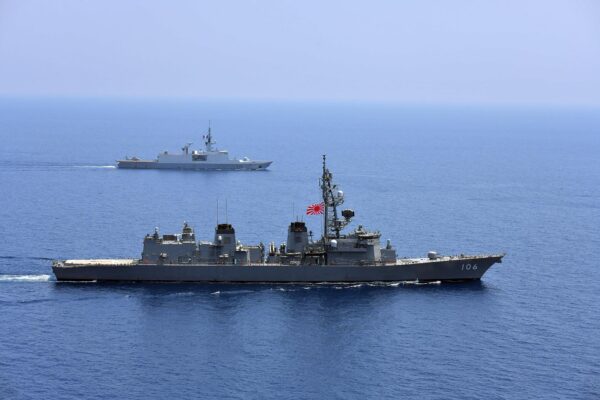
On April 24, Japan’s ruling Liberal Democratic Party (LDP) presented a set of policy proposals to Prime Minister Takaichi Sanae outlining measures the Japanese government should consider to address challenges posed by the disruption of energy supplies in the Middle East. In addition to looking for alternative fuel sources, the proposal also urged the government to seriously examine the feasibility of deploying Maritime Self-Defense Force (MSDF) minesweepers to the Strait of Hormuz once a cease-fire is agreed upon.
As the United States continues to press its allies to “do more” for the safety of the Strait of Hormuz, speculation has already begun to swirl on whether Japan should deploy MSDF vessels in the waters near the Strait of Hormuz for “intelligence-gathering” purpose.
To those who remember Japan’s response to the 1991 Gulf War, this is almost a “deja vu” moment.
The Gulf War: Same Pressure, Different Context
In 1991, the disruption of oil supply out of the Middle East was a major concern, especially after Iraq, then under the rule of Saddam Hussein, systematically destroyed Kuwaiti oil wells by setting them on fire as its military began a retreat after the Operation Dessert Storm commenced. Japan also faced pressure – directly from then-U.S. President George H. W. Bush, according to declassified diplomatic documents – to send “forces” to participate in the multinational force’s operations to repel Iraq’s invasion attempt of Kuwait.
At that time, Japan did send MSDF minesweepers to clear mines positioned by Iraq, but only in April 1991 – after the fighting had stopped.
It is important to note the difference in context between 1991 and now, however. Most importantly, In the case of 1991 Gulf War, Japan was requested to send the Self-Defense Forces (SDF) to support a multinational force whose operations were authorized by the United Nations Security Council Resolution 678. Operation Dessert Storm was truly a multinational force – a total of 28 countries sent combat troops and an additional 11 countries sent their military assets and/or non-combat personnel.
This presents a stark contrast between 1991 and today’s conflict with Iran. From the international authorization (or lack therefore) to the number of countries that are participating in the military operations, the 1991 Gulf War and the situation in the Strait of Hormuz today cannot be more different.
Still for Japan, one important factor remains constant – pressure from the U.S. administration. To be clear, Japan is not alone in facing U.S. pressure this time. In fact, most U.S. allies – in Europe as well as Indo-Pacific – have been facing mounting pressure from the Trump administration since the United States and Israel began joint military operations against Iran on February 28.
More importantly, Japan, unlike the 1991 Gulf War, is not alone at balking at U.S. demands. In fact, there is a widespread hesitation that has been shared by U.S. allies worldwide in supporting U.S. and Israeli military operation while the combat operation is ongoing. That much is clear from a March 19 joint statement signed by 20 countries – including Japan – that expressed their collective commitment to support the safe passage in the Strait of Hormuz after the cessation of hostilities.
Japan Already Has Forces in the Area
Still, given the importance of the Strait of Hormuz being “free and open” for global energy security, it would be wise for Japan to “show the flag” to signal that it has a concrete plan to that end. And this mark another difference from the 1991 Gulf War: today, Japan is in much better position to articulate its plan of contribution to the international effort.
Specifically, Japan can shape a two-step approach. As the first step, it can utilize the contingent it has already deployed in the Gulf of Aden to participate in the ongoing Combined Task Force (CTF 151) counterpiracy operations. The CTF 151 is one of the five task forces established under the Combined Maritime Force, a 47-nation naval partnership established in 2001 following the 9/11 terrorist attacks to “promote security, stability and prosperity across approximately 3.2 million square miles of international waters.” The CMF divides responsibilities among five CTFs, with their combined areas of operation covering some of the critical shipping lanes from the Red Sea to Arabian Sea and western Indian Ocean.
Although its activities largely go unnoticed, it is important to point out that the CMF, which includes participation from most of the signatories to the March 19 joint statement, continues to operate after the Iran-U.S. military standoff began on February 28. In fact, according to a press release published as recently as April 8, the CMF successfully deterred activities by a Iranian-flagged ship boarded by Somali pirates.
The CTF 151 was established in 2009 with a specific mission to counter Somali piracy. Authorized by multiple U.N. Security Council resolutions, it has four core missions: (1) deter, disrupt, and suppress piracy; (2) protect commercial shipping in the Gulf of Aden, Somali Basin, and western Indian Ocean; (3) conduct maritime security operations (including boarding, surveillance and patrols); and (4) coordinate with other multinational missions. As such, its primary areas of operations cover the vast areas from the Gulf of Aden all the way to the Indian Ocean, even including parts of the Arabian Gulf that are assessed to have a higher risk of piracy.
Japan has long been a part of this CTF, including taking the command of the CTF 151 four times to date. Initially approved as “maritime patrol operations” under the Self-Defense Force Law, the SDF participation in the CTF 151 is now authorized by the Counter-Piracy Law passed in June 2009. Today, Japan deploys MSDF destroyers and surveillance aircrafts, Air Self-Defense Force transportation assets and personnel, as well as Ground Self-Defense Force personnel for base protection and other support.
Given the responsibilities already granted to the CTF 151 under U.N. Security Council resolutions, Japan can work with other CTF-151 partners to enhance the counterpiracy operations’ surveillance and patrols operations of their areas of responsibility, with an added emphasis on the mandate to patrol, gather intelligence, and escort commercial ships that transit the International Recommended Transit Corridor (IRTC) off the Somali coast. The participating countries can assume commanding responsibility on rotation.
It’s expected that the U.N. Security Council will fail to pass a relevant resolution even with the cessation of the Iran-U.S. hostilities. In that case, Japan will likely need to pass the Special Measures Law in order to participate in a multinational coalition operations to enforce “the free and open” Strait of Hormuz. However, Japan already has a template for such a temporary legal framework, thanks to its past experiences in deployment the SDF to Indian Ocean to support Operation Enduring Freedom and Operation Iraq Freedom.
Active coordination with the other CTF 151 participating nations to look into the ways in which the Combined Task Force can provide indirect yet critical support for situational awareness in the region through ongoing surveillance activities will give Takaichi much-needed time and space to craft a law tailored for the anticipated missions in the Strait of Hormuz.
In a nutshell, rather than hastily put together an SDF deployment plan for the Strait of Hormuz, Tokyo can take a more deliberate two-step approach, with initial step of playing up Japan’s participation in the CTF 151, followed by the Special Measures Law to authorize the JSDF deployment as a part of multinational force to “monitor and enforce” the safety of the Strait of Hormuz, leveraging the intelligence gathered by the ongoing CTF 151.
To Takaichi’s credit, she has so far demonstrated a much more agile response to the ongoing crisis in the Middle East compared to her predecessors. From deciding to release Japan’s strategic oil reserve ahead of most countries to proactively diversifying the supply of the material critical for many chemical products, Takaichi seems to be navigating Japan through this quickly evolving situation to minimize the impact of the current crisis on Japanese economy. By taking a two-step approach to Japan’s participation in existing international operations to enforce the “free and open” Strait of Hormuz, she can make sure that the eventual SDF deployment to the Middle East will be carried out in lockstep with other international partners and boost domestic backing for her decision.