
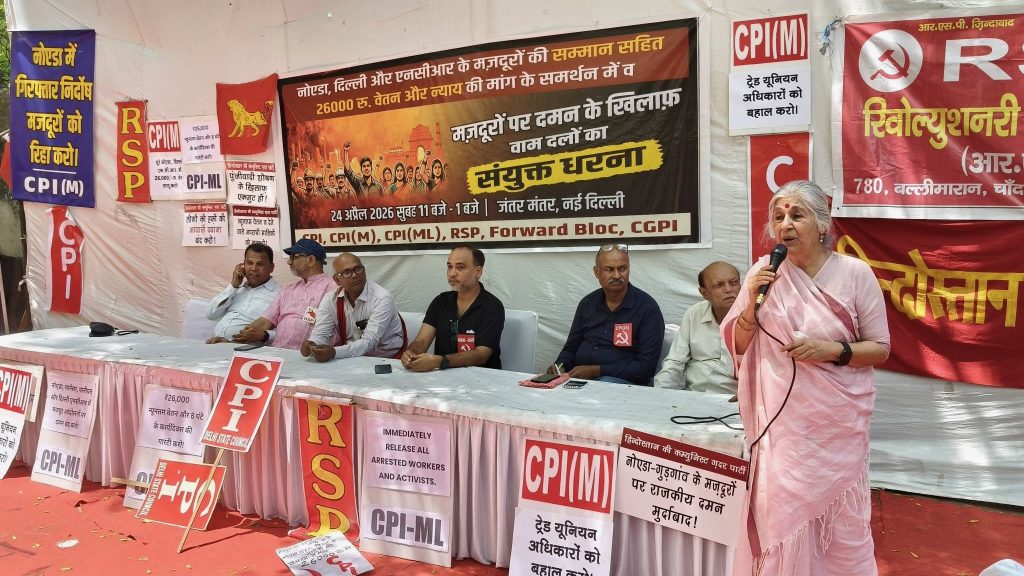
Left parties join worker demonstration for minimum wage increase. Photo: CPI(M) Delhi
Members of major left parties in India rallied in New Delhi on Friday, April 24, in solidarity with workers who have been staging protests across the country seeking an increase in their minimum wage and an end to state repression.
The protesters raised slogans denouncing the arrest of hundreds of workers by the security forces and demanded the scrapping of four new labor codes enacted by the ultra-right-wing government in the country.
The protest was organized jointly by the Communist Party of India (Marxist), the Communist Party of India (CPI), the Communist Party of India (Marxist-Leninist) Liberation, the Revolutionary Socialist Party (RSP), Forward Block, and others.
Speakers at the rally claimed that the protests in the industrial suburb of New Delhi, Noida, show that the attempt by the ultra-right-wing government to delegitimize unions through decades of demonization, through oppressive laws and through attempts to create divisions on social and regional lines is crumbling as more and more workers are uniting and seeking collective bargaining.
The speakers cited the recent protests in Barauni refinery in Bihar, the agitation of workers in Panipat refinery in Haryana, the workers agitation in Gujarat, and now the agitation in Noida and other regions of India’s National Capital Region (NCR), among others, as examples of the rising working-class consciousness in India.
Speakers noted that most of these protests began without the active involvement of trade unions and defied the attempts by the respective state governments to paint them as law and order problems and suppress them by force.
All major trade unions, including the Centre for Indian Trade Union (CITU), have already extended their support to the workers in Noida and participated in setting a channel of communication between the workers and the administration.
Decent minimum wage is the central demand
The left parties extended their support to the trade unions’ demand to raise the minimum wage in the NCR to Rs. 26,000 (USD 276) per month and for adequate social security measures and overtime. They also demanded restrictions on contract employment and the immediate release of all workers arrested during the protests.
After facing a steep rise in their cost of living for years due to inflation in the price of all essential commodities and services, workers in Noida (Gautam Budhha Nagar) and other regions of the NCR, one of the major industrial clusters in the country near the national capital, New Delhi, went on strike in the second week of April, demanding a hike in wages.
They underlined the fact that the state government of Uttar Pradesh has failed to constitute a wage board since 2014 to revise the minimum wages to match the rising inflation, which had left the majority of the workers to survive on wages as low as Rs 11,000 (USD 117) per month.
Instead of addressing their demands, the security forces from Uttar Pradesh, the largest state of India, unleashed a massive crackdown on the workers, arresting hundreds of them and even accusing them of taking part in anti-national activities.
There were reports of custodial torture of workers arrested during the agitation as well with a large number of trade union leaders put under house arrest.
The Uttar Pradesh government, led by the ultra-right-wing Bharatiya Janata Party (BJP) also tried to pacify the agitating workers by raising the minimum wages by 21%.
The left parties supported the trade unions’ decision to reject the paltry hike in wages announced by the Uttar Pradesh government, calling it grossly inadequate for a dignified life.
A part of the larger struggle
Various speakers addressing the protests on Friday claimed that the Noida struggle is a reflection of growing unrest among the working class in India, the majority of whom remain un-organized.
Successive governments in India have unleashed a systematic attempt to deprive the workers of their collective bargaining powers such as the right to form unions. This has resulted in a situation where over 90% of all workers in the country are outside the purview of trade unions.
The non-recognition of unions, refusal to set up wage boards, and the criminalization of protests are some of the other means adopted by the governments to silence the workers.
Subhashini Ali, leader of the CPI (M), claimed that the Narendra Modi government’s refusal to acknowledge the genuine grievances of the workers and brush them under the carpet of “anti-national” activities comes from the fact that it sees itself as the self-appointed guardian of big corporations.
The introduction of four new labor codes by the Modi government is the latest and most comprehensive attempt to kill the workers movement in the country, claimed Amrinder Kaur, leader of the All India Trade Union Congress (AITUC), one of the oldest and largest trade union federations in the country.
She underlined that one must link the workers’ struggles taking place across the country to the February 12 national strike against the implementation of the four new labor codes.
Read more: 300 million on the streets in a historic national strike in India
The four new labor codes brought by the Modi government empower the capitalists at the cost of the workers who lose all the rights won through decades of struggle.
Nearly 300 million workers, out of a total of over 600 million in the country, participated in the strike called jointly by all the major trade unions in the country to oppose the implementation of the four new labor codes.