
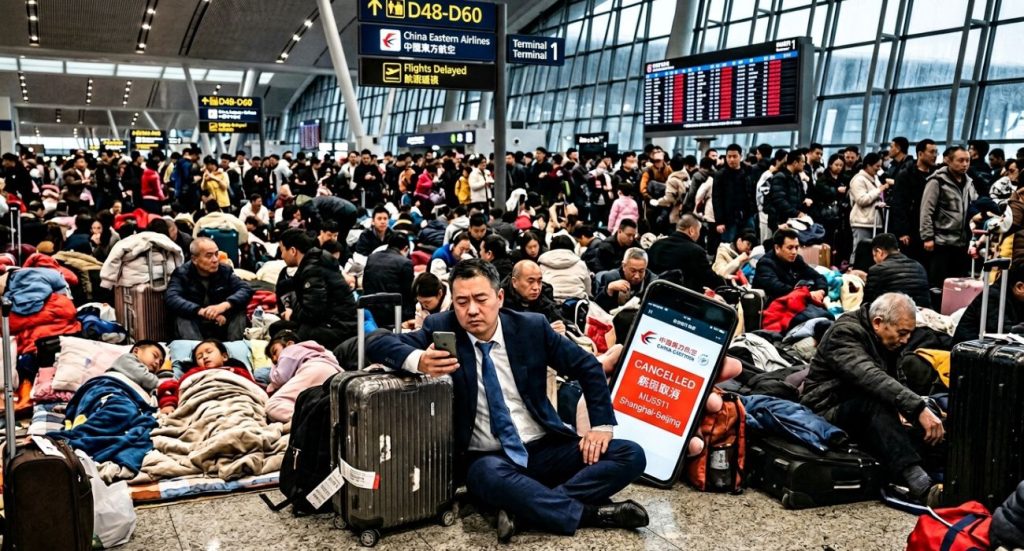
Systemic Atmospheric Instability Paralyzes the “Air Bridge” of Asia; 619 Total Flight Disruptions Leave Thousands Stranded and Regional Tourism in States of Significant Flux
BEIJING, China — The Chinese aviation landscape has been plunged into a state of severe operational stalemate as a massive “Weather Wall” continues to ground and reschedule hundreds of flights across the nation’s most critical hubs. In a series of breaking aviation updates on April 21, 2026, the trio of major carriers—China Eastern Airlines, China Southern Airlines, and China Express Airlines—confirmed that 60 flights have been grounded and a staggering 559 have been rescheduled. From the high-tech gates of Beijing Daxing (PKX) to the southern metropolitan hub of Guangzhou Baiyun (CAN), the atmospheric disruption has triggered a wave of travel chaos that is reshaping the schedules of business and leisure travelers alike.
EXPANDED OVERVIEW: The Scale of the “619 Disruptions” Crisis
The current airport disruptions are not merely localized events but a systemic failure of the region’s air corridors due to adverse, persistent weather patterns. The scale of the crisis involves a total of 619 flight modifications, a figure that has sent shockwaves through the local economic zones. As the three dominant players in the Chinese market grapple with these conditions, the ripple effects are being felt in every sector, from international logistics to high-stakes panda tourism in Chengdu.
For passengers of China Eastern (CES) and China Southern (CSN)—the “Big Two” of the region—the crisis has meant navigating a maze of cancellations and last-minute gate changes. Meanwhile, regional specialist China Express (HXA) has seen its network in the more remote western provinces virtually immobilized, highlighting the vulnerability of the nation’s “Secondary Connectivity” during extreme weather events.
SECTION-WISE BREAKDOWN: THE CARRIER IMPACT ANALYSIS
China Eastern Airlines (CES): The Hub-to-Hub Stalemate
As a cornerstone of the nation’s flight grid, China Eastern has seen its most profitable routes descending into volatility. The airline’s operations between Beijing Daxing and Shenzhen Bao’an, a critical lane for the “Silicon Valley of China,” have been hit with successive flight cancellations. Business travelers heading for the Shanghai Pudong financial hub from Shijiazhuang have found themselves caught in a cycle of rescheduling that has seen wait times extend into the 12-hour mark.
China Southern Airlines (CSN): Massive Disruptions at Southern Hubs
China Southern, operating out of some of the busiest airspaces in Asia, is currently managing a “Logistical Red Alert.” Key routes from Guangzhou Baiyun to Chongqing Jiangbei—one of the most traveled domestic segments—have seen significant grounding. The airline’s presence in Wuhan, Harbin, and Nanning has also been severely compromised, as the “Weather Wall” moves across the central and southern provinces, turning high-frequency schedules into a game of operational chance.
China Express Airlines (HXA): Regional Isolation in the West
Perhaps the most dramatic impact is seen in the regional operations of China Express. Specialized in connecting rural and remote destinations, the airline has seen a total shutdown of connectivity in airports like Qiemo, Shache, and Xilinhot. For these regions, air travel is not a luxury but a “Vital Life-Line” for healthcare, business, and personal transit. The current grounding has effectively isolated these communities, leaving local residents with limited alternate escape routes.
FLIGHT DETAILS: THE WORST-AFFECTED HUBS AND ROUTES
The disruption is concentrated in a “Diamond Grid” of twelve major airports across the country. Travelers traversing through these points are facing the highest probability of delay or cancellation.
Mandatory Data: Affected Hubs by Airline
| Airline | Worst-Hit Airports | Key Affected Routes |
|---|---|---|
| China Eastern (CES) | Shijiazhuang (SJW), Kunming (KMG), Chengdu (TFU), Guilin (KWL) | SJW → Shanghai (PVG), TFU → Zhuhai, KWL → Jieyang Chaoshan |
| China Southern (CSN) | Guangzhou (CAN), Beijing (PKX), Wenzhou (WNZ), Nanning (NNG) | CAN → Chongqing (CKG), PKX → CAN, WNZ → Guilin (KWL) |
| China Express (HXA) | Qiemo (IQM), Shache (QSZ), Xilinhot (XIL), Guiyang (KWE) | IQM → Hotan (HTN), XIL → Wuhai (WUA), CKG → Wenshan |
Specific Route Disruptions:
- China Eastern: Shijiazhuang Zhengding to Shanghai Pudong; Kunming Changshui to Dehong Mangshi; Chengdu Tianfu to Zhuhai.
- China Southern: Guangzhou Baiyun to Chongqing Jiangbei; Beijing Daxing to Guangzhou Baiyun; Nanning Wuxu to Beijing Daxing.
- China Express: Qiemo to Hotan; Xilinhot to Wuhai; Shache to Hotan; Chongqing Jiangbei to Wenshan Puzhehei.
PASSENGER IMPACT: Stranded in the High-Traffic Vacuum
The human cost of these airport disruptions is measurable in the crowded terminals of Chengdu Tianfu and Guangzhou Baiyun. With 60 flights grounded, thousands of passengers are now competing for a dwindling number of seats on the 559 rescheduled flights.
Missed connections have become the “New Reality” for international travelers arriving in Beijing or Shanghai. Business contingencies are being activated across Shenzhen and Shanghai, while leisure travelers in Chengdu—many visiting for the iconic giant panda reserves—face the financial burden of last-minute accommodation and inflated fare rates for rail-based alternatives. The “In-Terminal Experience” has been described by many as a state of “Orderly Resignation,” as passengers wait for any window of atmospheric relief.
INDUSTRY ANALYSIS: THE TOURISM RIPPLE AND HUB RESILIENCE
Aviation analysts suggest that this event highlights a critical threshold in Asian aviation resilience. The “Weather-Induced Stalemate” has a double-edged impact on the tourism sector:
- The Panda Tourism Pause: Cities like Chengdu and Guilin, which depend heavily on high-frequency domestic and international air arrivals, are seeing a sharp decline in visitor numbers, impacting everything from hotel occupancy to tour operators.
- The Business Connectivity Drain: The disruption of the Beijing-Guangzhou-Shenzhen “Golden Triangle” hits the corporate sector’s bottom line, as face-to-face deal-making is stalled by groundings in PKX and CAN.
Industry bodies are currently reviewing the “Crisis Management Protocols” of these major carriers, noting that while weather is uncontrollable, the speed of rebooking and the transparency of communication remain the variables that will determine long-term passenger confidence.
CONCLUSION: THE ROAD TO ATMOSPHERIC RECOVERY
While the current aviation updates are grim, the resolution lies in the movement of the high-pressure system currently stalled over Central China. As China Eastern, China Southern, and China Express prepare for a massive “Catch-Up Schedule” once the skies clear, the industry must deal with the backlog of 559 rescheduled services. This will likely mean a week of “Compressed Capacity,” where flights will operate at 100% load factors to clear the stranded traveler vacuum.
KEY TAKEAWAYS
- The Numbers: 60 flights grounded and 559 rescheduled across three airlines.
- The Hubs: Major gridlock in Beijing Daxing, Guangzhou Baiyun, and Chengdu Tianfu.
- The Regional Cost: China Express has seen a total connectivity freeze in remote western hubs like Qiemo and Shache.
- Passenger Survival: Travelers are urged to verify status via official airline apps before heading to airports to avoid “Double Stranding.”
- Sector Impact: High-value tourism zones like Chengdu face immediate visitor shortages due to hub grounding.
Author’s Observation: All data in this breaking news report has been sourced from verified flight monitoring bodies and airline carrier statements as of April 21, 2026. Travelers are advised to remain flexible and prepare for 24-48 hour ripple effects even after weather conditions improve.