
The company inaugurated its office on Monday to serve as a coordination hub for consultancy, design, and urban rail construction activities in the city.
HCMC is speeding up expansion of its metro network, and targets having around 200 kilometers of lines by 2030, up from the current 20 km.
The opening ceremony was attended by Ho Chi Minh City vice chairman Bui Xuan Cuong, Guangzhou vice mayor Lai Zhihong, and Chinese consul general in HCMC Tang Li.
 |
|
Authorities of Ho Chi Minh City and Guangzhou City along with representatives from Guangzhou Metro at the event to open the company’s office in HCMC, June 1, 2026. Photo by VnExpress/Ha Giang |
The company, owned by Guangzhou city in Guangdong Province, has more than 30 years of experience in urban rail development.
It has played a key role in developing Guangzhou’s metro network, which spans 1,500 kilometers and serves 9.3 million passengers daily on average.
Nguyen Vinh Toan, deputy director of HCMC’s Department of Construction, said the opening of the representative office marks a new stage in cooperation between the city and Guangzhou Metro, shifting from individual projects to a long-term strategic partnership in urban rail development.
In April 2024, the Ho Chi Minh City Management Authority for Urban Railways, the government agency responsible for the planning, implementation, and development of the comprehensive metro system for the city, the China Metro Association, and Guangzhou Metro signed a memorandum of understanding for cooperation in urban railroad planning and development.
They have since undertaken a number of activities related to the metro line No.2 that will run 11.3 km between Ben Thanh and Tham Luong, connecting the city’s downtown with the northwest, and line No. 4, a 47-km route linking former Hoc Mon and Nha Be districts on the city’s outskirts.
Several other projects are being studied by the company’s subsidiaries.
City officials said they expect closer cooperation following the opening of the company’s office, particularly in training and workforce development to help Vietnam gradually master urban rail technologies.
The city also aims to build a core local workforce capable of supporting the long-term growth of the sector.
It hopes to establish an industry ecosystem involving Guangzhou Metro and local businesses, with officials saying this would enhance the competitiveness of the latter and encourage their participation in regional and global railway industry supply chains.
The city called on its Guangzhou counterparts and the company to help optimize its metro master plan, develop transit-oriented development projects, and strengthen connectivity between rail and road transport, underground spaces, and smart-city infrastructure.
Liu Zhicheng, chairman of Guangzhou Metro, said the opening of the HCMC office represents not only a new milestone in urban rail cooperation but also an opportunity to deepen economic and trade relations between the two sides.
His company is ready to share expertise in technology, infrastructure investment, construction, and railway operations, he said.
It would also help Vietnam develop technical standards, regulations, and management models for the rail sector, indigenize technology, and train its workforce, he added.
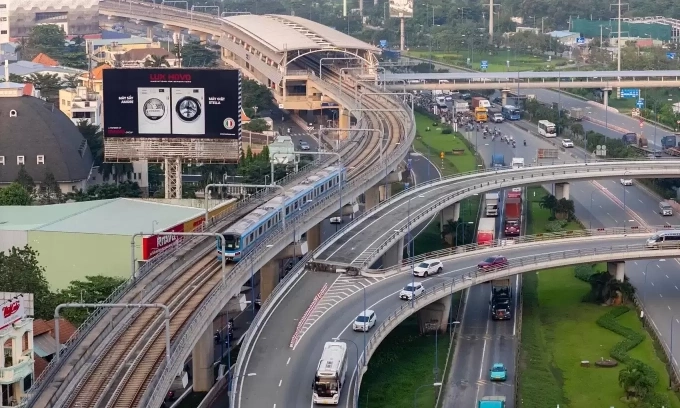
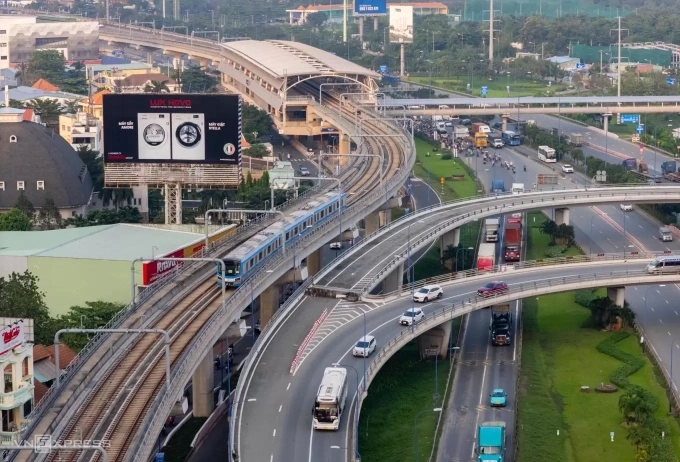
HCMC currently has just one metro line between downtown Ben Thanh and Suoi Tien in the eastern gateway.
 |
|
A train moves on elevated tracks of the Ben Thanh – Suoi Tien metro line in HCMC. Photo by VnExpress/Quynh Tran |
Construction has recently begun on the Ben Thanh-Tham Luong line and Ben Thanh-Thu Thiem line beneath the Saigon River.
The 54-km Ben Thanh-Can Gio line, which broke ground in December 2025, is being built by VinSpeed, a subsidiary of the Vingroup conglomerate. Designed for speeds of up to 350 kph, it will connect the city with the coastal Can Gio, site of a major Vingroup resort, and is slated to begin operations in 2028.
Several other routes are also planned.
Work on the 48-km line to the under-construction Long Thanh International Airport is likely to begin before July 2, the 50th anniversary of Saigon being renamed as Ho Chi Minh City. The airport is nearing completion.
The city plans to begin work on three more lines this year, including to the former Binh Duong Province and Tan Son Nhat airport.