
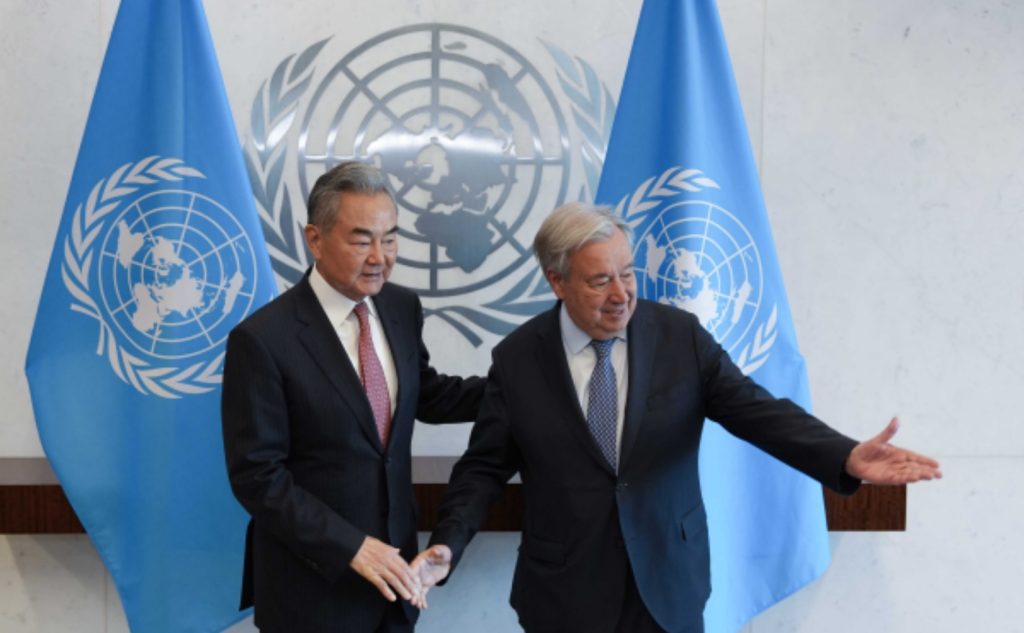
During his recent visit to the United Nations in New York to attend the UN Security Council high-level meeting on ‘Upholding the Purposes and Principles of the UN Charter and Strengthening the UN-centred International System’, called by China during its rotating presidency, along with the meeting of the Group of Friends of Global Governance, Chinese Foreign Minister Wang Yi also held numerous bilateral meetings with his counterparts who had also made special trips to join the meetings.
The following are some of the highlights:
On May 26, Wang met with the foreign ministers of Azerbaijan, Panama, Indonesia, Argentina, Czech Republic, Kyrgyzstan, Colombia, Thailand and Bahrain, as well as with the United Nations Secretary-General.
Meeting with Azerbaijani Foreign Minister Jeyhun Bayramov, Wang Yi said that no matter how the international situation changes, China’s determination to develop relations with and deepen cooperation with Azerbaijan will not waver. China stands ready to work with Azerbaijan, following the consensus reached by the two heads of state, to firmly support each other, jointly build the Belt and Road, share development opportunities, strengthen multilateral coordination and better support each other’s modernisation efforts. China will fully support Azerbaijan’s chairmanship of the Conference on Interaction and Confidence Building Measures in Asia (CICA).
Jeyhun Bayramov thanked China for sending high-level representatives to attend the World Urban Forum held in Baku and for supporting Azerbaijan in assuming the chairmanship of the CICA. Azerbaijan firmly supports China on issues related to Taiwan, Hong Kong and Xinjiang, and always regards China as an important strategic cooperative partner.
Meeting with Panamanian Foreign Minister Javier Martínez-Acha Vásquez, Wang Yi stated that China and Panama enjoy a long history of exchanges. In the 19th century, large numbers of Chinese labourers traveled to Panama to build railways and dig the Panama Canal, contributing to Panama’s economic and social development. Nearly nine years since the establishment of diplomatic relations between China and Panama, bilateral relations have generally progressed smoothly, with trade volume doubling compared to the pre-establishment period, delivering tangible benefits to the Panamanian people. Facts fully prove that the establishment of diplomatic relations between China and Panama serves the long-term interests of both countries and represents the shared aspiration and irresistible trend of the times. Adherence to the one-China principle is the political foundation of the establishment of the bilateral diplomatic ties. Chinese enterprises have operated in Panama for years, making important contributions to Panama’s economic growth and people’s well-being. It is hoped that Panama will earnestly safeguard the legitimate rights and interests of Chinese enterprises. China has always maintained that bilateral relations do not target any third party nor should they be subject to third-party interference. China stands ready to work with Panama to uphold the original aspiration of establishing diplomatic relations, deepen practical cooperation, fend off external disruptions, and promote the healthy and stable development of bilateral ties.
Javier Martínez-Acha Vásquez said that the Panamanian people remember the contributions made by the Chinese people to the construction of Panama’s railways and the Canal in early years. Panama stands ready to work with China to look to the future, resolve differences through constructive dialogue on the basis of mutual respect, build solid mutual trust, and turn a new page in Panama-China relations.
Relations between China and Panama have become strained recently as the government buckled in the face of threats by US President Donald Trump to annex the Panama Canal. As a result, Panama withdrew from the Belt and Road Initiative (BRI) and arbitrarily cancelled operational contracts regarding the Panama Canal hitherto enjoyed by Hong Kong Chinese company CK Hutchison Holdings owned by Li Ka-shing.
Meeting with Indonesian Foreign Minister Sugiono, Wang Yi welcomed his special trip to New York for the high-level meeting. He stated that as representatives of emerging economies and major developing countries, China and Indonesia have the obligation and necessity to strengthen cooperation, jointly safeguard the authority and status of the United Nations, inject stability into a world where changes and turbulence are intertwined, and make greater contributions to addressing global challenges. China proposed the convocation of this meeting to support, revitalise and strengthen the United Nations with concrete actions.
Sugiono congratulated China on the successful convening of this Security Council high-level meeting, noting that it helps rally support for international rule of law and multilateralism, and contributes to building a more open, balanced and effective multilateral system. Indonesia highly values relations with China, stands ready to strengthen exchanges at all levels and deepen practical cooperation across all fields with China, and jointly implement the consensus on maritime development. Indonesia will provide a sound business environment for Chinese enterprises, jointly enhance cooperation in energy, mineral resources and other sectors, continuously elevate the level of the comprehensive strategic partnership between the two countries, and promote regional peace, stability and inclusive development.
Meeting with Argentine Foreign Minister Pablo Quirno, Wang Yi noted that the economies of China and Argentina are highly complementary, and bilateral trade has grown substantially and become more balanced. The two sides should continue to expand practical cooperation in various fields. The two sides need to properly manage disruptive factors. China has no intention of engaging in geopolitical rivalry, still less asking other countries to take sides. China-Argentina cooperation does not target any third party but reflects mutual benefit and win-win outcomes.
Pablo Quirno said that the momentum of Argentina-China relations is sound. Argentina appreciates China’s support on the issue over the Malvinas Islands (still under the colonial rule of British imperialism) and will firmly pursue the one-China policy.
In their meeting, Deputy Prime Minister and Minister of Foreign Affairs of the Czech Republic Petr Macinka said that the new Czech government firmly adheres to the one-China policy, and this position will never change. The Czech side is willing to strengthen communication with China, increase mutual trust, make good use of direct flights and other convenient conditions, promote people-to-people exchanges, and gradually bring Czech-China relations back on track and restore exchanges and cooperation in various fields.
Wang Yi said he agreed with the remarks of Petr Macinka. Facing current global challenges, major countries in particular need to play their due role: take the lead in observing international rule of law, take the lead in practicing multilateralism, take the lead in supporting small and medium-sized countries, and take the lead in maintaining peace and stability. This is what a major country should look like. President Xi Jinping put forward four major global initiatives to better address global challenges and promote the building of a community with a shared future for humanity. China will continue to fulfill its due international responsibilities, speak up for and uphold fairness for small and medium-sized countries, and safeguard the international system with the United Nations at its core.
Wang Yi said that this year marks the 10th anniversary of the China-Czech strategic partnership. China is willing to work with the Czech side to overcome interference and obstacles, improve bilateral relations, and revitalise traditional friendship. The two sides should strengthen dialogue and cooperation, increase political mutual trust, gradually expand practical cooperation in economy, trade, tourism and other fields, and firmly grasp the correct direction for the development of bilateral relations. The Taiwan question is China’s internal affair. China hopes the Czech government will practice the one-China principle, use more positive actions to offset any weakening or negative remarks, consolidate the political foundation of bilateral relations, and push China-Czech relations back onto the track of healthy development.
The new Czech government was formed on 15 December 2025 with Andrej Babiš, leader of the ANO (Yes) party, as Prime Minister. Under the previous government Czech relations with both China and Russia had deteriorated sharply. The Babiš government has given some indication that it wishes to pursue a more balanced and rational policy with regard to both countries.
Meeting with Kyrgyz Foreign Minister Jeenbek Kulubaev, Wang Yi said that China and Kyrgyzstan have always trusted and supported each other. President Xi Jinping and President Sadyr Japarov have forged strong mutual trust and friendship, providing strategic underpinning for the development of bilateral relations. Thanks to joint efforts, bilateral trade and people-to-people exchanges have hit new highs, the China-Kyrgyzstan-Uzbekistan railway project is advancing in an orderly manner, and practical cooperation has yielded fruitful outcomes. China supports Kyrgyzstan in following a development path suited to its national conditions, upholding national sovereignty, security and development interests, and opposes any force interfering in Kyrgyzstan’s internal affairs. China highly appreciates Kyrgyzstan’s long-standing constructive role in the China-Central Asia mechanism and will fully support Kyrgyzstan in successfully hosting the Shanghai Cooperation Organisation (SCO) summit this year.
Jeenbek Kulubaev said he is honored to attend the Security Council high-level meeting initiated by China. Kyrgyzstan and China are sincere and trustworthy partners. The two heads of state share profound mutual trust and have drawn up strategic blueprints for bilateral relations. Kyrgyzstan firmly supports China on issues concerning China’s core interests such as Taiwan, Xinjiang and Hong Kong. It highly appreciates and supports the series of global initiatives put forward by President Xi Jinping and hopes China will continue to support Kyrgyzstan in its tenure as the rotating presidency of the SCO. Kyrgyzstan stands ready to work with China to deepen good-neighbourly friendship and elevate bilateral relations to new heights.
In his meeting with Colombian Foreign Minister Rosa Yolanda Villavicencio, Wang Yi appreciated her making a special trip to attend the high-level meeting and said that China will support Colombia in assuming the rotating presidency of the Security Council in June. Under the strategic guidance of the two heads of state, China-Colombia relations have achieved breakthrough progress. In particular, since Colombia joined the Belt and Road cooperation family a year ago, practical cooperation has yielded fruitful results and brought tangible benefits to the two peoples. China has all along viewed and advanced its relations with Colombia from a strategic height. China supports Colombia’s domestic peace process and appreciates Colombia’s long-standing commitment to the one-China principle. Developing friendly relations with Latin American and Caribbean countries, including Colombia, has long been a fine tradition of China’s diplomacy. The development of China’s relations with Latin America does not target any third party. China is ready to work with Colombia to advance cooperation in various fields on the basis of mutual respect, equality and mutual benefit, and to promote the steady and sustained growth of the China-Colombia strategic partnership.
Rosa Yolanda Villavicencio expressed pleasure in attending the high-level meeting upon invitation and noted that as Colombia is about to take over the rotating presidency of the Security Council, it looks forward to China’s support. She said that the United Nations was founded by countries to maintain peace and prevent war, and it now needs to keep pace with the times and reform and improve itself. China is a peace-loving country that values trust and honours its commitments. Strengthening cooperation with China is a common choice of Latin American countries. President Gustavo Petro attaches great importance to relations with China, and his two visits to China both produced positive outcomes. Colombia adheres to the one-China principle and is willing to strengthen practical cooperation with China in trade, investment and infrastructure, advocate dialogue among civilisations, advance the two countries’ strategic partnership, and make new contributions to the long-term development of relations between Latin America and China.
Meeting with Deputy Prime Minister and Minister of Foreign Affairs of Thailand Sihasak Phuangketkeow, Wang Yi said that China appreciates Thailand’s firm adherence to the one-China principle and stands ready to strengthen high-level exchanges with Thailand to make the “China-Thailand affinity” even closer. The two sides should accelerate the formulation of a new China-Thailand joint action plan on strategic cooperation, make comprehensive plans for cooperation in all fields, and deliver new outcomes in building a China-Thailand community with a shared future. China supports Thailand and Cambodia in adhering to dialogue and consultation to consolidate the ceasefire, gradually rebuild mutual trust and resolve disputes peacefully, and stands ready to continue playing a constructive role in this regard.
Sihasak Phuangketkeow said that China’s initiative to hold this high-level meeting comes at the right time. The situation in Iran not only affects the Middle East region but has also spilled over to ASEAN countries. The world needs rules rather than unilateralism, and it is particularly urgent to jointly safeguard the authority of the United Nations at present. Thailand appreciates China’s efforts in mediating the Thailand-Cambodia dispute and will continue to maintain dialogue and communication with Cambodia to achieve peace and stability in border areas.
Meeting with Bahraini Foreign Minister Abdullatif bin Rashid Al Zayani, Wang Yi said that as a good friend and partner of Bahrain and other Gulf countries, China sincerely hopes for an early restoration of peace and tranquility in the Middle East and Gulf region. President Xi Jinping has solemnly made four propositions on safeguarding and promoting peace and stability in the Middle East, which embodies a responsible attitude and an impartial position. This conflict should never have happened, let alone continued. The top priority is to promote a comprehensive and lasting ceasefire. The international community should intensify efforts to promote peace, work together to de-escalate the situation, and in particular, oppose actions that stoke tensions and exacerbate conflicts. China supports Pakistan and other countries in continuing to actively mediate and stands ready to maintain close coordination with Bahrain and other Security Council members to ensure the Council’s work advances in the right direction of political settlement, and jointly strive for long-term peace and stability in the Middle East.
Abdullatif bin Rashid Al Zayani congratulated China on successfully convening this high-level meeting as the rotating Presidency of the Security Council. He noted that in the current international landscape, China’s leadership and wisdom are exactly what the world needs. Since the turbulence in the Middle East, China has upheld fairness and justice, maintained close communication with Gulf countries, and made active efforts to achieve a ceasefire and end the conflict. Bahrain appreciates these efforts and looks forward to China playing an even greater role. Bahrain highly values its relations with China and stands ready to further strengthen cooperation across all fields, and continuously advance Bahrain-China and Gulf Cooperation Council (GCC)-China relations to new heights.
In his meeting with United Nations Secretary-General António Guterres, Wang Yi conveyed warm greetings from Chinese leaders to him, saying that the current international situation is full of chaos, regional conflicts are erupting in multiple places, the United Nations is facing severe challenges and is also being held to higher expectations. As the rotating president of the UN Security Council for May, China proposed holding a high-level Security Council meeting on the theme of ‘Upholding the Purposes and Principles of the UN Charter and Strengthening the UN-centred International System’, hoping to work with all countries to revisit the original aspirations of the UN Charter, restore the authority of the United Nations, and build the broadest possible consensus on this. Judging from the statements of all parties, everyone agrees that the UN Charter should be upheld, the status of the United Nations should be maintained, and UN reform should be supported.
Wang Yi said that this year marks the 55th anniversary of the restoration of the lawful seat of the People’s Republic of China in the United Nations. China highly appreciates the Secretariat’s firm commitment to the one-China principle and its adherence to the United Nations General Assembly Resolution 2758. As a firm supporter of the cause of the United Nations, China is willing to continue to hold high the banner of multilateralism, firmly uphold the international system with the United Nations at its core, and continuously deepen cooperation with the United Nations in such fields as advancing South-South cooperation, reforming the international economic and financial system, addressing climate change, artificial intelligence and regional hotspots, so as to support, reinvigorate and strengthen the United Nations with concrete actions, continuously empower global governance and inject stronger momentum into building a community with a shared future for humanity.
He added that since taking office, Secretary-General António Guterres has adhered to the principle of multilateralism, worked hard for peace and spoken up for justice, earning recognition from the international community. China appreciates this and has invited him to visit China within this year.
António Guterres thanked China for its consistent defense of the UN Charter and international law. He said that development and peace are two sides of the same coin, and they reinforce each other. China is the most reliable partner for sustainable development and a strong participant in UN peacekeeping operations. The United Nations appreciates the series of global initiatives proposed by China in the fields of security, peace and development, and looks forward to working together with China to eliminate conflicts, so that peace prevails, international law prevails and multilateralism prevails. The United Nations firmly adheres to the General Assembly Resolution 2758, which embodies the one-China principle, and there is no room for ambiguity on this. The United Nations stands ready to continue deepening cooperation with China including in the fields of reforming the international economic and financial system, sustainable development, climate change and artificial intelligence, so as to promote the balanced development of the three pillars of the United Nations, namely peace, development, and human rights.
On May 27, Wang Yi met with his counterparts from Cuba, Serbia, Portugal, Trinidad and Tobago, Turkmenistan, Costa Rica and Cambodia.
We previously reported on his important meeting with Cuban Foreign Minister Bruno Rodríguez Parrilla here.
Meeting with Serbian Foreign Minister Marko Djuric, Wang Yi appreciated his making a special trip to attend the UN Security Council High-Level Meeting initiated by China. He said that the ongoing visit of President Aleksandar Vučić to China is of milestone significance in advancing bilateral relations. The two heads of state held in-depth strategic communications, further cemented mutual trust and friendship and reached extensive consensus. President Xi Jinping personally conferred the Friendship Medal of the People’s Republic of China on President Aleksandar Vučić. The two countries released two major cooperation documents, and Serbia has become the first country to issue a joint statement with China supporting the four major global initiatives, which fully embodies the special nature and high standard of China-Serbia relations.
Wang Yi stated that China firmly supports Serbia in safeguarding its national sovereignty and territorial integrity and appreciates Serbia’s consistent adherence to the one-China principle. Going forward, the priority for both sides is to fully deliver on the consensus reached by the two heads of state. The two sides will maintain close exchanges at all levels, press ahead with the construction of the Hungary-Serbia Railway, expand cooperation in artificial intelligence, new energy and other fields, strengthen coordination and cooperation on platforms including the United Nations, and steadily advance the building of a China-Serbia community with a shared future in the new era.
Marko Djuric said that he was honoured to attend the UN Security Council High-Level Meeting and work with China to speak in unison for upholding the purposes and principles of the UN Charter and multilateralism. President Vučić’s visit to China is a historic state visit. The two sides signed a package of cooperation documents that chart the course for the future development of bilateral relations. Serbia appreciates China’s long-standing support for its sovereignty and territorial integrity and will continue to firmly abide by the one-China principle. No matter how the external situation changes, Serbia will always remain China’s most reliable ironclad friend in Europe. Serbia stands ready to work with China to fully implement the outcomes of this visit, deepen strategic mutual trust, expand mutually beneficial cooperation, strengthen multilateral coordination, and elevate the Serbia-China community with a shared future to a new height.
Meeting with Portugal’s Minister of State and Foreign Affairs Paulo Rangel, Wang Yi thanked him for confirming his attendance at the UN Security Council High-Level Meeting at the earliest opportunity. He noted that participating countries had unanimously called for upholding the UN Charter, supporting multilateralism, and rejecting unilateral bullying and the law of the jungle. China-Portugal friendly relations are developing rapidly, growing from strength to strength, with positive outcomes in cooperation across all fields. China stands ready to carry forward traditional friendship with Portugal, scale up and strengthen cooperation in new energy, deepen collaboration in emerging fields such as artificial intelligence, and support each other’s development and revitalisation. Macao has become a vital link in China-Portugal relations. China welcomes Portugal to further deepen exchanges and cooperation with the Macao Special Administrative Region and jointly host the Forum for Economic and Trade Cooperation between China and Portuguese-speaking Countries successfully.
Wang Yi stated that China has always viewed the European Union as an important pole in a multipolar world and supports Europe in pursuing strategic autonomy. China and the EU can absolutely achieve mutual success, mutual reinforcement, and win-win results for their respective development. China hopes that Portugal will play an active role in promoting China-EU relations.
Paulo Rangel thanked China for chairing the UN Security Council High-Level Meeting, noting that the participation of over 100 countries set a historic record, fully demonstrating the timeliness of the meeting. The sovereignty and territorial integrity of all countries are rooted in the multilateral system and enshrined in international law. Supporting the United Nations serves the common interests of Portugal, China, and all countries. He appreciated China’s warm reception of the Portuguese Prime Minister’s visit to China last year. Portugal-China relations enjoy strong momentum and bright prospects. Portugal firmly adheres to the one-China policy and will reiterate this clear position at bilateral and multilateral events. Portugal opposes protectionism, supports free trade, and stands ready to actively promote the stable and healthy development of EU-China relations.
Meeting with Minister of Foreign and CARICOM Affairs of Trinidad and Tobago Sean S.M. Sobers, Wang Yi said that China has always upheld that all countries, big or small, are equal. This is China’s diplomatic tradition and a consistent policy. China and Trinidad and Tobago enjoy a deep traditional friendship. China is ready to strengthen exchanges with Trinidad and Tobago, build mutual trust, deepen practical cooperation in trade and other fields, and vigorously promote people-to-people exchanges. China appreciates Trinidad and Tobago’s adherence to the one-China principle and will continue to support Trinidad and Tobago in pursuing a development path suited to its national conditions. Latin American and Caribbean countries have the right to choose their own development partners.
Sean S.M. Sobers said Trinidad and Tobago is firmly committed to developing relations with China and always sees China as a good friend. Prime Minister Kamla Persad-Bissessar still vividly remembers President Xi Jinping’s visit to Trinidad and Tobago in 2013 and her own visit to China in 2014. Trinidad and Tobago firmly follows the one-China policy, and thanks China for supporting Trinidad and Tobago in safeguarding its sovereignty and security. The vast majority of Latin American and Caribbean countries support engagement and cooperation with China. Trinidad and Tobago will continue to support the work of the China-CELAC (Community of Latin American and Caribbean States) Forum. Trinidad and Tobago-China relations and LAC-China relations will not be affected by any third party.
Meeting with Deputy Prime Minister and Minister of Foreign Affairs of Turkmenistan Rashid Meredov, Wang Yi thanked him for making a special trip to New York to attend the Security Council high-level meeting. He said the more complex and changing the international situation becomes, the more we must stick to multilateralism and uphold the authority of the United Nations. Otherwise, Global South countries will be the first to suffer.
Rashid Meredov said that under the current international situation, upholding the UN Charter and reforming global governance are especially important. The visit by the National Leader of the Turkmen people and Chairman of the Halk Maslahaty of Turkmenistan Gurbanguly Berdimuhamedov to China was very successful, and he thanks China for the warm and friendly reception. Turkmenistan greatly values its comprehensive strategic partnership with China. The two countries have deep political trust, frequent high-level exchanges, and strong momentum in practical cooperation. Turkmenistan is ready to work with China to advance the cooperation in major projects such as natural gas development, expand the cooperation in various fields including trade and connectivity, and push bilateral relations to a new level.
Meeting with Costa Rican Foreign Minister Manuel Tovar Rivera, Wang Yi conveyed President Xi Jinping’s greetings to President Laura Fernández. He noted that President Xi Jinping sent a special envoy to attend Costa Rica’s presidential handover ceremony, and President Laura Fernández expressed her commitment to deepening Costa Rica-China friendship and strengthening bilateral relations, which China appreciates. Costa Rica is the first Central American country to establish diplomatic relations with China in the new century, as well as the first to forge a strategic partnership and sign a free trade agreement with China, taking the lead among Central American countries in developing relations with China. China’s policy toward Costa Rica remains consistent and stable. June 1 will mark the 19th anniversary of the establishment of China-Costa Rica diplomatic relations. Over the past 19 years, bilateral relations have achieved substantial growth, and practical cooperation between the two countries has yielded fruitful results. The venue for Costa Rica’s presidential handover ceremony – the National Stadium, built with China’s assistance – has become a symbol of bilateral cooperation and friendship.
Manuel Tovar Rivera conveyed President Laura Fernández’s greetings to President Xi Jinping, thanked him for sending a special envoy to attend the presidential handover ceremony, and congratulated China on the successful holding of the UN Security Council High-Level Meeting proposed by China. He stated that Costa Rica reaffirms its firm commitment to the one-China policy and appreciates China’s support and assistance for Costa Rica’s economic and social development. Next year will mark the 20th anniversary of the establishment of Costa Rica-China diplomatic relations. Taking this opportunity, Costa Rica stands ready to enhance political mutual trust with China, strengthen practical cooperation, and elevate bilateral relations to a new height. As a small country, Costa Rica fully recognises the importance of the United Nations and is ready to work with China to uphold multilateralism and safeguard world peace and development.
Meeting with Cambodian Deputy Prime Minister and Minister of Foreign Affairs and International Cooperation Prak Sokhonn, Wang Yi thanked him for attending the Security Council high-level meeting, where Cambodia made its voice heard, showed its image, and raised its influence on this important platform. Facing a chaotic international situation, all participants called for upholding the UN Charter, practicing multilateralism, giving the UN its proper role, and rejecting unilateral bullying. China-Cambodia relations are maintaining strong momentum. The first meeting of the China-Cambodia “2+2” strategic dialogue mechanism between foreign and defence ministers was held successfully. Both sides agreed to upgrade it to a “3+3” mechanism covering diplomacy, national defence and public security. This reflects the high level of mutual trust between the two countries and points to new and greater development ahead.
Prak Sokhonn said he was honoured to attend the high-level meeting at China’s invitation. Under the current circumstances, upholding the UN Charter is essential for world peace, security and sustainable development. China’s initiatives have shown a leading role in global governance. Cambodia upholds the one-China principle, supports China’s national reunification, and opposes any form of “Taiwan independence”. This position is firm and will not change. Both countries agreed that upgrading the “2+2” mechanism to a “3+3” mechanism will further expand the breadth and depth of cooperation.
On May 28, Wang Yi met with his counterparts from Pakistan and Uruguay.
Meeting with Pakistani Deputy Prime Minister and Foreign Minister Mohammad Ishaq Dar, Wang Yi stated that Prime Minister Shehbaz Sharif’s successful visit to China has seen the leaders of the two countries reach new important consensus, pushing the construction of the China-Pakistan community with a shared future to a new level. Pakistan has actively participated in the Security Council high-level meeting and the meeting of the Group of Friends of Global Governance, and joined other parties in articulating the common voice of revitalising the authority and core position of the United Nations, as well as reforming and improving global governance. As a non-permanent member of the Security Council, Pakistan has undertaken the responsibility of maintaining international peace and security, which China appreciates.
Wang Yi noted that China-Pakistan friendly cooperation is all-dimensional, all-weather and all-field. The two countries have always trusted each other, united with each other and supported each other at the bilateral, regional and international levels, which is the background of the iron-clad China-Pakistan friendship and the value of the strategic partnership between the two countries.
Mohammad Ishaq Dar said that the current multilateral system is weakened, and the task of reform is more urgent. China’s initiative to convene the Security Council high-level meeting is timely, and has therefore won support from all parties and achieved positive results. Pakistan is willing to work with China to implement the consensus reached by the leaders of the two countries, strengthen the docking of development strategies, promote the construction of the China-Pakistan Economic Corridor, deepen cooperation in various fields, and push the Pakistan-China all-weather strategic cooperative partnership to continuous development. The International Organization for Mediation has been established and operates in Hong Kong, advocating mediation instead of litigation, which reflects the advantages of Eastern practice.
The two sides also exchanged views on the situation in Iran. Wang Yi said that Pakistan has actively mediated the US-Iran negotiations and is a reliable and qualified mediator. China will continue to support Pakistan’s efforts for peace, jointly push all parties to adhere to dialogue and negotiation, promote a comprehensive ceasefire, and restore peace and stability in the Middle East and Gulf region as soon as possible. Mohammad Ishaq Dar thanked China for its support to Pakistan’s mediation efforts and said that Pakistan and China put forward a five-point initiative for peace and stability in the Middle East and Gulf region, which has won extensive support. Pakistan will continue to play a constructive role in cooling down the situation.
Meeting with Uruguayan Foreign Minister Mario Lubetkin, Wang Yi thanked him for attending the Security Council high-level meeting, joining other countries to speak for the Global South, working together to revitalise the United Nations, and not allowing the law of the jungle where the strong prey on the weak to make a comeback. In February this year, President Yamandú Orsi successfully paid a state visit to China. President Xi Jinping held friendly talks with him, leading bilateral relations to the best level in history. Since the establishment of diplomatic relations, the biggest features of China-Uruguay relations have been maturity, stability and predictability. China appreciates Uruguay’s adherence to the one-China principle, and will support Uruguay in safeguarding its sovereignty, security and development interests.
He added that the world today is going through major changes unseen in a century, with the most prominent feature being the collective rise of the Global South. Uruguay is the current rotating chair of the Group of 77 and China. China is ready to strengthen multilateral coordination with Uruguay to promote equal and orderly multipolarity and inclusive economic globalisation. China looks forward to Uruguay, as the rotating presidency of the Community of Latin American and Caribbean States (CELAC), playing a coordinating role and making greater contributions to strengthening the China-CELAC Forum and implementing the five major projects for building a China-Latin America community with a shared future.
Mario Lubetkin congratulated China on successfully hosting the Security Council high-level meeting. He said that the current international situation is changing rapidly, and all countries must maintain a long-term vision to stay on the right path and effectively respond to various challenges. Uruguay is ready to fulfill its role as the rotating chair of the Group of 77 and China, and work with China to advance the UN reform agenda. During President Yamandú Orsi’s successful visit to China earlier this year, the two heads of state reached important consensus on deepening Uruguay-China relations, pointing the way forward for cooperation in all areas. As the rotating presidency of CELAC, Uruguay will fully uphold Latin America’s status as a nuclear-weapon-free zone and a zone of peace and promote the development of Latin America-China relations.
Whilst in New York, Wang Yi also held a meeting with representatives of US strategic and business sectors.
Following the completion of his work at the United Nations, Wang Yi visited Canada, May 28-30, where he met with Prime Minister Mark Carney, Foreign Minister Anita Anand and former Prime Minister Jean Chretien.