
April 20, 2026
NEW DELHI – President Lee Jae Myung said his upcoming summit with Prime Minister Narendra Modi could take South Korea-India relations to “a completely different level,” as the ongoing Middle East war underscores the growing importance of closer cooperation.
Lee admitted that “the relationship has not expanded as much as it could have,” while also noting that “considerable progress” has been made since the two countries established a special strategic partnership in 2015 across a wide range of areas, including politics, the economy and culture.
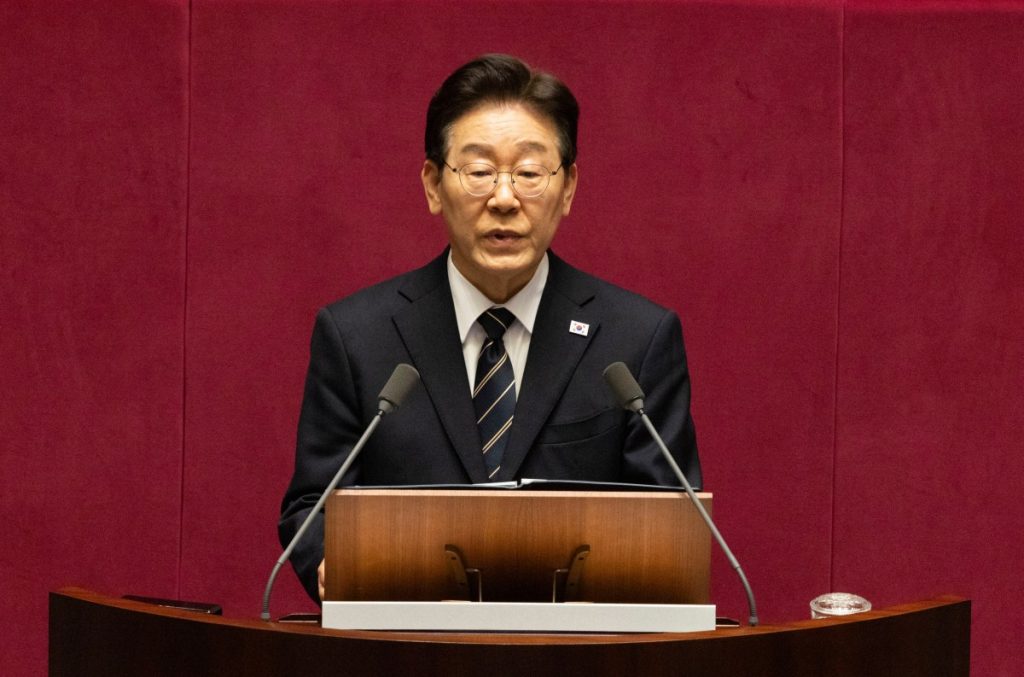
Lee made the remarks in his opening speech at a dinner meeting with Korean residents in India at a hotel in New Delhi on Sunday, which came after his closed-door meeting with Indian External Affairs Minister S. Jaishankar.
Lee said he and Jaishankar “shared the view that cooperation between the Republic of Korea and India has remained stagnant for quite a long time and is not sufficiently satisfactory,” referring to discussions held before the event. The Republic of Korea is South Korea’s official name.
“Indian authorities also agree that, compared with India’s vast potential, the level of cooperation between Korea and India is considerably low,” Lee said.
“So there is a very high possibility that tomorrow’s summit will serve as an occasion for relations between Korea and India to develop on a completely different level from where they are now,” Lee added.
Lee noted that about 10,000 South Korean companies have entered Vietnam, whereas the figure for India stands at only around 600 to 700. Lee added that the number of Koreans living in India is only about 12,000 — a very small presence compared with India’s population of 1.46 billion, the largest in the world.
“India is no longer simply a consumer market, but has now become a key country driving global production and supply chains. And it will continue to grow further,” Lee underscored.
Lee further underscored that the importance of the partnership between Seoul and New Delhi is growing amid the US-Israeli war on Iran, which has closed the Strait of Hormuz and disrupted energy supplies for both Seoul and New Delhi.
“Because supply chain instability and the global economic crisis are becoming a constant reality amid the fallout from the Middle East war, Korea and India will become each other’s most important strategic partners,” Lee said. “India, too, like Korea, depends heavily on overseas sources for raw materials and energy. In that sense, there will be considerable room for cooperation between Korea and India.”
According to Cheong Wa Dae, 61 percent of South Korea’s crude oil imports and 54 percent of its naphtha imports last year passed through the strait. India’s Ministry of Petroleum and Natural Gas said about 90 percent of LPG imports — supplying roughly 60 percent of domestic demand — transit the strait. Diversification efforts, however, have raised the share of crude imports arriving via routes outside Hormuz to 70 percent, from about 55 percent previously.
Lee repeatedly underlined that the current partnership between Seoul and New Delhi does not match India’s economic weight.
“India is the world’s fourth-largest economy and is expected to soon become the third-largest. Compared with that, the level of economic cooperation with the Republic of Korea is truly very low,” Lee said. “Going forward, we will expand that scope and make relations between the Republic of Korea and India completely different from what they are now.”
Lee also introduced the story of the first generation of Koreans in India — former prisoners of war who, following the 1950-53 Korean War, refused repatriation to either South or North Korea and instead chose to resettle in India, a third country.
Lee expressed “deep respect for the passion and dedication” of those first-generation Korean residents in India who overcame hardship and rebuilt their lives.
“The Korean community in India — where compatriots from both the South and the North live together — points to the future of peace and prosperity that we must build on the Korean Peninsula,” Lee said.
Lee’s remarks notably came hours after North Korea fired multiple short-range ballistic missiles toward the East Sea on Sunday, according to South Korea’s military.
Lee’s three-day state visit marks the first state visit to India by a South Korean president in eight years, since then-President Moon Jae-in’s trip in July 2018. Lee’s visit was arranged on the shortest notice after the launch of a new administration among all previous South Korean administrations.