
- BF-BOF route’s share in total steel industry emissions is 90%
- With methane emissions, steel’s intensity reaches over 3 tCO2/t
- 71% of BFs around the world face a relining decision by 2030
Morning Brief: The urgent actions needed to decarbonise the steel sector, responsible for 7% of global CO2 emissions and around 9% of GHG emissions, are largely focused on phasing out coal – still the mainstay of primary steel production. Globally, 70% of steel is new, primary steel produced from iron ore and coal in 400-odd facilities around the world.
Emissions profile
According to worldsteel, BF-BOF production accounted for 3.2 gigatonnes (Gt) CO2 in 2021, which is an estimated 86% of the entire steel sector’s annual GHG emissions. Producing one tonne of steel through the BF-BOF method requires 0.77 t of coal. A 2022 report by the IEA estimated that methane leakage from metallurgical coal mining is significant, estimated to represent 1 Gt CO2e per annum.
With methane emissions included, Steel Watch has estimated that steel production via the BF-BOF route emits 4.2 Gt of CO2e per year and 90% of emissions for the entire industry. The implication is a huge emissions intensity of over 3 t of CO2e per tonne of steel produced via the blast furnace route.
Future of coal
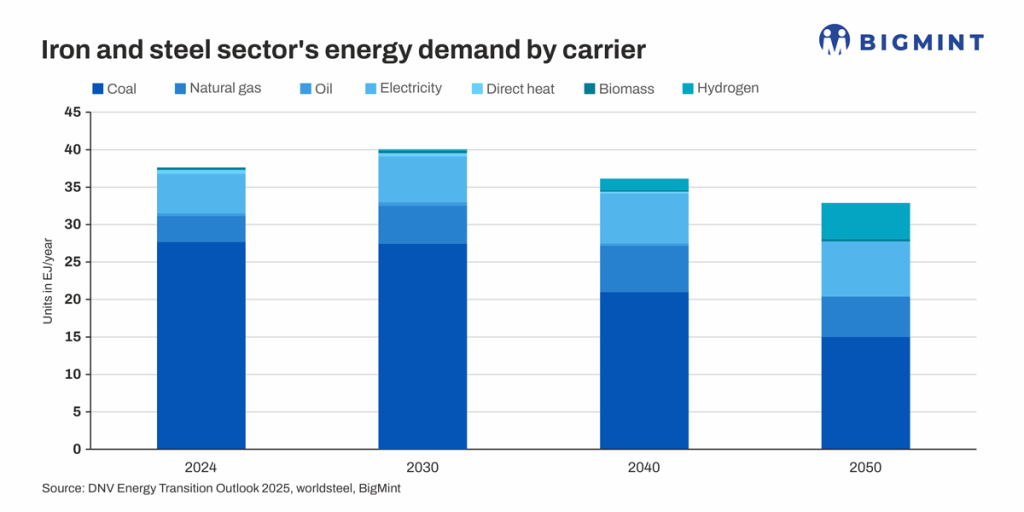
Studies have shown that the three hard-to-abate sectors, iron and steel, chemicals and cement, account for almost 60% of industrial energy demand. The iron and steel industry consumed 36 exajoules (Ej) of energy in 2024, which was 21% of total global industrial consumption. Coal’s share in final energy consumption was around 28 Ej – an exceptionally high level of 77.77%.
Research shows that coal demand, as a traditional provider of high temperature heat, will decline more slowly than in the global industrial sector than in other sectors. Coal will represent more than 15% of the sector’s energy use by 2050, despite a steady decline from the 2030’s.
According to projections, the steel sector, the largest single consumer of energy in manufacturing, will show a 22% decline in its reliance on fossil fuels between 2024 and 2050. Total energy consumption of the sector peaks before 2030 and then declines by about 15% by 2050 to 33 Ej. The share of electricity in the sector’s energy mix grows from 14% in 2024 to 23% in 2050. But this excludes coal used as feedstock. The share of fossil fuels declines from 84% to 62% by 2050, with share of coal declining from over 77% to 56% in 2050.
Future of steel
These projections clearly show that despite the rapid growth in EAF technology and secondary steel production, material as well as energy efficiency measures, the share of primary coal-based steel production will remain at around 50% by 2050 – the year most countries and companies intend to reach net-zero.
According to Steel Watch, to meet net-zero decarbonisation targets by 2030, 2040, and 2050, avoiding building new blast furnaces or relining existing ones is essential. There are 397 steel production facilities that rely on blast furnace production and over 1,000 blast furnaces in operation.
As per Steel Watch, “71% of global blast furnaces face a relining decision by 2030. If they are relined, at the cost of hundreds of millions of dollars each, this risks locking in high-emission technologies for another 20 years. The steel industry has over 125 new projects with one or more blast furnaces announced or under construction. These new facilities could have potential lifespans of 40-50 years, blowing past carbon neutrality in 2050.”
The key challenges that make the blast furnace still the preferred choice are:
- Cost and economic considerations – H2-based production is roughly 40-150% costlier compared to BF
- Unavailability of enough recycled steel – more and more countries are coming up with supply restrictions
- CCUS still not viable – no effective post-combustion technology to capture 90-95% of steel mill emissions; only one facility in the Middle East
- Geopolitical conflict reinforcing fossil fuel demand – even countries in the EU announcing re-opening of coal-based plants to beat energy volatility
- Steel quality and purity – auto and other critical downstream sectors still reliant on primary steel
How these challenges are addressed via technology and policy will determine how fast the global steel industry can minimise dependence on the BF route and, most importantly, coal.
