
Mung Bean Starch Market Size, Market Forecast and Outlook By FMI
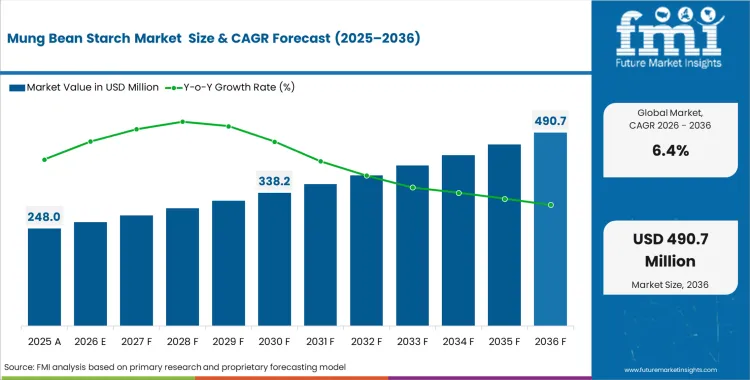
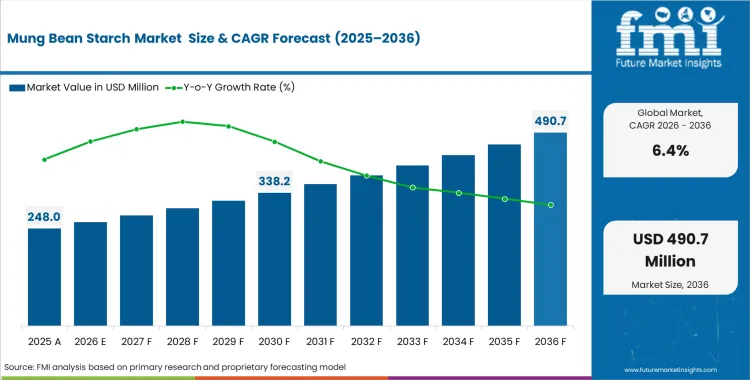
The mung bean starch market was valued at USD 233.0 million in 2025. Industry valuation is estimated to reach USD 248.0 million in 2026 and is projected to expand at a CAGR of 6.4% from 2026 to 2036. The market is expected to attain USD 463.0 million by 2036 as food manufacturers increase the use of high-amylose pulse starches in formulations that require thermal stability, texture control, and extended shelf life.
Summary of Mung Bean Starch Market
- The market is forecast to reach USD 463.0 million by 2036.
- The market is expected to grow at a CAGR of 6.4% from 2026 to 2036.
- The market was estimated at USD 233.0 million in 2025.
- The forecast period represents an incremental opportunity of USD 215.0 million.
- The market is a niche food ingredient segment where gel clarity, binding performance, and texture functionality are key differentiators.
- Growth is driven by strong demand in starch noodles, vermicelli, and texture-focused food applications.
- Clean-label and gluten-free product development is expanding adoption beyond traditional Asian markets.
- India, China, and Thailand are among the fastest-growing markets, with India leading at a 7.5% CAGR through 2036.
- Food-grade starch dominates the segment, while native starch remains the most widely used form.
- Noodles represent the leading application segment due to long-standing consumption patterns.
- Key players in the market include Sitthinan Company Limited, Harbin Hada Starch Co., Ltd., Castle Ingredients, Relsus Pte. Ltd., and Yantai Oriental Protein Tech Co., Ltd.
Food manufacturers are facing stronger pressure to replace chemically modified thickeners with native starches that can perform reliably under high-shear and retort-processing conditions. Delays in this shift can weaken clean-label positioning and make reformulation more difficult across packaged foods, noodles, sauces, and convenience meals. Purchasing decisions in this category are shaped by more than cost, since batch-to-batch gelatinization consistency has a direct effect on processing efficiency and finished-product texture. Pea starch remains relevant in selected formulations, while mung bean starch continues to hold a distinct role where translucent gels, process stability, and low flavor interference are required.
Supplier preference tends to strengthen once continuous-cooking and filling lines are calibrated around specific swelling, viscosity, and gel-strength characteristics. Production settings built around a proven starch profile make switching less attractive, especially where consistent line behavior matters more than short-term savings. Alternative bean ingredients may still enter formulation pipelines, yet substitution often remains measured when product uniformity and process continuity are closely monitored. Demand, in these applications, is therefore more likely to support longer supplier relationships where formulation precision carries greater weight than raw material flexibility.
India is projected to expand at a CAGR of 7.5% from 2026 to 2036, supported by rising snack processing capacity and broader growth in industrial food manufacturing. China is likely to register 6.8% over the same period, reflecting sustained use in noodle production and other starch-intensive food applications. Thailand is estimated to grow at a CAGR of 6.2% from 2026 to 2036, while Vietnam is projected to record 6.0% as vermicelli processing and starch-based food output continue to support demand. Indonesia is likely to witness 5.8% CAGR through 2036, backed by continued modernization across food manufacturing lines. United States is expected to advance at 5.2% from 2026 to 2036, while Germany is projected to grow at 4.9%. Country-level variation is being shaped by differences in processing requirements, formulation priorities, and clean-label positioning across food applications.
Segmental Analysis
Mung Bean Starch Market Analysis by Grade
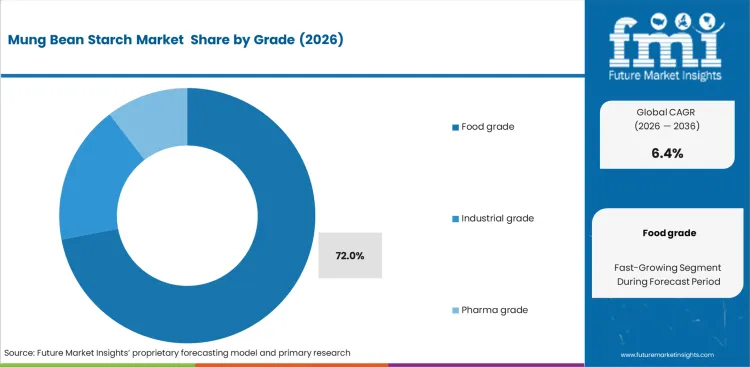
Food manufacturers continue to prefer ingredient systems that support performance without adding label complexity. Food-grade mung bean starch is estimated to account for 72.0% of market share in 2026, supported by its fit with mainstream food safety expectations and formulation requirements. Demand remains strong because processors require certified and consistent material that performs reliably in continuous cooking environments. Even limited variation in residual protein or fiber can influence gelatinization behavior and alter texture under industrial processing conditions. Greater emphasis on purity control is therefore shaping supplier preference, since lower-cost lots that fail during production can create losses that outweigh initial purchase savings.
- Yield Optimization: Extraction performance is more effectively assessed through the balance between conversion efficiency and final gel strength. Better process control is helping producers manage cost discipline without weakening functional output.
- Purity Validation: Residual protein and fiber levels require close review before material moves into production. Batch rejection can tighten supply availability and raise replacement costs when performance standards are not met.
- Lifecycle Calculation: Total cost is increasingly being evaluated through consistency during use rather than purchase price alone. More reliable vendor performance can improve uptime and support stronger cost visibility over time.
Mung Bean Starch Market Analysis by Application
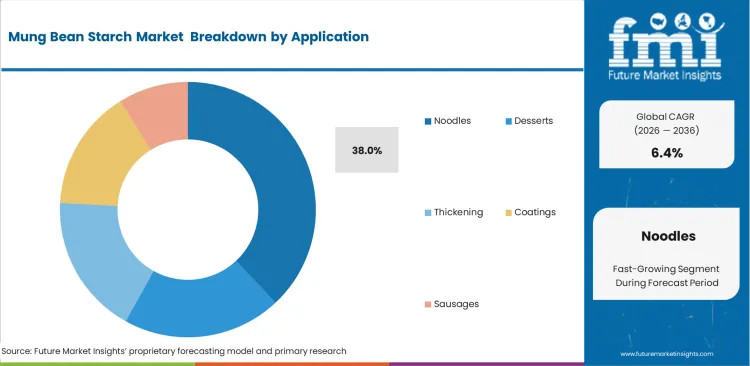
Application value is increasingly determined by how starch performs under live processing conditions rather than under simplified laboratory testing alone. Noodles are estimated to account for 38.0% of market share in 2026, supported by the ability of mung bean starch to deliver translucency, strand integrity, and boil stability across demanding production environments. Demand remains concentrated in this application because high-amylose functionality helps maintain product strength during cooking, cooling, and handling. Such performance is especially important in industrial vermicelli and noodle lines where clumping, breakage, and opacity can reduce finished-product consistency. Alternative legume and root starches may remain part of the formulation set, yet comparable texture and visual performance often require broader adjustment of both recipe design and line settings.
- Tensile Failure Prevention: Strand strength needs to remain stable through extrusion and pulling stages. Better rheology control is helping reduce line disruption and lower the risk of broken product.
- Clumping Mitigation: Finished strands are expected to stay separated after hydration and preparation. More stable starch performance can help reduce fused product risk and support better end-use consistency.
- Retrogradation Optimization: Cooling conditions continue to influence gel structure and final texture. Weak control at this stage can reduce usable output and raise material waste.
Mung Bean Starch Market Analysis by Form
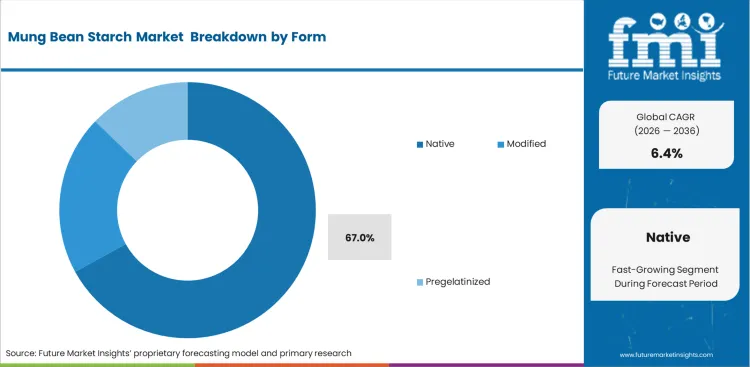
Format choice is influenced by process compatibility, labeling requirements, and hydration behavior under production conditions. Native starch is estimated to account for 67.0% of market share in 2026, supported by its suitability in food systems that require simpler ingredient declaration while maintaining dependable performance during controlled heating. Demand remains strong because formulators often prefer formats that align with clean-label expectations without creating avoidable processing trade-offs. Native material can also offer stable functionality in selected acidic and high-temperature applications where performance under live production conditions carries more weight than simplified comparison benchmarks.
Pregelatinized alternatives may improve instant solubility, yet they can introduce mixing and texture challenges when installed into lines designed around standard dispersion and heating sequences. Substitution decisions therefore require closer validation because mismatched format selection can affect flow behavior, nozzle performance, and cleaning frequency. Market preference, for this reason, continues to favor formats that balance label simplicity with process stability across commercial food manufacturing.
- Solubility Verification: Hydration behavior needs to be assessed across different process temperatures. Better format alignment is likely to improve line stability and support greater operating flexibility.
- Viscosity Validation: Thickness performance under retort and sterilization conditions requires confirmation before scale-up. Weak stability at this stage can increase reformulation needs and slow commercial rollout.
- Declaration Compliance: Cleaner ingredient statements remain commercially relevant in retail food positioning. Native starch supports this requirement while still offering acceptable functional performance in many applications.
Mung Bean Starch Market Analysis by Source
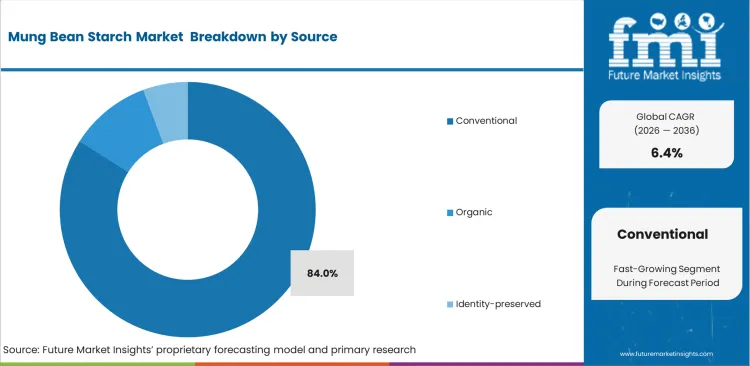
Source economics in this market continue to be shaped by raw material availability and the operating realities of industrial wet milling. Conventional source is estimated to account for 84.0% of market share in 2026, supported by the need for steady feedstock flow at volumes that specialized cultivation systems do not yet supply consistently at scale. Its position reflects the importance of uninterrupted harvest aggregation and processing continuity rather than a simple preference for lower-specification material. Supply planning becomes more complex when buyers seek identity-preserved volumes without dedicated farming structures, especially where certification and downstream traceability need to be maintained across larger sourcing networks. At industrial scale, even limited batch inconsistency can affect certification handling and create disruption in traceability workflows.
- Agricultural Aggregation: Industrial processors depend on broad farm collection networks to secure sufficient tonnage. Early volume contracting is likely to improve supply visibility and reduce exposure to spot-market volatility.
- Contamination Mitigation: Incoming raw material still requires close residue screening before milling. Non-compliant lots can disrupt operations and raise replacement costs when quality standards are not met.
- Traceability Implementation: Origin mapping becomes more difficult as sourcing expands across multiple farming groups. Processors are increasingly required to balance transparency goals with the practical limits of commodity-scale procurement.
Mung Bean Starch Market Analysis by Distribution
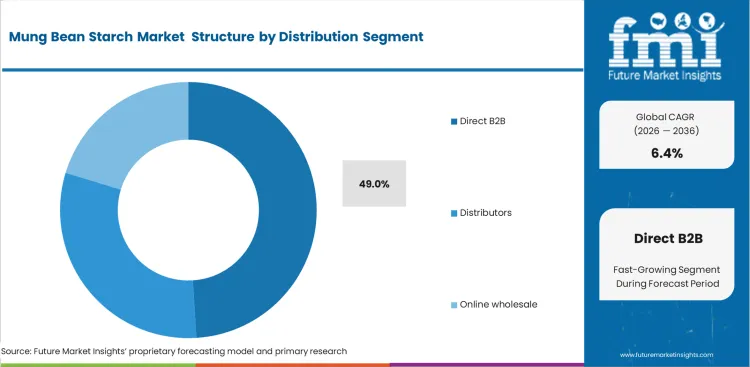
Distribution strategy in this market is shaped by whether buyers place greater value on direct technical coordination or broader channel flexibility. Direct B2B is estimated to account for 49.0% of market share in 2026, supported by rising preference among large processors for closer alignment with manufacturers on extraction timing, product specifications, and inventory planning. Direct sourcing can also provide better visibility into viscosity control and batch consistency than less specialized wholesale routes. Its commercial appeal, however, comes with greater responsibility for storage planning, minimum-order management, and stock handling at the buyer level. Where inventory discipline is weaker, some of these advantages can be reduced by higher holding cost, humidity-control needs, and lower responsiveness when demand changes.
- Direct Integration: Closer manufacturer linkage is improving allocation visibility and planning reliability. This becomes more important in periods when harvest conditions are less stable.
- Wholesale Buffering: Distributors can still play a useful role by absorbing short-term supply variation and reducing immediate inventory pressure. Such support remains relevant where production volumes shift frequently.
- Digital Consolidation: Online B2B platforms are improving price visibility, yet supplier screening remains important. Weak vendor control can raise quality inconsistency and adulteration risk in more tightly regulated supply chains.
Mung Bean Starch Market Drivers, Restraints, and Opportunities
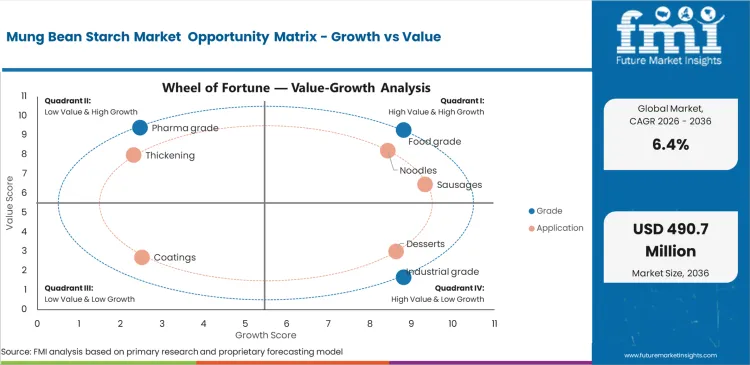
Clean-label requirements are encouraging food manufacturers to reduce the use of chemically modified texturizers in retail products. Demand for replacement ingredients is rising in applications that need reliable performance under high-temperature processing without making the label more complex. In this setting, food starch selection depends on more than simple ingredient substitution. Processors also need steady viscosity, texture retention, and smooth performance on commercial production lines. Vigna radiata extracts continue to draw attention where native functionality, high-amylose behavior, and heat stability are important. Interest is also increasing as manufacturers look for dependable wet milling capacity and consistent bean flour supply for both traditional Asian noodle products and newer plant-based foods.
Raw material variability still limits broader industrial adoption. Changes in agricultural yield can affect supply visibility, which makes large-scale reformulation more difficult for manufacturers trying to protect production stability. For that reason, some producers continue to use modified starches in higher-volume lines while introducing mung bean food starch more selectively in premium or clearly defined products. Wider farming networks and added milling capacity can improve supply balance over time, though expansion at commercial scale still takes time. Broader use is likely to build gradually as supply reliability improves.
Opportunities in the Mung Bean Starch Market
- Plant-based Structural Formulation: High-amylose gelling behavior is supporting use in plant-based products that need firmer structure and better mouthfeel. Demand here is likely to rise as formulators look for food starch options that perform well in texture-focused vegan applications.
- Gluten-free Baking Expansion: Native extracts are gaining attention in gluten-free baking, where dough handling and final texture often remain difficult to manage with standard flour systems alone. Better functional balance can help reduce crumbly texture in selected food starch applications.
- Clean-label Thermal Processing: Natural heat stability is supporting wider use in soups, noodles, and other thermally processed foods. Interest is growing where food starch performance needs to hold through sterilization or retort conditions without chemical modification.
Regional Analysis
Based on regional analysis, mung bean starch market is segmented into India, China, Thailand, Vietnam, Indonesia, United States, and Germany across 40 plus countries.
.webp "Top Country Growth Comparison Mung Bean Starch Market Cagr (2026 2036)")
| Country | CAGR (2026 to 2036) |
|---|---|
| India | 7.5% |
| China | 6.8% |
| Thailand | 6.2% |
| Vietnam | 6.0% |
| Indonesia | 5.8% |
| United States | 5.2% |
| Germany | 4.9% |
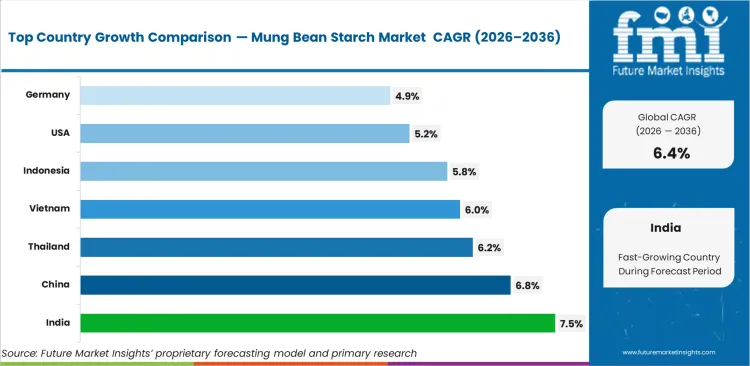
Source: Future Market Insights (FMI) analysis, based on proprietary forecasting model and primary research
Asia Pacific Mung Bean Starch Market Analysis
Asian snack and noodle manufacturing continues to shape demand for mung bean starch across core processing hubs. Native pulse starch remains closely tied to texture control, clarity retention, and formulation stability in region-specific food applications. Established wet milling clusters support this demand by supplying consistent starch quality suited to extrusion, vermicelli, and dessert processing. Production economics also remain favorable where starch extraction and downstream food manufacturing operate in close proximity, reducing handling inefficiencies and improving supply continuity.
- India: Demand for mung bean starch in India is projected to expand at a CAGR of 7.5% from 2026 to 2036. Extruded snack manufacturers are estimated to be upgrading older processing lines to handle high-shear pulse-based formulations more efficiently. Domestic starch use is also likely to benefit from efforts to reduce dependence on imported binders. Cost control and formulation flexibility continue to support wider uptake across snack processing.
- China: Mung bean starch demand in China is expected to rise at a CAGR of 6.8% during 2026 to 2036. Noodle and vermicelli manufacturers are estimated to require tight control over retrogradation behavior and batch consistency to keep automated lines stable. Strong domestic processing capacity is likely to support large-volume supply across both food manufacturing and export-oriented production. Scale advantages continue to reinforce China’s position in starch-intensive applications.
- Thailand: Sales of mung bean starch in Thailand are forecast to grow at a CAGR of 6.2% over the 2026 to 2036 period. Vermicelli processing is estimated to sustain demand for high-amylose starch grades that help maintain transparency and texture during boiling. Preference for cleaner formulations is also likely to support continued use in export-aligned food production. Application fit remains a key factor behind stable market expansion.
- Vietnam: Vietnam is likely to record a CAGR of 6.0% in mung bean starch demand between 2026 and 2036. Food processors are estimated to incorporate mung bean starch into dessert and convenience food formulations where texture stability during chilled storage remains important. Functional performance in moisture management and consistency retention is expected to support broader use across packaged food formats. Reliable regional sourcing also strengthens the market’s commercial foundation.
- Indonesia: Mung bean starch demand in Indonesia is projected to register a CAGR of 5.8% from 2026 to 2036. Food manufacturing upgrades are estimated to be increasing the need for functional texturizers across newer product lines. Standardized hydration and processing control are also likely to improve starch performance in scaled production environments. Demand growth remains tied to modernization in mainstream food processing rather than short-term substitution trends.
North America Mung Bean Starch Market Analysis
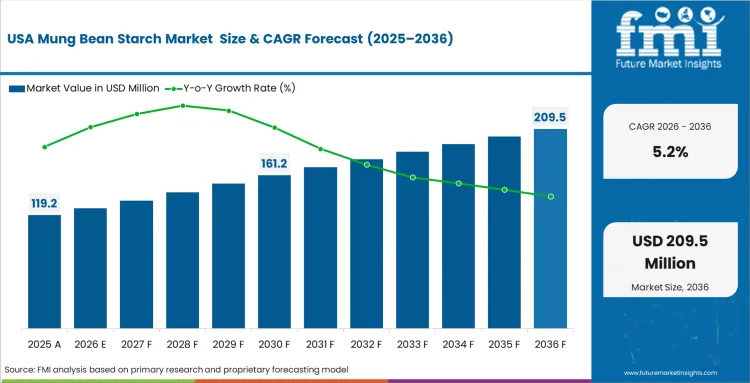
Clean-label product development continues to influence ingredient selection across North American food manufacturing. Mung bean starch is increasingly evaluated for gluten-free and texture-sensitive applications where functional performance extends beyond basic thickening needs. Limited domestic wet milling focus on pulse derivatives is estimated to keep supply relatively constrained, especially when compared with corn and wheat processing capacity. Demand for modified starch alternatives and refined pulse ingredients is therefore likely to remain closely tied to premium formulation requirements in specialty food categories.
- United States: Sales of mung bean starch in the United States are projected to expand at a CAGR of 5.2% from 2026 to 2036. Specialty food manufacturers are estimated to use their gelling and textural properties in plant-based and clean-label formulations where bite, stability, and additive reduction remain important. Dependence on imported refined pulse derivatives is also likely to persist where modified starch options do not fully meet premium texture targets. Functional differentiation in gluten-free and alternative protein applications continues to support market growth.
Europe Mung Bean Starch Market Analysis
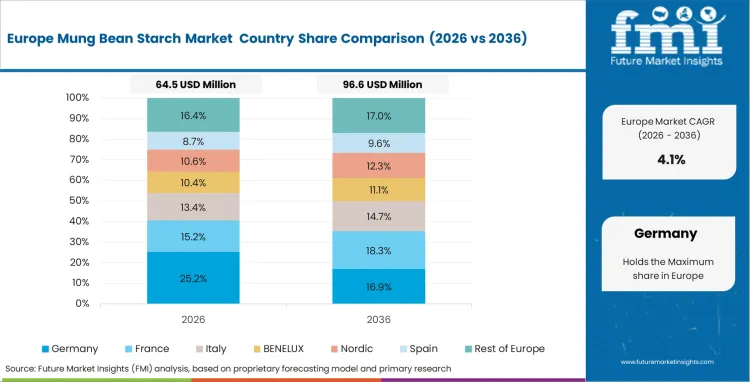
Regulatory scrutiny around food-grade texturizers continues to shape ingredient selection across Europe. Mung bean starch is increasingly assessed in applications where thermal stability, label clarity, and functional consistency remain commercially important. Limited regional pulse wet milling capacity is estimated to keep supply relatively dependent on imports, especially in categories requiring reliable performance at scale. Demand for clean-label ingredients is therefore likely to remain closely linked to supply discipline and formulation precision across European food manufacturing.
- Germany: Demand for mung bean starch in Germany is projected to rise at a CAGR of 4.9% from 2026 to 2036. Canned and processed food manufacturers are estimated to value their thermal stability in applications exposed to retort and high-pressure processing conditions. Use of imported pulse-derived starch is also likely to remain important where consistency and viscosity control carry greater weight in finished product performance. Commercial adoption continues to reflect the need for stable formulation outcomes in tightly specified food processing environments.
Latin America and the Middle East are also likely to present selective growth opportunities were supply resilience and ingredient consistency matter more in processed food applications. Demand in these secondary markets is estimated to strengthen gradually as manufacturers place greater emphasis on dependable sourcing under variable agricultural and trade conditions. Market traction in these regions remains tied to practical formulation needs rather than broad-based substitution.
Competitive Aligners for Market Players
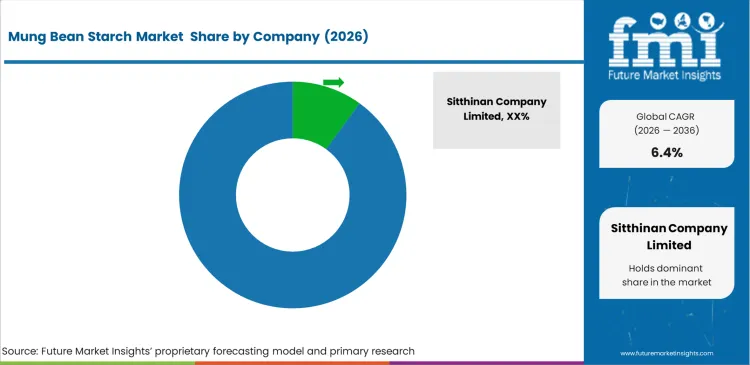
Competitive positioning in mung bean starch remains closely tied to wet milling efficiency, yield control, and batch consistency rather than branding strength alone. Scale matters because high-volume food applications require stable amylose content, predictable gelatinization behavior, and reliable viscosity performance across production cycles. Suppliers with integrated extraction and raw material access are estimated to hold an advantage in serving industrial food manufacturers that prioritize uniform output over narrow product differentiation. Market structure therefore continues to favor processors able to combine operational efficiency with dependable starch functionality.
Long-established processors are likely to retain a structural advantage through accumulated process knowledge in separation efficiency, water use control, and purity management. New entrants may still find selective opportunities, though commercial expansion is expected to remain constrained by capital intensity, raw material integration requirements, and the need for repeatable food-grade performance at scale. Organic and identity-preserved positioning can support niche participation, yet mainstream demand is estimated to remain concentrated in high-volume applications such as noodles, starch blends, and other texture-driven food formats. Competitive depth in this market is shaped more by processing discipline than by narrow specialty claims.
Buyer preferences are also likely to support multi-source qualification strategies where supply continuity carries strategic value. Supplier evaluation increasingly centers on technical consistency, response speed, and the ability to maintain stable product performance across changing crop conditions and sourcing cycles. Regional diversification in raw material and extraction capacity is therefore estimated to remain relevant, especially where harvest variability can affect supply reliability. Longer-term commercial strength is expected to stay with suppliers that support customer operations through consistent output and practical application reliability.
Key Players in Mung Bean Starch Market
- Sitthinan Company Limited
- Harbin Hada Starch Co., Ltd.
- Castle Ingredients
- Relsus Pte. Ltd.
- Yantai Oriental Protein Tech Co., Ltd.
Scope of the Report
| Metric | Value |
|---|---|
| Quantitative Units | USD 248.0 million to USD 463.0 million, at a CAGR of 6.40% |
| Market Definition | Refined carbohydrate fractions extracted from Vigna radiata provide unique functional texturization properties. Wet milling isolates high-amylose structures that deliver exceptional film-forming capabilities, thermal stability, and transparent gelling essential for specific culinary and industrial applications. |
| Segmentation | Grade, Application, Form, Source, Distribution |
| Regions Covered | North America, Latin America, Europe, Asia Pacific, Middle East and Africa |
| Countries Covered | India, China, Thailand, Vietnam, Indonesia, United States, Germany |
| Key Companies Profiled | Sitthinan Company Limited, Harbin Hada Starch Co., Ltd., Castle Ingredients, Relsus Pte. Ltd., Yantai Oriental Protein Tech Co., Ltd. |
| Forecast Period | 2026 to 2036 |
| Approach | Global commercial noodle production volumes cross-referenced against historical pulse extract inclusion rates. |
Source: Future Market Insights (FMI) analysis, based on proprietary forecasting model and primary research
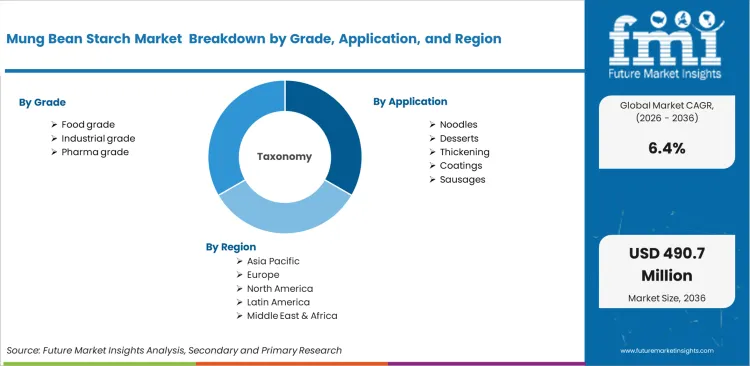
Mung Bean Starch Market Analysis by Segments
Grade
- Food grade
- Industrial grade
- Pharma grade
Application
- Noodles
- Desserts
- Thickening
- Coatings
- Sausages
Form
- Native
- Modified
- Pregelatinized
Source
- Conventional
- Organic
- Identity-preserved
Distribution
- Direct B2B
- Distributors
- Online wholesale
Region:
- North America
- Europe
- Germany
- United Kingdom
- France
- Italy
- Spain
- Asia Pacific
- China
- Japan
- South Korea
- Taiwan
- Singapore
- Latin America
- Middle East & Africa
- GCC Countries
- South Africa
Bibliography
- Food and Agriculture Organization of the United Nations. (2025). Agricultural production statistics 2010–2024.
- U.S. Department of Agriculture, Economic Research Service. (2024). Vegetables and Pulses Outlook: December 2024 (VGS-374).
- Tarahi, M., Ahmadi Partovi, G., & Hedayati, S. (2025). Mung bean as an emerging source of starch: A review on its isolation, structure, functionality, modification, and application. Food Chemistry, 497, 147033.
- Umnajkitikorn, K., Boonchuen, P., Senavongse, R., Tongta, S., Tian, Y., Hu, Y., Petersen, B. L., & Blennow, A. (2024). Transcriptomics and starch biosynthesis analysis in leaves and developing seeds of mung bean provide a basis for genetic engineering of starch composition and seed quality. Frontiers in Plant Science, 15, 1332150.
- Sharma, M., Bains, A., Dhull, S. B., Chawla, P., Goksen, G., Ali, N., & Singh, A. (2024). Extraction, characterization, and utilization of mung bean starch as an edible coating material for papaya fruit shelf-life enhancement. Food Science & Nutrition, 12(7), 5188–5200.
- Huang, Z., Li, Y., Guo, T., Xu, L., Yuan, J., Li, Z., & Yi, C. (2024). The physicochemical properties and structure of mung bean starch fermented by Lactobacillus plantarum. Foods, 13(21), 3409.
This bibliography is provided for reader reference. The full FMI report contains the complete reference list with primary source documentation.
This Report Addresses
- Specific gelatinization viscosity requirements demanded by commercial vermicelli manufacturers.
- Yield optimization challenges facing primary wet milling extraction facilities in Asia.
- Regulatory compliance strategies for replacing chemically modified thickeners with native variants.
- Sourcing vulnerabilities linked directly to seasonal Vigna radiata agricultural output fluctuations.
- High-shear resistance parameters essential for continuous retort processing applications.
- Vendor qualification protocols utilized by multinational food processors to ensure purity.
- Margin destruction risks associated with over-formulating inferior carbohydrate fractions.
- Supply chain tracking mechanisms necessary for identity-preserved organic ingredient certification.
Frequently Asked Questions
What is mung bean starch used for?
R&D chefs utilize exceptional gelling properties constructing fibrous textures mimicking animal muscle, thickening soups, and forming high-tensile transparent vermicelli noodles in commercial food processing.
How big is the mung bean starch market?
Revenues reached USD 233.0 million in 2025. This establishes a baseline supported primarily by continuous high-volume purchasing from commercial noodle manufacturing conglomerates across Asia.
Why is mung bean starch used in noodles?
Extrusion lines require specific retrogradation behaviors preventing vermicelli strands from fusing together. Vigna radiata extracts uniquely provide exact tensile strength and transparency requirements.
What drives growth in the mung bean starch market?
Clean-label regulatory pressures force formulation scientists abandoning synthetic thickeners. This mandate accelerates adoption of native high-amylose alternatives surviving severe thermal processing environments.
Who are the leading mung bean starch manufacturers?
Major industrial extraction operators include Sitthinan Company Limited, and Harbin Hada Starch Co., Ltd. dominating global agricultural processing hubs.
Is mung bean starch a clean-label ingredient?
Yes, native unmodified formats bypass complex chemical modification declarations. Formulators deploy unmodified powders satisfying consumer perceptions while maintaining essential production line viscosity.
How does mung bean starch compare with tapioca starch?
Evaluating mung bean starch vs tapioca starch reveals tapioca variants lack necessary high-amylose architecture, causing immediate product dissolution under high-shear stress, whereas mung bean variants maintain integrity during retort processing.
Which countries are growing fastest in mung bean starch demand?
India leads at 7.5% CAGR as domestic snack manufacturers aggressively scale high-shear extrusion capabilities, while China follows closely at 6.8% driven by industrial noodle production volumes.
How does mung bean starch vs corn starch perform in industrial settings?
Comparing mung bean starch vs corn starch indicates corn derivatives often turn opaque and mask delicate flavors upon cooling, whereas Vigna radiata extracts deliver consistently translucent gels essential for premium Asian culinary applications.
Why does Food grade dominate overall processing volume?
Strict regulatory compliance requires processors utilizing materials cleared for human consumption. Quality assurance teams reject industrial grades immediately due to severe cross-contamination risks during secondary manufacturing.
What specific friction slows organic adoption compared to Conventional?
Identity-preserved tracking networks collapse easily at industrial scales. Continuous operations cannot risk reliance on volatile organic yields, defaulting instead to massive conventional agricultural sources.
How does Direct B2B maintain its leading distribution position?
Multinational food processors link ERP systems directly to milling output schedules. Bypassing distributors allows processing plants to dictate custom specifications and guarantee supply during low-yield seasons.
How does China’s trajectory differ from Western regions?
Chinese buyers optimize for functional performance in traditional high-volume applications like pasta and noodles. Western buyers utilize extract primarily for specialized gluten-free and vegan formulations.
What operational barrier protects incumbent wet milling operators?
Decades of proprietary optimization in water-recycling and protein-fraction separation create massive efficiency gaps. Startups cannot replicate precise extraction yields without incurring crippling capital expenditures.
How do large buyers resist supplier pricing leverage?
Quality assurance directors actively validate multiple sources across different geographic zones. Approving both Thai and Chinese facilities ensures factories maintain continuous production even if localized weather destroys regional harvests.
Why do plant-based meat manufacturers value specific extracts?
Plant-based eggs and meat alternatives require firm bite resistance impossible achieving with standard rice flours. Mung bean derivatives deliver the exact cross-linking texture required for authentic mouthfeel.
How does acid hydrolysis impact ingredient selection?
Pasteurization processes destroy weak carbohydrate structures rapidly. Process engineers specify native Vigna radiata powders resisting degradation under extreme pH and temperature gradients.
What role does syneresis resistance play in frozen foods?
Prolonged cold storage forces water out of weak gel networks, destroying product texture. Formulation directors select pulse extracts specifically preventing moisture migration during extended freezing cycles.
Why do quality control managers test residual protein?
Imperfect wet milling leaves protein fractions altering gelatinization temperatures unpredictably. Companies face serious line stoppages if viscous gels form prematurely inside heating jackets.
How do retail shelf-life mandates influence purchase?
Supermarkets demand products capable of extended ambient storage without breakdown. Purchasing teams secure highly stable extracts satisfying strict retailer longevity requirements.
What tension exists within supply chain management?
Operations directors demand absolute inventory reliability while maintenance officers push for identity-preserved sourcing. Balancing massive volume requirements against ethical farming mandates creates severe logistical friction.
Why is precise swelling volume critical for automation?
Continuous-cooking equipment operates on rigid tooling parameters. If hydrated powder expands unpredictably, liquid dispersal nozzles block immediately, requiring expensive manual cleaning interventions.
How does extraction processes differ from standard pulse milling?
Crude milling produces coarse flours retaining hull and fiber components. Functional isolation requires complex wet milling separating pure high-amylose carbohydrate structures suitable for transparent gelling.
What immediate consequence faces buyers delaying clean-label transitions?
Regulatory bodies increasingly ban specific chemical modifiers. Companies failing to secure native botanical texturizers face imminent product recalls and total removal from major supermarket supply chains.
How are vegan formulation requirements reshaping sourcing?
Developers creating an egg substitute require binders with exceptional film-forming capabilities. Pulse extracts are being aggressively sourced as replacements for traditional animal-derived binding agents.
What long-term capability defines competitive dominance by 2036?
Processors integrating predictive agricultural data directly into client supply chains capture premium contracts. Anticipating harvest yields allows grains pulses and legumes buyers stabilizing pricing before spot-market shortages occur.