
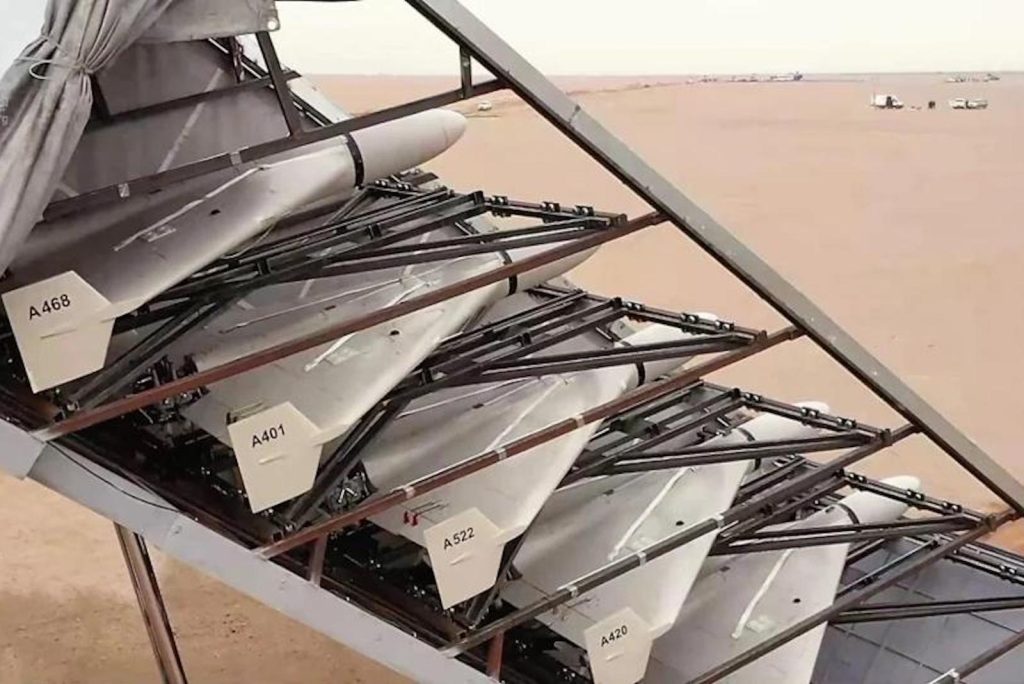
In the opening months of 2026, a fierce, 40-day conflagration between Iran, the United States and Israel upended decades of received wisdom regarding military power. The conflict did not hinge on the stealth of an F-35 fighter or the sophistication of an Aegis radar array.
Instead, it was defined by the relentless hum of cheap Iranian drones and the parabolic arcs of mass-produced ballistic missiles. A peer competitor’s breakthrough science did not shatter the so-called iron dome of Western technological supremacy; it was overwhelmed by arithmetic. In the sobering aftermath, defense analysts have begun applying a familiar, if painful, nomenclature to this upheaval: the “Third China Shock.”
The first shock saw China’s industrial leviathan hollow out America’s manufacturing heartland, trading durable, low-cost goods for American jobs. The second shock demonstrated that Chinese efficiency applied not only to toys and textiles but to the essential sinews of a modern economy — 5G infrastructure, industrial semiconductors and electric vehicles, all produced at a fraction of Western cost.
Now, the third shock has breached the citadel of defense. While the immediate protagonist was Iran, the strategic doctrine of overwhelming an adversary with cheap, expendable and scalable hardware is a Chinese export.
This is the new, unforgiving arithmetic of defense economics. It signals a reality that Washington’s strategists have been loath to admit: the American way of war, predicated on exquisite but exorbitant platforms, is no longer fiscally sustainable against a coalition of thrifty adversaries. The reasons are structural, deeply embedded and sixfold.
1. Wage asymmetry
The most unyielding factor in the cost of any weapons system is the hourly rate of the hands that build it. American defense manufacturing, while highly automated in parts, remains tethered to a labor market where industrial wages routinely exceed US$30 per hour, culminating in monthly pay packets north of $5,000.
Contrast this with the payrolls of the adversarial axis: Russian workers earn roughly $900 to $1,100 monthly; their Chinese counterparts hover between $830 and $1,225; and Iranian labor costs bottom out between $200 and $600. This is not a marginal gap; it is a chasm.
It means that an Iranian Shahed-136 drone—a crude but effective munition costing perhaps $20,000—can be countered only by a Patriot interceptor costing several million dollars. The exchange ratio is ruinous.
The US is effectively fielding a bespoke, artisanal arsenal against adversaries wielding the military equivalent of fast fashion. No amount of qualitative superiority can indefinitely absorb a wage differential of 12-to-1.
Table 1: Wage differential among four countries
| Country | Monthly Wage (USD) | Hourly Wage (USD) | Year | Main Source |
| USA | Approximately 5,000 – 6,300 | Approximately 29.95 (production) 36.59 (all manufacturing employees) | March 2026 | U.S. Bureau of Labor Statistics (BLS) / FRED |
| Russia | Approximately 900 – 1,100 | Approximately 5 – 6.5 | January 2026 | Rosstat via Trading Economics |
| China | Approximately 830 – 870 (private sector), 1,225+ (public state sector) | Approximately 4 – 5 (private sector base) | 2024 annual | National Bureau of Statistics of China (NBS) |
| Iran | Approximately 200 – 600 | Approximately 1 – 3.5 | Recent estimates | Supreme Labor Council, Wage Indicator & reports |
2. The profit motive
In the US, defense is a marketplace. Firms like Lockheed Martin, RTX and Boeing are beholden to quarterly earnings calls and shareholder returns before they are beholden to the Pentagon’s readiness. This imperative to extract profit injects a systemic inflationary pressure into every bolt, line of code and engineering hour.
Conversely, the defense industrial bases of China, Russia and Iran function less as commercial enterprises and more as state-owned enterprises of utilities. Whether state-owned enterprises or directly managed by the military, their metric of success is output, not profit margin.
They are not burdened by the need to pad contracts with profit percentages that often rival the cost of the weapon itself. The result is a marketplace distortion where an American drone program, burdened by the invisible tax of corporate overhead and shareholder yield, produces a system that is functionally comparable to an Iranian equivalent but carries a price tag several orders of magnitude higher.
3. Innovation and R&D
There is a persistent, almost quaint, belief in the West that the private sector holds a monopoly on disruptive innovation. The reality of long-cycle weapons development tells a different story.
Private firms, governed by fiduciary duty, are rationally risk-averse. They excel at incrementally improving established platforms because that path guarantees the next contract.
But genuine, leap-ahead research—the kind that requires decades of patient capital with no promise of a dividend from each quarterly financial statement—is anathema to the corporate model.
In authoritarian or state-capitalist systems, the state acts as a patient, even indifferent, investor. It can pour resources into hypersonics, directed energy, or swarming algorithms for years without the tyrannical pressure of a stock ticker.
While America’s defense giants lobby to keep legacy aircraft production lines running, China’s state labs are refining the engineering economics of the next conflict. The practical reality of short-termism is mugging the textbook theory of democratic innovation in business management and economic science.
4. Uncertainty and risk
Innovation requires a tolerance for failure, yet the American acquisition system is uniquely allergic to it. When a private company commits capital to a new weapons concept, it does so under the shadow of a four-year political cycle and the whims of the appropriations process.
A change in congressional committee leadership or a bad headline in a watchdog report can terminate a project overnight, leaving sunk costs unrecovered. This uncertainty acts as a brake on ambition.
In Beijing, Moscow, or Tehran, the state’s monopoly on both demand and supply eliminates this variable. They know the factory will remain open and the funding will flow, regardless of the project’s early stumbles.
This certainty provides the psychological and financial space required to perfect a weapon like the Shahed—an imperfect, low-tech device that, through sheer confidence in production scale, became a strategic game-changer.
5. Distorted incentives of subsidies and delay
Washington attempts to compensate for its cost disadvantages by flooding the defense sector with subsidies. The annual defense budget, well north of $800 billion, is a staggering sum. Yet this very largesse creates a perverse ecosystem akin to a hospital patient on a permanent IV drip.
American defense contractors have learned that cost overruns and schedule delays are not punished; they are often rewarded with supplementary contracts.
The F-35 stealth fighter program is the enduring monument to this pathology: a marvel of engineering that consumed trillions of dollars and decades of delays precisely because the incentive structure encouraged complexity and longevity over speed and thrift.
In the state-driven economies of America’s rivals, such bureaucratic sandbagging is a luxury that does not exist. The state sets a cost target and a delivery date; the factory meets it, or the manager is replaced. It is a brutal, but undeniably efficient, model of procurement.
6. Policy instability
Finally, the US suffers from a self-inflicted wound: strategic attention deficit disorder. Every four to eight years, the ship of state tacks violently in a new direction. A Democratic administration’s emphasis on climate resilience and European alliances gives way to a Republican fixation on the Pacific and trade tariffs.
These oscillations are fatal to defense planning, which is measured in decades, not election cycles. Shipyards cannot plan for future carrier construction if the industrial base policy shifts with the political winds.
By contrast, the strategic continuity provided by the Chinese Communist Party, the Russian presidency or the Iranian clergy is a profound asset. They can set a course — say, for dominance in low-cost drone warfare — and hold it for a generation.
This allows for the accumulation of industrial expertise and the refinement of doctrine in ways that the American system, with its constant relitigation of first principles, cannot match.
New defense economics
The conflict of 2026 is not a fluke; it is a financial statement. It is exposing the folly of using a million-dollar guided missile to swat a $20,000 drone. The side that does not win wars of attrition with the most elegant engineering, but with the most durable supply chains.
As the Chinese strategist Sun Tzu observed millennia ago, mastery of war requires mastery of accounts. The US is currently attempting to wage modern warfare with the cost structure of a luxury boutique while its opponents operate vast discount warehouses.
The Third China Shock has arrived in the defense sector, rewriting the rules of military engagement. It is an economic reality from which no amount of carrier strike groups can shield the republic. The balance of power is shifting, and it is being measured not in megatons but in unit cost.
In terms of economic cost and efficiency, the US can no longer win a major war against China, Russia or Iran. America needs to understand this new reality. If it does not, it will pay a heavy economic and strategic price in future conflicts.
The Third China Shock is already reshaping the global balance of power. Cheap technology and large-scale production are challenging traditional military superiority. Unless America restructures its defense industry — moving away from short-term profit and towards sustainable, long-term production — this challenge will only intensify.
Ignoring this change is to court a greater security risk. The sooner America recognizes this reality, the better. The Third China Shock has already arrived, and it has changed the rules of the defense game for good.
This article was first published on Bhim Bhurtel’s Substack and is republished with permission. Become a subscriber to Bhim’s Substack here.