
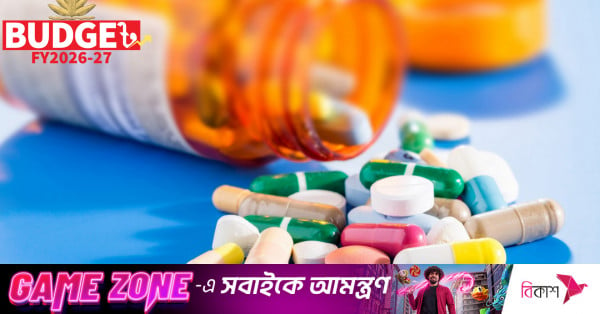
The government is set to propose significant tax concessions on the import of pharmaceutical raw materials in the FY2026-27 budget to enhance the export competitiveness of Bangladesh’s pharmaceutical industry.
The budget is also expected to include several measures aimed at reducing dialysis costs for kidney patients. In addition, VAT at the supply stage on cardiac stents and intraocular lenses may be withdrawn to reduce out-of-pocket healthcare expenses.
According to sources at the National Board of Revenue (NBR), the proposal includes adding 17 new basic raw materials to the existing concessionary import facility and reducing their import duty to zero. Stakeholders believe this will help Bangladeshi pharmaceutical products remain competitive in international markets.

To further strengthen the domestic pharmaceutical industry, the budget is also expected to propose zero-duty and zero-VAT treatment for the import of nine new raw materials used in the production of anti-cancer medicines.
At the same time, the government plans to fully exempt import duties on an additional 51 raw materials used in the production of Active Pharmaceutical Ingredients (APIs). The primary objective is to boost local API production and reduce dependence on imported pharmaceutical ingredients.
Dialysis costs may decline
To lower treatment expenses for kidney patients, the government is considering a proposal to completely withdraw the existing 15% value-added tax (VAT) and 5% advance income tax on imported dialysis filters.
According to NBR sources, if the proposal is implemented, the combined VAT, tax and duty concessions could reduce the cost of each dialysis session by up to Tk800.
The government is also considering a full exemption from the existing 7.5% advance tax imposed on imports of blood tubing sets used in haemodialysis treatment. This measure is expected to significantly reduce dialysis expenses for kidney patients.
Physicians estimate that around 3.8 crore people in Bangladesh suffer from some form of kidney disease. Each year, between 30,000 and 40,000 patients develop kidney failure and require dialysis or transplantation.
A study by the Bangladesh Institute of Development Studies (Bids) found that 92% of families with dialysis patients in Bangladesh face significant financial hardship in covering treatment costs.
VAT on cardiac stents and intraocular lenses may be withdrawn
To reduce high out-of-pocket healthcare expenditure in Bangladesh, the budget is expected to propose the complete withdrawal of the existing 10% VAT at the supply stage on cardiac stents and intraocular lenses.
According to NBR sources, if implemented, the measure could reduce the price of each cardiac stent by up to Tk20,000. Similarly, the price of each intraocular lens used in eye treatment could fall by approximately Tk5,000.
Duty concessions proposed on raw material imports for medical equipment industry
The upcoming budget is expected to propose duty concessions on raw material imports to support the development of Bangladesh’s medical equipment and components manufacturing industry.
According to sources at the National Board of Revenue (NBR), the proposal includes setting import duties at 15% on certain essential raw materials and 5% on several other raw materials used in the sector. The government is also considering extending the validity of the related notification until 30 June 2030.
Industry stakeholders say the country’s medical equipment industry is still in a developing stage. Duty concessions on raw material imports would help boost local production, reduce import dependence and potentially lower healthcare costs.
According to the Bangladesh Association for Medical Devices and Surgical Instruments Manufacturers and Exporters, the domestic market for medical devices is worth around Tk15,000 crore and is growing at an annual rate of 15%. About 90% of total demand – from syringes to imaging and surgical equipment – is currently met through imports.
Proposal to cut duty on mortuary imports to 1%
The FY2026-27 budget is also expected to propose a significant reduction in import duties on mortuary equipment used for preserving dead bodies.
NBR sources said the existing 25% import duty on mortuary equipment may be reduced to 1%.
Stakeholders noted that mortuary facilities are essential equipment for hospitals, medical colleges and other healthcare institutions. High import duties increase procurement costs and place additional pressure on the healthcare system.
If implemented, the proposal would make mortuary equipment more affordable, enhance hospitals’ capacity and improve the management of body preservation facilities.
The issue has gained attention recently after refrigeration units at the morgue of Dhaka Medical College Hospital became inoperative, resulting in the decomposition of around 20 bodies, including unidentified newborns, and causing foul odours.
Proposal to fully exempt duties, taxes on 21 assistive devices
The budget is expected to propose a complete exemption from all duties and taxes on the import of 21 categories of assistive devices used by persons with disabilities.
According to NBR sources, the proposal would fully exempt these special assistive devices from import duty, regulatory duty, supplementary duty and advance income tax.
Stakeholders believe the tax relief would improve mobility and independence for persons with disabilities, enhance their quality of life and reduce the financial burden on families and society.
Proposal to reduce duty on sewage treatment plants to 1%
The upcoming budget is also expected to include a proposal to reduce import duties on sewage treatment plants (STPs) to support modernisation of waste management systems in Dhaka, divisional cities and industrial facilities.
According to NBR sources, the current 5% import duty on STPs may be reduced to 1%.
Stakeholders say the proposed duty reduction would make it easier to establish wastewater treatment infrastructure and play an important role in implementing a circular economy model, particularly in industrial and urban waste management.