
image:
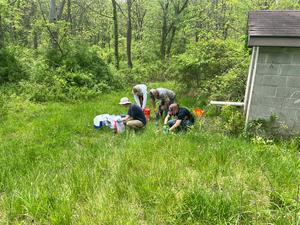
To collect samples, researchers from Penn State traveled to different locations around Washington and Greene Counties in Southwestern Pennsylvania.
Credit: Provided by Nathaniel Warner
UNIVERSITY PARK, Pa. — Pennsylvania ranks second in U.S. natural gas production, accounting for about one-fifth of U.S. output in 2024, and has one of the most extensive histories of energy extraction in the country. A team of researchers from Penn State is trying to better understand the environmental impacts of these sites — specifically, if fracking is increasing radium content in local drinking water.
According to a new study recently published in Environmental Science and Technology, the answer is not a simple yes or no. The team recorded higher salt concentrations in samples taken closer to energy extraction sites, indicating that natural gas drilling might contribute to elevated salinity in the ground, in turn releasing radium — a radioactive chemical — and other heavy metals trapped in the surrounding rock into drinking water.
The team connected with homeowners across Washington and Greene Counties in southwestern Pennsylvania to collect samples from 91 private water wells and springs, testing if nearby fracking-based oil and gas operations contributed to higher concentrations of radium in the groundwater. The team found elevated radium content was associated with some drilling operations, as well as higher salt concentrations in the water. However, the recorded upticks in salinity and radium could also be associated with a host of other environmental factors aside from energy extraction.
Radium can be found in the ground at very low concentrations everywhere in the environment, explained Nathaniel Warner, associate professor of environmental engineering at Penn State. However, drinking water with elevated radium levels can pose serious health problems, including an increased risk for cancer.
“Radium has a chemical makeup sort of similar to other metals like calcium, so it follows in the body where those chemicals naturally go,” Warner explained. “Your body says, ‘I need calcium for my bones, so I’m going to send some calcium there, along with some radium that I’m drinking.’ Over time, that radium will decay, releasing particles and energy that will damage your cells.”
Oil and gas drilling traditionally involves mining into oil or gas pools miles underground. However, as these wells have depleted over decades of use, unconventional oil and gas (UOG) drilling has emerged to access previously untapped fuel reserves. UOG uses a process known as fracking to extract fuel from the ground, shooting a high-pressure mixture of water, sand and chemicals to break apart rock horizontally from the initial borehole.
“The big difference is really the scale of the operation — the amount drilled and the amount of water used to frack and break apart the rock,” Warner explained. “In UOG, you’re drilling miles down, but then also drilling miles out horizontally. With that said, there are a lot of similarities in the impacts you might see associated with UOG and conventional operations.”
Previous research by another team at Penn State had associated elevated “hotspots” of salt content near UOGs, particularly in the Northern Appalachian Basin, stretching from Alabama to upstate New York. According to Warner, these areas of elevated salinity can carry up to 200% higher risk for radium-related health effects, because introducing salty chemicals can knock existing radium off surrounding rocks and into underground freshwater reservoirs.
However, little research had examined whether these drilling operations were specifically responsible for increased radium content in groundwater. Previous studies had focused on upticks in deep brine salts like sodium, chloride, barium and strontium in areas that had experienced oil or gas spills, but radium measurements were notably absent.
The team began by reaching out to homeowners living within different distances to UOG operations, specifically within about half a mile, just under two miles and slightly more than three miles. Embarking on several field campaigns to collect samples of drinking water from the homes, the researchers directly tapped into residents’ private wells before the water was exposed to any type of treatment system, such as faucet filters. Once the samples were collected, they returned to the lab and analyzed the samples’ radium and salt content.
Through this process, the team was able to do more than just take readings on the radium content of the water — they were able to pull broad insights about the homes’ water quality, which they shared back to the homeowners. Jennifer Baka, associate professor of geography at Penn State, explained how studies like this help not just researchers, but the local communities they’re conducted in.
“Communities want to know what is in their drinking water and whether it is safe to drink,” Baka said. “Over the course of years, we have established relationships with communities living in close proximity to UOG operations in order to gain their trust and help address their concerns.”
Of the 91 samples, six could potentially be associated with the presence of fracking wastewater, the researchers reported. This indicates that although the correlation is not broadly generalizable to all extraction operations, spills or other mismanagement could contribute to localized impacts. Samples taken from within three kilometers, or just under two miles, were more likely to exhibit elevated radium levels, although it was not significant enough to cite as a broad correlation. Additionally, all radium levels remained within the Environmental Protection Agency’s legal limits across the board.
Warner said that examining radium content in relation to UOG operations is one piece in a larger puzzle of understanding how residential and industrial development impacts the groundwater quality of an area.
“Radium levels tend to increase in areas with higher salinity, but that salinity can come from a host of other factors,” Warner said. “Road salt, nearby septic tanks, even animal waste can all contribute to increasing salinity in an area.”
According to Warner, more research will be critical to fully encapsulate the impacts UOG operations have on salinity in nearby groundwater, and in turn, radium content. In addition to continuing their radium work with larger samples and more targeted sampling near oil wells, the team said they want to expand their search to abandoned oil and gas wells across the region to see how historical natural gas drilling is impacting the community today.
Other co-authors affiliated with Penn State include Susan Brantley, Atherton Professor and Evan Pugh University Professor Emerita of Geosciences; Brandon Forsythe, assistant research professor of earth and mineral sciences; Lara Williams, a geosciences doctoral candidate; Allison Fenske, assistant professor of engineering at Juniata College, who earned her doctorate from Penn State; and Sam Shaheen, a postdoctoral fellow at the University of Minnesota, who earned his doctorate from Penn State.
Additional co-authors include Tao Wen, an assistant professor in the Department of Earth and Environmental Sciences at Syracuse University, and Jianfeng Su, an environmental and earth science doctoral candidate at Syracuse University.
The Health Effects Institute and the U.S. National Science Foundation supported this research under award number 1942601. The content is solely the responsibility of the authors and does not necessarily represent the official views of the funders.
At Penn State, researchers are solving real problems that impact the health, safety and quality of life of people across the commonwealth, the nation and around the world.
For decades, federal support for research has fueled innovation that makes our country safer, our industries more competitive and our economy stronger. Recent federal funding cuts threaten this progress.
Learn more about the implications of federal funding cuts to our future at Research or Regress.
Journal
Environmental Science & Technology
Method of Research
Observational study
Subject of Research
Not applicable
Article Title
Matrix-Derived Radium Mobilization in Shallow Aquifers Near Unconventional Oil and Gas Operations
Article Publication Date
20-Aug-2026