
When world leaders gathered at the United Nations in New York in March for the 70th session of the Commission on the Status of Women, the atmosphere was anything but routine. For the first time in 70 years, consensus broke down and member states had to vote on a declaration affirming women’s access to justice. Thirty-seven countries said yes. One said no.
Dr. Jemimah Njuki, the African Development Bank’s Director for Gender, Women and Civil Society, attended the session to make the case that on a continent where women make up half the population, they also face a $42 billion gap in access to finance. The debate is not abstract — it has a price tag. For the African Development Bank, the gathering was less about speeches and more about advancing partnerships and turning ideas into action — reinforcing priorities that were subsequently highlighted during the Bank’s 2026 Annual Meetings in Brazzaville, held under the theme “Mobilising Africa’s Development Financing at Scale in a Fragmented World.”
Across the Bank’s engagements in New York, one message remained consistent: investing in women delivers economic and social returns and is central to the Bank’s Ten-Year Strategy and its priorities, from expanding access to capital and harnessing Africa’s demographic potential to building climate-resilient economies.
“Investing in women is not just the right thing to do, it is the smart thing to do for Africa’s growth and resilience,” Njuki said.
The Bank’s collaboration with the African Women Leaders Network at the African Union’s Permanent Observer Mission to the United Nations was a key moment of the week. The conversation focused on the Bank’s upcoming Gender Action Plan (2027–2031), which aims to shift its gender work from individual projects to broader, systemic approaches. Once operational, the plan will guide the Bank in tackling the barriers women face across labour markets, infrastructure and economic policy.
The Gender Action Plan is being shaped by the people it aims to serve. The Commission on the Status of Women brought together African women leaders and partners to share priorities and feed them directly into the design process, reinforcing the need to move from dialogue to action. “The future of gender equality lies in moving from fragmented efforts to coordinated solutions that unlock opportunities at scale,” Njuki said.
The Bank advanced its partnership with UN Women, discussing ways to work together on capital mobilisation, infrastructure and support for countries affected by conflict. The goal is straightforward: make sure the Bank and UN Women are pulling in the same direction, so that financing and technical support reach the women who need them, rather than being absorbed by parallel processes.
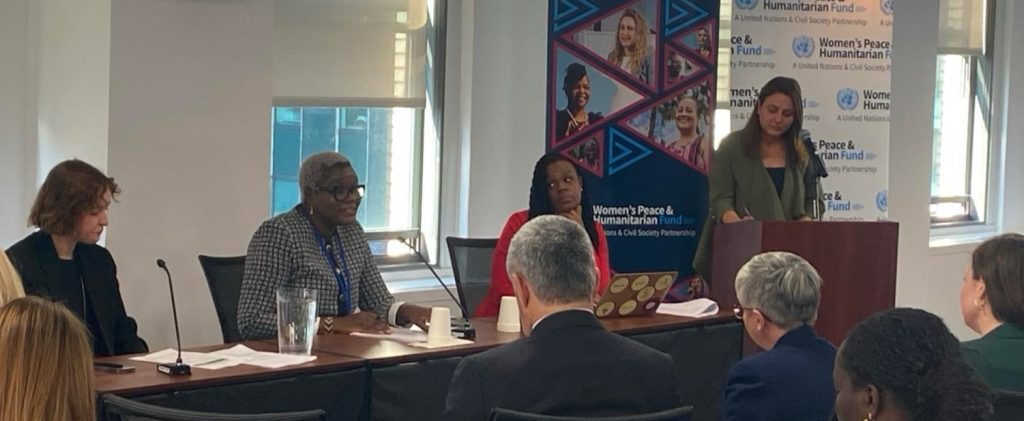
The Bank also joined a UN Women event focused on a practical challenge: how to get money to women’s organisations working in conflict zones and fragile states, where standard banking and lending simply do not reach. The discussion centred on the Women’s Peace and Humanitarian Fund and how its instruments could be better adapted to work at the grassroots level.
The Bank drew on its own experience, pointing to the Crisis Response for Women and Affected Communities in Sudan project, which has reached more than 95,000 women through cash support, livelihood assistance and access to essential services. The project links economic empowerment, protection and access to justice.
The Bank’s flagship initiative, Affirmative Finance Action for Women in Africa (AFAWA), was a recurring topic of conversation during the week-long conference in New York. AFAWA is designed to help close that $42 billion financing gap facing women-owned businesses and is central to the Bank’s goal of expanding access to capital across the continent. AFAWA is well on its way toward unlocking up to $5 billion by combining capital, policy reform, mentorship and skills development for Africa’s women entrepreneurs. To date, AFAWA has secured partnerships with more than 200 financial institutions and channelled more than $3.1 billion to women-led businesses, making it a tested model for how the Bank intends to scale capital flows.