
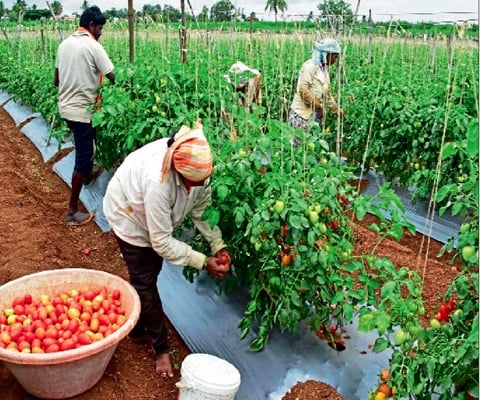
Under the visionary leadership of President John Dramani Mahama, Ghana is poised to transform its tomato industry through a groundbreaking Public-Private Partnership (PPP) agreement. The Ministry of Food and Agriculture has inked a pivotal deal with FarmMate Limited to produce an impressive 600,000 tonnes of tomato products annually. This ambitious initiative is strategically designed to propel Ghana towards self-sufficiency in tomato production and drastically reduce the country’s current $500 million annual expenditure on tomato imports.
Tomatoes are an essential staple in Ghanaian cuisine and a critical raw material for many food processing businesses. However, despite its importance, Ghana has historically relied heavily on imports to meet domestic demand. This reliance has not only drained valuable foreign exchange but also exposed the local market to price volatility and supply chain disruptions. The new PPP agreement reflects a clear policy shift toward strengthening local agriculture, fostering industrial growth, and enhancing food security.
The partnership with FarmMate Limited is particularly significant because FarmMate is a leading agribusiness player with extensive experience in modern farming techniques, supply chain management, and product processing. Leveraging its expertise, FarmMate has committed to scaling up tomato production on a massive scale, incorporating innovative farming practices including greenhouse technology, mechanised irrigation, and the use of improved tomato seed varieties to boost yield and quality. Such advances are expected to enhance productivity and reduce post-harvest losses.
The Minister of Food and Agriculture emphasised that this landmark agreement aligns perfectly with the Mahama-led government’s broader agenda to revamp the agriculture sector as a central engine of economic growth. By linking smallholder farmers with FarmMate’s processing facilities and providing them with access to quality inputs and training, the PPP will empower local farmers as key stakeholders in the value chain. This inclusive approach ensures that the benefits of increased production—and the resulting economic gains—are widely distributed among rural communities.
Importantly, the increase in local production will stimulate the downstream agro-processing industry, creating jobs not only in farming but also in processing, packaging, transportation, and marketing. It is estimated that generating 600,000 tonnes of tomato products annually could create thousands of direct and indirect employment opportunities, bolster rural incomes, and contribute significantly to poverty reduction efforts.
From an economic perspective, reducing Ghana’s import bills on tomato products will have a favourable impact on the country’s balance of payments. Currently, spending half a billion dollars yearly on imported tomato paste and related products diverts capital that could otherwise be invested in domestic agriculture and industrialisation. This PPP aims to retain more of this economic value within Ghana, promoting sustainable growth.
Moreover, by increasing the availability of quality, locally produced tomato products, the initiative will help stabilise domestic prices and improve food availability. Consumers are likely to enjoy fresher, healthier tomato-based products at more affordable prices, reducing vulnerability to international market shocks.
The partnership also sends a strong signal to other potential investors that Ghana’s agriculture sector is ripe for innovation and collaboration. It underscores the government’s commitment to creating an enabling environment where private enterprises can thrive alongside public institutions to achieve shared development goals.
In conclusion, the Ministry of Food and Agriculture’s PPP with FarmMate Limited represents a milestone in Ghana’s agricultural transformation. By producing 600,000 tonnes of tomato products annually, Ghana is set to make significant strides toward achieving tomato self-sufficiency, reducing import expenditures, creating jobs, and improving food security. Under President John Dramani Mahama’s leadership, this initiative exemplifies how strategic partnerships can harness local potential and drive sustainable economic development in Ghana.
Anthony Obeng Afrane