
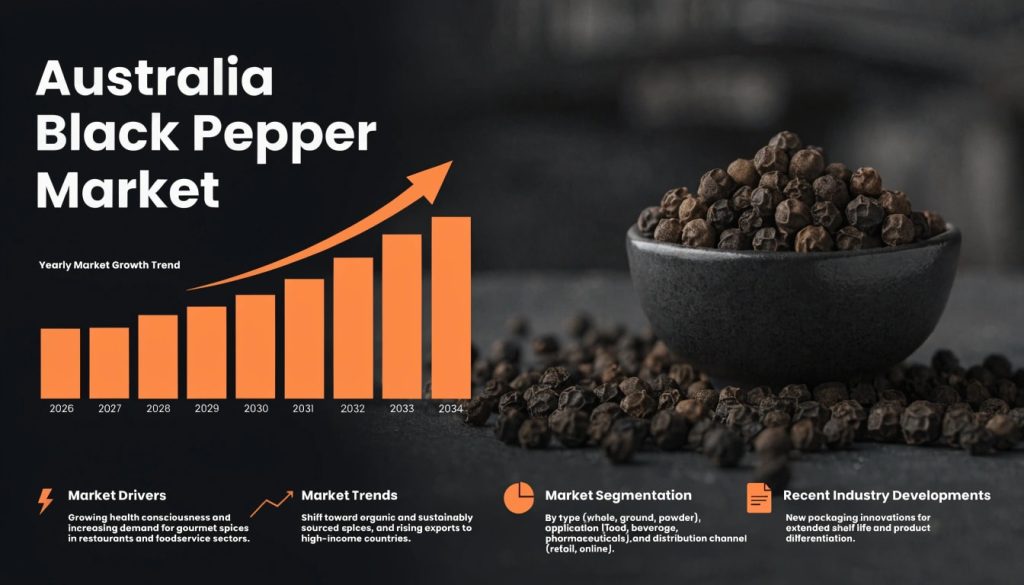
The Australia black pepper market is expanding steadily as households, food processors and health conscious consumers increasingly prioritise natural seasonings, authentic flavours and functional ingredient benefits. Black pepper — encompassing whole peppercorns, ground variants, organic offerings and specialty extracts — is deployed across residential kitchens, commercial food preparation, processed meat production and nutraceutical formulations to enhance taste profiles, support digestive health and amplify nutrient bioavailability. According to IMARC Group, the market size reached USD 72.80 Million in 2025 and is projected to reach USD 117.87 Million by 2034, exhibiting a compound annual growth rate (CAGR) of 5.50% during 2026–2034. As Australia’s spices and seasonings market reached approximately USD 570.6 Million in 2024 and consumers increasingly scrutinise ingredient provenance, black pepper — long dubbed the “King of Spices” — has solidified its position as an indispensable pantry staple across the continent.
What’s Driving Market Growth?
Rising Demand for Natural, Clean Label and Organic Spices. Australian consumers are becoming increasingly ingredient conscious, favouring spices free from artificial additives and synthetic processing aids. The national organic spices market reached USD 584.00 Million in 2025 and is projected to grow at a CAGR of 6.10% through 2034 — outpacing conventional spice growth. Consumers are seeking organic and clean label spice products driven by heightened awareness of food quality and sustainable sourcing practices, prompting retailers and brands to expand their organic black pepper offerings. Although inorganic sources lead the market with 71.2% share in 2025 due to cost effectiveness and commercial availability, organic variants are the fastest growing segment as health oriented consumers willingly pay premium prices for chemical free, sustainably sourced pepper.
Multicultural Culinary Landscape and Ethnic Cuisine Popularity. Australia’s expanding multicultural dining culture and rising preference for international cuisines are substantially boosting black pepper consumption. Consumers are increasingly seeking diverse and exotic flavours, driving a surge in the availability of specialty spice shops and online retailers. Black pepper remains an essential seasoning ingredient across the meat processing sector, ready to eat meal production and household cooking applications, with the food and beverages segment accounting for 68.7% of the market in 2025. The growing interest in spice blends and value added mixes for home cooks and chefs further amplifies pepper demand.
Health Benefits of Piperine Gaining Mainstream Recognition. The active compound piperine — responsible for black pepper’s pungency — is gaining significant attention among wellness oriented consumers for its therapeutic properties. Piperine enhances nutrient absorption, supports gastrointestinal health, promotes cognitive function, maintains normal inflammatory levels and assists weight management. The Australian piperine market is growing steadily driven by rising awareness of its health benefits and increasing use in pharmaceuticals, nutraceenuticals, and food industries. Black pepper extract is now commonly included in nutritional supplements for its ability to enhance the bioavailability of other compounds, ensuring supplement formulas work more efficiently. This functional repositioning is expanding black pepper beyond culinary applications into the pharmaceutical and personal care sectors.
Premiumisation and Single Origin Offerings. The premiumisation of spice offerings — including single origin and organic variants — is creating new revenue opportunities and broadening market access for established brands and emerging specialty producers. Boutique Australian growers such as L & L Pepperfarms, Australia’s only commercial pepper estate located in North Queensland’s tropical hinterland, produce sun dried, hand harvested peppercorns grown without synthetic inputs, appealing to consumers seeking locally sourced, low food mile alternatives. Sovereign Foods offers Australian grown peppercorns grown in North Queensland by L & L Pepperfarms, marketed as a chemical free, uniquely Australian alternative to imported pepper.
Market Segmentation & Key Insights
By Product, Vietnamese black pepper dominates the market with a share of 34.8% in 2025, owing to competitive pricing, consistent supply volume and well established trade networks that ensure reliable access across Australian import channels. Vietnam’s FOB prices have risen to US6.10–US6.10–US6.20 per kilo (up from US$4.30 in early 2023), a price increase of approximately 43 per cent in less than two years.
By Source, inorganic leads the market with a share of 71.2% in 2025, driven by cost effectiveness, wider commercial availability and strong demand from food processing and foodservice industries requiring large volume conventional pepper supplies. Conventional pepper’s seamless integration into high throughput procurement networks continues to sustain preference across Australia’s food industry, though organic alternatives are expanding.
By Form, ground black pepper holds the majority of the market with a share of 46.5% in 2025, owing to its convenience for immediate culinary application, widespread use in commercial food preparation and consistent consumer preference for ready to use spice formats.
By Distribution Channel, offline exhibits clear dominance with 63.9% share in 2025, reflecting strong consumer reliance on supermarkets, specialty stores and wholesale channels for purchasing everyday seasoning products with tactile quality assessment.
By Application, food and beverages represent the biggest segment with 68.7% share in 2025, reflecting the core role of black pepper as an essential seasoning ingredient across meat processing, ready to eat meal production and household cooking applications.
By Region, Australia Capital Territory & New South Wales are the largest region with 36.4% share in 2025, driven by the concentration of population centres in Sydney and Canberra, higher density of food processing facilities and a diverse multicultural demographic fuelling spice consumption.
What the Opportunities Are?
Organic and Fair Trade Certified Pepper Lines. With the organic spices market growing at 6.10% CAGR, there is substantial opportunity for suppliers to offer certified organic, fair trade and sustainably sourced black pepper. Growing consumer preference for chemical free and sustainably grown spices is fuelling the adoption of organic black pepper globally, with health conscious consumers increasingly opting for organic variants due to concerns over pesticide residues and environmental impact. The considerable price premium associated with organic certification (while limiting mass market penetration) creates attractive margin opportunities for specialty producers targeting premium consumer segments.
Piperine Extraction and Nutraceutical Applications. The piperine market presents niche investment opportunities driven by its applications in pharmaceuticals, nutraceuticals and food industries. Investment in sustainable sourcing, extraction technologies and product development can capitalise on consumer trends favouring natural and health boosting compounds. Black pepper extract providing a much higher dose of piperine than regular dietary black pepper ensures each capsule delivers consistent active phytochemical content. BioPerine®, a branded black pepper fruit extract containing 95% piperine, demonstrates the commercial viability of standardised pepper extracts in supplement formulations.
E Commerce and Direct to Consumer Distribution. Online platforms enable direct access to consumers seeking authentic, organic and specialty black pepper varieties, allowing emerging brands to bypass traditional retail gatekeepers. Subscription based spice delivery services, social media influencer marketing and transparent sourcing narratives resonate strongly with younger, value driven consumers. The expanding online retail channel is a key factor strengthening the Australia black pepper market share, particularly for premium and single origin offerings.
Australian Grown Pepper Development. With L & L Pepperfarms remaining Australia’s only commercial pepper grower, significant opportunity exists for expanding domestic cultivation. Black pepper production faces challenges including labour intensity, weather risks and low domestic consumption volume historically limiting investment. However, the gap in the market for Australian grown pepper is clear, with boutique producers offering intensely aromatic, sun dried pepper with flavour profiles distinct from mass market imports — featuring notes of chocolate and citrus that elevate everything from eggs to salads. Investment in agricultural R&D, climate resilient varieties and contract farming arrangements could unlock a differentiated “grown in Australia” premium segment.
Value Added Pepper Products and Spice Blends. Rising innovation in pepper oils, extracts and blended formulations for flavour development, cosmetics and healthcare sectors present expansion pathways. Consumers are increasingly gravitating toward convenient spice blends and mixes offering unique flavour profiles for home cooks and chefs. Strategic partnerships between pepper suppliers and food manufacturers to create proprietary seasoning blends for meat processing, snack foods and ready to eat meals capture recurring B2B revenue.
Recent News and Developments in Australia Black Pepper Market
April 2025: Herbie’s Spices Managing Director Ian Hemphill warned of a global black pepper shortage due to unpredictable monsoons in Vietnam, Brazil, Indonesia and India, causing lower crop yields. Prices were expected to remain elevated until early 2026, with global black pepper production approximately 11% lower than 2020 levels due to extreme weather events and reduced plantation investment.
June 2025: A global black pepper shortage threatened supermarket stocks across Australia, with Vietnamese FOB prices rising 43% in less than two years. Hemphill noted that price increases would take two to three months to fully reach retail shelves due to existing inventory buffers held by major organisations.
July 2025: “Satan’s spit” pepper spray gained attention from chefs, priced at $22.95 at Bunnings with a Scoville rating of 1.8 million, demonstrating the crossover applications of pepper derived products.
October 2025: Australian spice markets saw continued growth in organic and sustainably sourced offerings, with the Australia organic spices market reaching USD 584.00 million in 2025, projected to grow at 6.10% CAGR through 2034.
February 2026: IBISWorld reported the herb and spice manufacturing market size in Australia at $538.7 million in 2026, having declined at a -1.6% CAGR between 2021 and 2026, highlighting the challenging environment for domestic processing amid import competition.
March 2026: Tridge market intelligence data indicated black pepper sampled transaction unit prices in Australia ranging from 5.15 to 10.55 USD per kilogram, reflecting ongoing price volatility driven by global supply constraints.
Why Should You Know About Australia Black Pepper Market?
You should know about this market because it illustrates how clean label consumer priorities, multicultural culinary evolution and functional ingredient science intersect to create steady growth in a foundational segment of the Australian spice economy. Black pepper is no longer merely a basic table condiment — it is a premium, traceable and scientifically validated ingredient that helps food manufacturers meet clean label standards, enables supplement formulators to enhance nutrient bioavailability and satisfies increasingly sophisticated consumer demand for authentic, ethically sourced flavours.
For investors, the black pepper market offers exposure to a stable growth consumer staples category anchored in Australia’s expanding multicultural population, rising health consciousness and accelerating adoption of organic and sustainably sourced products. The projected CAGR of 5.50% reflects consistent baseline demand, while higher growth sub segments — including organic certified pepper (6.10% CAGR in the broader organic spices market), piperine extracts for nutraceutical applications, and e commerce direct to consumer distribution — offer differentiated upside potential.
For food manufacturers, ingredient suppliers, retailers and supply chain planners, understanding black pepper segmentation, global sourcing dynamics, organic certification pathways and emerging piperine applications helps shape intelligent procurement strategies, product development roadmaps and brand positioning that deliver measurable consumer trust, flavour excellence and functional value in an increasingly competitive spice market.
In essence, the Australia black pepper market captures how culinary heritage, ingredient transparency and nutritional science converge — making it a compelling area for investors, innovators and organisations seeking smarter approaches to natural flavouring, functional food formulation and sustainable spice sourcing.