
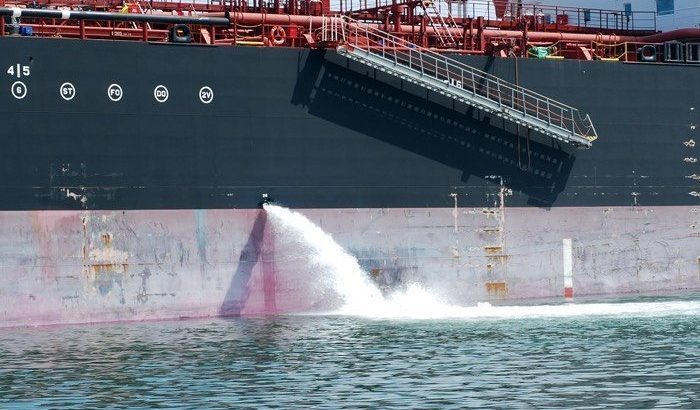
Ballast systems are judged on whether they kill invasive organisms, not on what their oxidant chemistry leaves behind. With billions of tonnes discharged each year, ports still have little idea how much bromoform and other by-products are accumulating in their waters. Captain Alex Byelyavtsev reports.
Ballast water treatment was built for one problem: ships were carrying live organisms from one sea to another, and some of those organisms took hold where they did not belong. The Ballast Water Management Convention deals with that directly. A system is approved if it kills what is in the tank, and a discharge is legal if it meets a concentration limit on the way out. Nobody asks what happens to the chemistry that made the kill possible once it is in the harbour.
Not every system creates that chemistry. Ultraviolet treatment adds no chemical to the water. The systems that do are oxidant-based, mainly electrochlorination, which generates chlorine inside the ballast tank from seawater. The chlorine kills the organisms, but in seawater it does not stay chlorine. It reacts with bromide and organic matter to form bromoform, bromate, chlorate and a family of brominated acids. Chemists call them disinfection by-products. The International Maritime Organization knows they exist. Its scientific advisory group, GESAMP, keeps a list of them. Manufacturers have to test for them under IMO’s Procedure (G9) before a system is approved. That risk assessment is not run against a real port. It is run against what GESAMP itself calls a Model Harbour, a standardised, hypothetical stand-in. Discharge limits apply to the leftover chlorine. What is not tracked is the cumulative load once systems are in commercial use.
Scale is where the picture breaks. Concentrations are measured in micrograms per litre, to check whether one ship’s discharge crossed a line. Ballast water itself is measured in tonnes, and only a few places count it. Around Singapore, cargo-based modelling has put annual ballast discharge at something closer to 190m cu m. Ships are not required to report where they deballast. IMO’s own guidance puts the global transfer at 3bn to 5bntonnes a year in one place and at 10bn tonnes in another, within the same document. There is no agreed way to measure ballast volumes, let alone the by-products inside them.
Once concentration sits next to a real annual discharge, the arithmetic changes. A 2022 review in Water Research measured disinfection by-products in treated ballast water directly. It found bromoform averaging around 247 micrograms per litre, roughly 10 times the concentration the same researchers measured in cooling water or desalination effluent. A ballast tank holds its chlorine dose longer, and with less dilution, than either. On that basis the review estimated that ballast water treatment worldwide releases something like 860 tonnes of bromoform into the sea every year. Modelling for Singapore and the Pearl River Delta, published in Ocean Science and using ocean-current data from the EU’s Copernicus Marine Service, put the regional bromine input from ballast-derived bromoform at roughly eight to 63 tonnes a year.
Bromoform evaporates, and in open water much of it leaves the sea surface for the atmosphere. The Singapore modelling found that most of the bromoform produced there does exactly that. In slow harbours, exchange is what removes it. The Gulf of Fos and the Persian Gulf already show what happens when the same chemistry enters semi-enclosed water from industrial outfalls: bromoform concentrated near discharge points, related compounds building up in marine tissue at concentrations many thousands of times higher than in the surrounding water. Ballast water has not been added to that count in those regions, or in most of the world.
In 2019, Australia’s Bureau of Agricultural and Resource Economics and Sciences ran the same risk-assessment method against real ports instead of the Model Harbour. At Port Hedland, dibromoacetonitrile exceeded its safe environmental threshold even under a plausible scenario. In Melbourne, monochloroacetic acid exceeded its threshold at every dock modelled, and dibromoacetic acid at Appleton Dock. The report recommended physical sampling. As far as the public record shows, nobody has.
This is not an argument for stopping oxidant-based treatment. The convention solved the problem it was built for. GESAMP reviews the chemistry at approval, and discharge limits on residual oxidant are real. For most ports, the other side of the picture is still missing: how much oxidant-treated ballast they receive each year, how slowly their water exchanges with the open sea, and what that adds up to after a decade of discharges. Singapore has one model. Australia has one. Most harbours do not.