
Close Menu
Simply Invest Asia
  • Home
  • About us
  • Explore industries/sectors
    • Automobile
    • Aviation
    • Banking
    • Biotechnology
    • Chemical & Fertilizer
    • Entertainment and Media
    • Food Processing
    • Healthcare
    • Iron and Steel
    • Leather
    • Mining
    • Oil and Gas
    • Pharmaceutical
  • Explore by countries
    • China
    • Dubai / UAE
    • Hong Kong
    • India
    • Indonesia
    • Japan
    • Malaysia
  • Explore cities
    • Bangkok
    • Beijing
    • Chongqing
    • Delhi
    • Dubai
    • Guangzhou
    • Jakarta
    • Kuala Lumpur
  • Why Asia
Facebook X (Twitter) Instagram Threads
Trending:
  • Kitchee – Eastern, 17/05/2026 – Hong Kong Premier League – Match sheet
  • Chongqing Anti-Corruption Probe Reveals USDT Bribery
  • Gulf educators gather in Dubai to share teaching and innovation ideas – Dubai Eye 103.8
  • Goa: Why foreign tourists are turning away from India’s party capital
  • Jindal Steel to establish RO150mn plant in Suhar Industrial City – Muscat Daily
  • TikTok Updates Ad Offerings, Entertainment, AI, Shopping, Avatars, Creator Collaboration 05/15/2026
  • Rock-eating microbes have a chemical machine that turns CO2 into life without sunlight
  • Indonesian president recognises ‘problems’ with free meal scheme
  • Hong Kong Selections for Sunday, May 17, 2026 at Sha Tin – Daily Racing Form
  • Consortium of UAE Shipbuilders Formed by AD Ports Group – News and Statistics
  • Merck Foundation advances Healthcare… – Africa.com
  • From beef ribs to a ‘heavenly’ walk: Xi-Trump summit symbolism underscored American power and Chinese tradition
  • Swatch Royal Pop: 300-person lines in Tokyo, chaos in Dubai: A $400 Swatch is breaking the watch world today
  • The First Floor brings cocktail culture to South Delhi
  • Why has Air India cut international flight operations?
  • Moderate Magnitude 4.5 Quake Hits 57 km Southeast of Bugalaga, Indonesia Early Morning
  • Putin to Visit China for Talks With Xi Days After Trump’s Beijing Trip
  • 8 dead, dozens hurt as train hits bus in Bangkok
Sunday, May 17
Facebook X (Twitter) Instagram
Simply Invest Asia
  • Home
  • About us
  • Explore industries/sectors
    • Automobile
    • Aviation
    • Banking
    • Biotechnology
    • Chemical & Fertilizer
    • Entertainment and Media
    • Food Processing
    • Healthcare
    • Iron and Steel
    • Leather
    • Mining
    • Oil and Gas
    • Pharmaceutical
  • Explore by countries
    • China
    • Dubai / UAE
    • Hong Kong
    • India
    • Indonesia
    • Japan
    • Malaysia
  • Explore cities
    • Bangkok
    • Beijing
    • Chongqing
    • Delhi
    • Dubai
    • Guangzhou
    • Jakarta
    • Kuala Lumpur
  • Why Asia
Simply Invest Asia
Home»Explore industries/sectors»Chemical & Fertilizer»Rock-eating microbes have a chemical machine that turns CO2 into life without sunlight
Chemical & Fertilizer

Rock-eating microbes have a chemical machine that turns CO2 into life without sunlight

By IslaMay 16, 20265 Mins Read
Share
Facebook Twitter Pinterest Threads Bluesky Copy Link


Take any enzyme that turns one molecule into another. Add the right ingredients, and it does its job. That’s just how they work – reliable molecular machines, driven by chemistry alone.

Inside a rock-eating sulfur bacterium, there’s a carbon-capture enzyme unlike any other. Load it with CO2, give it water – it just sits there. Only the cell membrane’s electrical charge can make it react.

Microbes without sunlight


EarthSnap

These organisms have a name that sounds borrowed from a tabloid: rock-eating microbes. Scientifically they’re chemolithoautotrophs.

Instead of sunlight, they harvest energy by chewing through inorganic chemistry – hydrogen, sulfur compounds, iron, ammonia.

They live where almost everything else would die: hot vents, sulfide-rich sediments, rock kilometers below the surface. Collectively, they make up a vast slice of Earth’s microbial life.

Two German labs took the puzzle apart together. Dr. Jan Schuller’s group at the University of Marburg (Uni Marburg) and Dr. Sven Stripp’s at the University of Potsdam (Uni Potsdam) targeted a sulfur-loving species called Halothiobacillus neapolitanus.

CO2 and bicarbonate

Carbon dioxide drifts through cell membranes easily. That’s not the hard part. The hard part is what happens next. Cells can’t use CO2 directly for carbon fixation – they need it converted into bicarbonate.

Bicarbonate is electrically charged, and it doesn’t cross the membrane on its own. Most organisms burn ATP, the cell’s energy currency, to pump it inside.

Rock-eaters can’t afford that. Energy is so scarce in their world that every molecule of ATP is spoken for. A system that burns through it just to import bicarbonate would leave nothing for growth.

A 2019 study identified a two-piece protein called DAB2 in H. neapolitanus‘s membrane that seemed to pull CO2 inside and convert it to bicarbonate without burning ATP. The mechanism was a mystery.

Mapping the machine

Schuller’s team used cryo-electron microscopy – a technique that flash-freezes proteins and images them at near-atomic detail – to get a close look at DAB2. They caught it in three snapshots: empty, gripping CO2, and holding bicarbonate.

Weeks of trouble. The protein kept falling apart during preparation. The team fused the two subunits together and dropped the construct into a tiny lipid disc that mimicked a cell membrane.

What they saw was a two-piece complex: one subunit in the cell’s interior, one embedded in the membrane.

The interior piece, DabA2, resembled carbonic anhydrase – an enzyme that swaps CO2 and bicarbonate. But a strange version.

A buried active site

Normal carbonic anhydrases sit wide open – their reaction chamber sits near the surface, easy for CO2 to wander in and out.

This one is built differently. Its chamber is buried deep inside the protein, reachable only by squeezing through two narrow tunnels.

At the bottom of that chamber sits a zinc atom. Around it, the frozen image revealed something no standard carbonic anhydrase has ever shown – two CO2 molecules packed in side by side.

Stranger still, the building block thought to trigger the reaction in every other carbonic anhydrase is absent here. Leucine sits in its place – and leucine can’t do that job.

Power from gradients

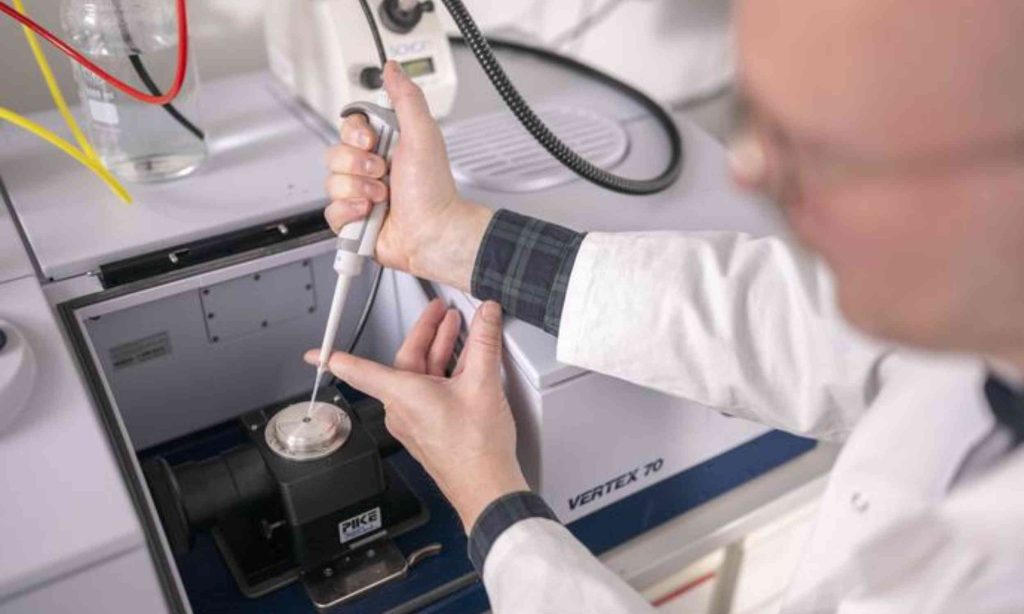
That missing piece was the clue. To investigate, Stripp’s group ran infrared spectroscopy – a method that tracks chemical reactions in real time by detecting how molecules absorb light – as CO2 was added to the protein.

Unexpected result. The protein grabbed CO2 tightly – about ten times more strongly than a non-catalytic control – but produced no bicarbonate. Just binding. Nothing more.

Alone, the complex is inert. It appears to need a charge difference across the membrane to activate – the same electrical gradient that drives ATP synthesis everywhere else in biology.

Now they had a mechanism in hand. Rock-eaters appear to tap that same charge gradient, but route it through a custom enzyme instead of spending ATP, Stripp said.

Trapping bicarbonate inside

Until this study, no one had directly observed how rock-eating bacteria connect proton flow to carbon capture. Most carbonic anhydrases work both directions – they can turn CO2 into bicarbonate, or split bicarbonate back into CO2. DAB2 doesn’t.

Structural maps show that bicarbonate can’t fit in the active site in reverse. Only one direction works: CO2 in, bicarbonate out, no going back.

That’s the trick. When protons move through the membrane, the tunnels appear to open. The active site only forms bicarbonate, never undoes it. Every CO2 molecule that enters gets locked in, accumulating far above the outside concentration.

Where it leads

The rock-eaters’ trick is now in view. Schuller and Stripp’s teams showed for the first time that a buried, gated pump inside a sulfur bacterium runs carbon fixation on the cell membrane’s charge alone. No ATP spent.

It’s a mechanism unlike the cyanobacterial carbon pumps we already knew. That finding also explains how vast slices of microbial life survive in low-energy habitats, including the deep subsurface – where recent research puts a huge fraction of Earth’s biomass.

The implications stretch beyond basic biology. Close relatives of DAB2 turn up in human pathogens like Bacillus anthracis and Vibrio cholerae, where carbon scavenging supports their virulence.

Targeting these pumps could give microbiologists a new antibiotic angle. The same blueprint, in friendlier hands, could help engineers build ATP-free carbon concentrators into crops or industrial microbes.

The study is published in Nature Communications.

—–

Like what you read? Subscribe to our newsletter for engaging articles, exclusive content, and the latest updates.

Check us out on EarthSnap, a free app brought to you by Eric Ralls and Earth.com.

—–


Source link

Related Posts

Russia’s Nevinnomyssk Azot chemical plant reported on fire after overnight explosions – at least 6th attack on the site

May 16, 2026

Explosions reported at Russian chemical facility in Stavropol Krai, local media reports

May 16, 2026

Brain scans reveal lower choline levels in people with anxiety

May 15, 2026
Add A Comment
Leave A Reply Cancel Reply

Top Posts

Abandoned malls, whispers of nuclear war and young foreigners detained. This is what’s REALLY going on in Dubai… and the chilling warning one taxi driver gave to the Mail’s IAN BIRRELL

April 11, 2026

Guangzhou airport unveils replica of China’s first airplane

April 12, 2026

Aviation Capital Group Announces Departure of Chief Financial Officer

April 17, 2026
Don't Miss

Kitchee – Eastern, 17/05/2026 – Hong Kong Premier League – Match sheet

By IslaMay 17, 2026

25/26 Tsz-Yin Leung Central Midfield Eastern Youth Hongkong Kitchee U22 HKPL U22 League 12/09/2025 free…

Chongqing Anti-Corruption Probe Reveals USDT Bribery

May 16, 2026

Gulf educators gather in Dubai to share teaching and innovation ideas – Dubai Eye 103.8

May 16, 2026

Goa: Why foreign tourists are turning away from India’s party capital

May 16, 2026
SUBSCRIBE TO OUR NEWSLETTER

Get our latest downloads and information first. Complete the form below to subscribe to our weekly newsletter.


I consent to being contacted via telephone and/or email and I consent to my data being stored in accordance with European GDPR regulations and agree to the terms of use and privacy policy.

Stay In Touch
  • Facebook
  • YouTube
  • TikTok
  • WhatsApp
  • Twitter
  • Instagram
Top Trending

Swatch Royal Pop: 300-person lines in Tokyo, chaos in Dubai: A $400 Swatch is breaking the watch world today

By IslaMay 16, 2026

The First Floor brings cocktail culture to South Delhi

By IslaMay 16, 2026

Why has Air India cut international flight operations?

By IslaMay 16, 2026
Most Popular

Boeing Company – Boeing, U.S. Navy Achieve Successful MQ-25A Test Flight

April 27, 2026

Ed Miliband hold firm! North sea oil and gas drilling won’t help anyone other than Nigel Farage | Zoe Williams

April 9, 2026

Indians hunger for untested Chinese weight-loss peptides | India News

April 12, 2026
Our Picks

Govt extends interest subvention benefit to micro, small exporters of certain iron, steel goods

April 22, 2026

Moderate Magnitude 4.5 Earthquake 48 km South of Manokwari, Indonesia

April 10, 2026

A Guide to Bangkok’s Water Festival 2026

April 12, 2026
SUBSCRIBE TO OUR NEWSLETTER

Get our latest downloads and information first. Complete the form below to subscribe to our weekly newsletter.


I consent to being contacted via telephone and/or email and I consent to my data being stored in accordance with European GDPR regulations and agree to the terms of use and privacy policy.

© 2026 Simply Invest Asia.
  • Get In Touch
  • Cookie Policy
  • Privacy policy
  • Terms & Conditions

Type above and press Enter to search. Press Esc to cancel.

SUBSCRIBE TO OUR NEWSLETTER

Get our latest downloads and information first.

Complete the form below to subscribe to our weekly newsletter.


I consent to being contacted via telephone and/or email and I consent to my data being stored in accordance with European GDPR regulations and agree to the terms of use and privacy policy.