
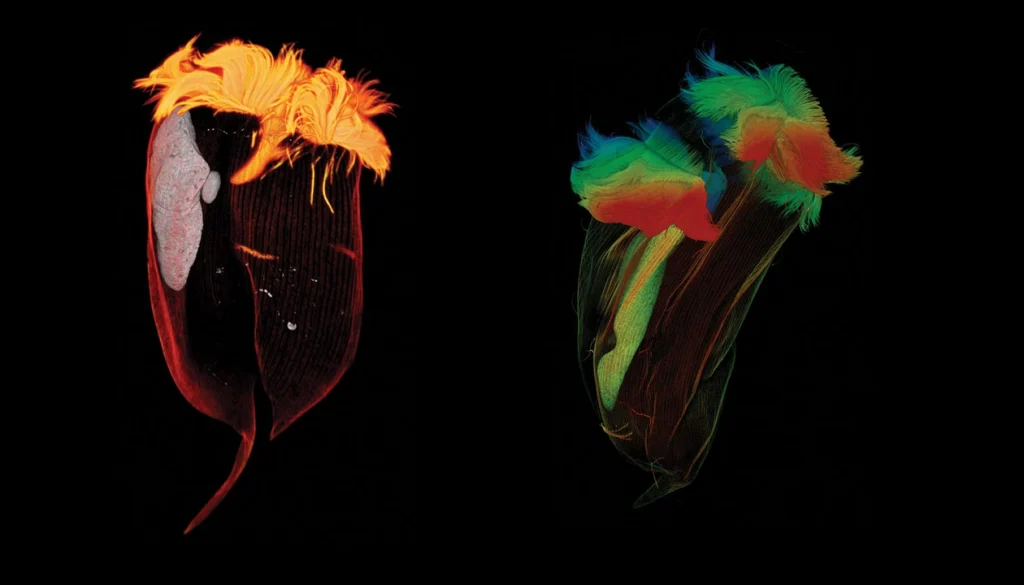
Although they may look like fancy tulips, the high-resolution 3D fluorescence images above actually show two different types of rumen ciliate. The single-celled organisms live in ruminant stomachs and come in many forms—including fuzzy eggs, like the ones shown below. They may just hold the key to understanding cows’ methane-rich, climate-warming burps.
Ciliates living in an animal’s rumen don’t produce methane themselves, but researchers have noticed that their presence is associated with gassier beasts. Now Fei Xie and his colleagues have discovered an organelle unique to rumen ciliates that makes them the perfect neighbors to methane-producing archaea. Dubbed the hydrogenobody, the organelle produces hydrogen and removes oxygen, creating an optimal environment for such archaea. More hydrogenobodies seem to lead to more methane. Could they be the agricultural sector’s next target for reducing livestock emissions?
The 3D fluorescence of rumen ciliates Isotricha prostoma (left) and Dasytricha ruminantium. Credit:
Chuanqi Jiang, Jinying He, and Che Hu/Institute of Hydrobiology, Chinese Academy of Sciences

Credit: Chuanqi Jiang/Jinying He/Che Hu/Institute of Hydrobiology, Chinese Academy of Sciences/Science. Read the paper in Science.
Do science. Take pictures. Win money. Enter our photo contest.
See more Chemistry in Pictures.

Chemical & Engineering News
ISSN 0009-2347
Copyright ©
2026 American Chemical Society