
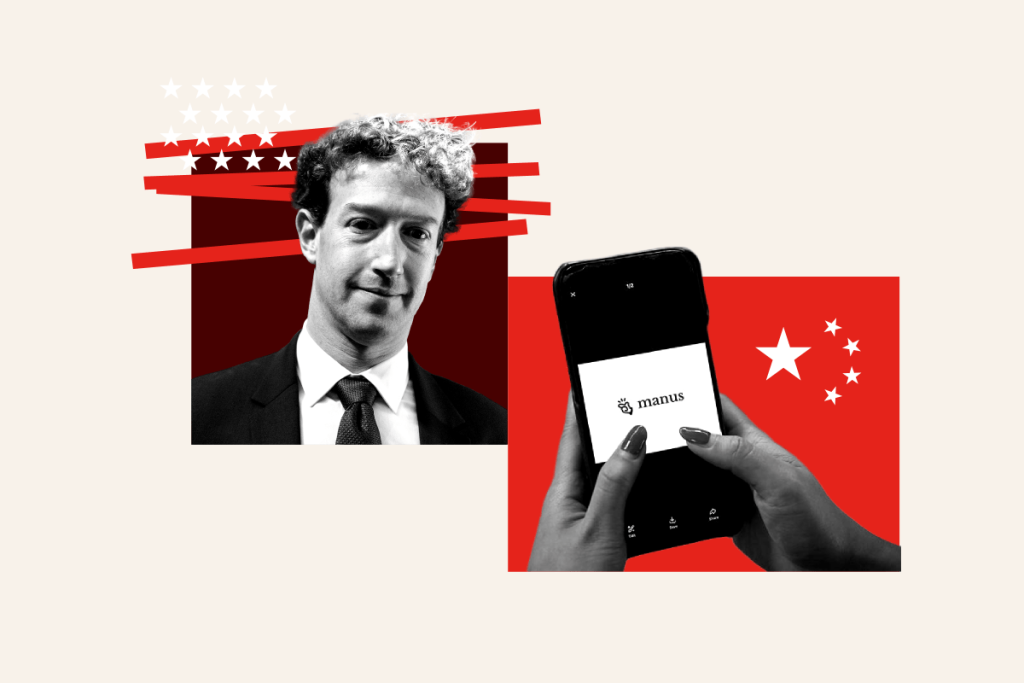
China’s government has blocked Meta’s acquisition of a Chinese start-up’s artificial intelligence agent, demonstrating the lengths to which Beijing will go to keep its technology out of the U.S.’s hands.
Manus created waves when it was released onto the market by its founders Xiao Hong and Ji Yichao last March.
Unlike chatbots such as ChatGPT which require user prompts, Manus is supposed to function automatically to complete tasks with minimal human direction.
It immediately attracted interest and within months had raised $75 million in a funding round led by a U.S. venture firm. It claimed to have gone from $0 to $100 million faster than any company.
The company then shut its China offices, cut off most of its Chinese customers and moved headquarters and core staff to Singapore in July. Then six months later, the owner of Facebook and Instagram announced it was buying the firm for $2 billion.
That’s when Beijing’s regulators jumped in.
Beijing Pulls the Plug
U.S. acquisitions of Chinese firms are rare. Silicon Valley has largely avoided buying Chinese start‑ups outright in recent years amid regulatory scrutiny, geopolitical tensions, and national security concerns.
Those issues have come to the fore with the Meta-Manus purchase.
When Meta announced the deal in December, Beijing responded soon after, launching a review of the deal, and in March imposed exit bans on Xiao Hong and Ji Yichao, both in their early 30s, preventing them from leaving the country.
On Monday, after a three-month assessment, the Chinese government blocked the purchase.
The decision to roll back the Meta‑Manus deal was made by China’s National Development and Reform Commission, a ministerial‑level body founded 74 years ago to spearhead Mao Zedong’s push for a planned economy.
The commission did not specify the reason for the cancelation, stating only that it had acted in accordance with laws and regulations.
Long known as a powerful macroeconomic planner, the NDRC has in recent years expanded its on matters deemed important of national security, including a review of Hong Kong conglomerate CK Hutchison’s failed deal to sell its ports near the Panama Canal.
In a statement shared with media after Beijing this week blocked the deal, Meta said the deal “complied fully with applicable law” and that the company expects “an appropriate resolution to the inquiry,” without specifying its next move.
Liu Pengyu, spokesperson for the Chinese Embassy in the U.S., referred Newsweek to the “competent authorities” for the specifics. “But I would like to stress more broadly that the Chinese government conducts reviews of foreign investment and makes relevant decisions in accordance with laws and regulations.”
Newsweek reached out to Meta and the U.S. Department of State by email with requests for comment.
‘Singapore Washing’ Not A Fix
Manus moved its headquarters and key personnel to Singapore last year in anticipation of this move, becoming the latest in a stream of tech firms to set up shop there.
The Southeast Asian city state has achieved one of the most developed AI ecosystems, and in recent years emerged as a regional hub for Western companies seeking to enter Asian markets and vice versa.
China’s intervention over Manus however raises questions over just how far a Singapore location for headquarters can protect firms wanting to escape Beijing’s long arm.
The exit bans send a message—that any AI company founded in China, with business operations still in the country, are likewise reachable by Beijing, Ke Yan, head of Singapore’s DZT Research, told Newsweek.
Beijing’s regulators then treat the deal as a technology export, arguing that the team, model weights, and training data were developed in China, regardless of where the company is legally based.
“Once they were physically in China, Singapore’s corporate domicile became irrelevant,” he said.
Beijing is most concerned on whether strategically sensitive technologies developed in China—and the talent and data behind them—continue to be transferred offshore through corporate restructuring in Singapore, Winston Ma, New York University law school adjunct professor and the author of The Digital War, told Newsweek.
The Chinese authorities have made clear this “Singapore washing” will not automatically insulate any deal from government oversight, Ma stated.
“The real challenge is defining what counts as ‘strategic’ in a fast-moving AI landscape—much like how TikTok’s seemingly goofy videos initially appeared far removed from national security concerns—until their underlying data and algorithmic power came into sharper focus.”
Manus’s gambit echoes the 2020 move by ByteDance, the Chinese owner of TikTok, to blunt regulatory pressure—not from Beijing but from Washington.
TikTok relocated operations to Singapore and tapped Singaporean Shou Zi Chew as chief executive, in hopes of allaying U.S. officials with national security concerns over the China link.
Around the same period, parent company ByteDance shifted some TikTok operations and senior leadership to Singapore as the company sought to present the app as globally managed and operationally separated from China.
Yan views the deal as a high-profile test case of what will become standard in the coming years. “The [tech] acquisition channel is effectively closed at the frontier,” he said.
Michael Sobolik, a senior fellow at D.C. think tank the Hudson Institute, agrees. He says Meta has tried every possible way to stay competitive, including this deal, but Beijing will not allow companies in strategic sectors to move core intellectual property out of China.
Other foreign companies with grand ambitions inside China should take note, he added.
“The house always wins in Vegas, and the CCP always wins in China. Betting against the house is a bad bet, especially when national security is at stake,” he told Newsweek.