
Close Menu
Simply Invest Asia
  • Home
  • About us
  • Explore industries/sectors
    • Automobile
    • Aviation
    • Banking
    • Biotechnology
    • Chemical & Fertilizer
    • Entertainment and Media
    • Food Processing
    • Healthcare
    • Iron and Steel
    • Leather
    • Mining
    • Oil and Gas
    • Pharmaceutical
  • Explore by countries
    • China
    • Dubai / UAE
    • Hong Kong
    • India
    • Indonesia
    • Japan
    • Malaysia
  • Explore cities
    • Bangkok
    • Beijing
    • Chongqing
    • Delhi
    • Dubai
    • Guangzhou
    • Jakarta
    • Kuala Lumpur
  • Why Asia
Facebook X (Twitter) Instagram Threads
Trending:
  • Overseas human rights experts explore grassroots governance in Chongqing Minzhu Village
  • DHL Supply Chain and Toho Holdings sign MoU to strengthen healthcare logistics in Japan
  • India offers fuel price relief for airlines amid cost pressures
  • China, Laos agree to build all-weather community with shared future in new era
  • Pattern invests in new Dubai warehouse to scale MENA operations
  • UAE Sees Robust African Investments Despite Gulf Crisis
  • JAC Delhi 2026 counselling registration ends tomorrow: Check direct link to apply, key details here
  • China’s Xi visits North Korea as Russia ties test Beijing’s grip
  • Hong Kong CE John Lee wraps up successful five-day Central Asia mission
  • Chemical impurities make carbon surfaces superslippery
  • Neutralizing Agents For Leather Market Growth Outlook to 2035: Automotive and Luxury Sectors Fuel Demand – News and Statistics
  • Dubai employee ordered to pay Dh2.3 million for embezzling company funds
  • Mock political party for India’s young ‘cockroaches’ holds first street protest
  • Indonesian Rupiah hits historic lows as forex reserves plunge
  • 403 – Operations too frequent
  • Firm seeks govt action, power reforms as energy costs threaten drug production
  • Honda MD blames stalled auto industry on forex volatility, policy uncertainty
  • China coking coal hits highest since 2024 on safety shutdowns
Monday, June 8
Facebook X (Twitter) Instagram
Simply Invest Asia
  • Home
  • About us
  • Explore industries/sectors
    • Automobile
    • Aviation
    • Banking
    • Biotechnology
    • Chemical & Fertilizer
    • Entertainment and Media
    • Food Processing
    • Healthcare
    • Iron and Steel
    • Leather
    • Mining
    • Oil and Gas
    • Pharmaceutical
  • Explore by countries
    • China
    • Dubai / UAE
    • Hong Kong
    • India
    • Indonesia
    • Japan
    • Malaysia
  • Explore cities
    • Bangkok
    • Beijing
    • Chongqing
    • Delhi
    • Dubai
    • Guangzhou
    • Jakarta
    • Kuala Lumpur
  • Why Asia
Simply Invest Asia
Home»Explore industries/sectors»Chemical & Fertilizer»Chemical impurities make carbon surfaces superslippery
Chemical & Fertilizer

Chemical impurities make carbon surfaces superslippery

By IslaJune 8, 20264 Mins Read
Share
Facebook Twitter Pinterest Threads Bluesky Copy Link


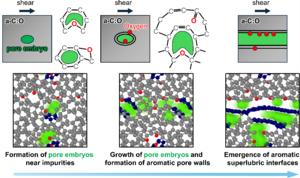
Formation of ultra-low-friction interfaces through shear-induced aromatization

image: 

Under sliding stress, impurities such as oxygen help stabilize nano-voids in amorphous carbon (a-C), enabling surrounding carbon atoms to reorganize into aromatic, graphene-like structures that support superlow friction.


view more 

Credit: Osaka Metropolitan University

Engineers often treat impurities as a problem to eliminate in order to improve material performance. But new research from Osaka Metropolitan University and Fraunhofer Institute for Mechanics of Materials IWM suggests that in some cases, a little chemical messiness is exactly what helps materials slide more smoothly.

When two surfaces slide or rub against each other, friction occurs. Whilst friction is essential for many everyday applications, it also wears down machines, wastes energy, and limits the lifespan of moving parts. Therefore, research has focused on achieving superlow friction, or superlubricity, in which surfaces can slide past one another with exceptionally low resistance.

“While graphene- or graphite-like structures are known to enable nearly frictionless sliding, creating and maintaining such structures in practical systems remains challenging,” said Takuya Kuwahara, lecturer at Osaka Metropolitan University’s Graduate School of Engineering and lead author of the study.

Carbon has a lot of different structural forms including graphene, graphite, diamond, and amorphous carbon. However, the forms vary in their ability to slide.

Graphite is made of stacked graphene layers that can slide easily over each other, resulting in extremely low friction, whereas graphene consists of atomically thin carbon sheets. In contrast, diamond forms a rigid three-dimensional structure that makes it exceptionally hard and difficult to slide, whereas amorphous carbon lacks an ordered atomic arrangement.

Amorphous carbon interested the research because it can transform into graphitic, aromatic structures at points of contact between sliding surfaces.

This process, called shear-induced aromatization, raised the possibility of coatings that could form and even restore their own low-friction interfaces.

Yet, one question remained: Why does this transformation happen in some cases but not others?

To investigate, the researchers conducted a large-scale computational study using quantum-mechanical molecular dynamics simulations. They found that it was affected by chemical impurities.

“While impurities have often been associated with reduced material performance, we found that chemical impurities play a key and previously underappreciated role in enabling the formation of superlow-friction interfaces in amorphous carbon,” Kuwahara said.

The results of 1,000 simulations of sheared amorphous carbon containing different impurity elements showed that impurities with low valency, meaning they form fewer than four chemical bonds, consistently promoted the formation of graphitic, aromatic structures. Hydrogen and oxygen, in particular, enabled the emergence of stable low-friction interfaces. In contrast, pure carbon and silicon-doped systems failed to develop the same structures.

The researchers found that these impurities help stabilize tiny voids within the carbon network. Under continued mechanical stress, surrounding carbon atoms reorganize into aromatic ring structures resembling graphene or graphite. At the same time, the impurities prevent the material from reverting to harder, diamond-like arrangements, allowing slippery interfaces to persist.

The findings challenge the conventional view that impurities mainly degrade material performance and point to a new design strategy: carefully tuning the type and concentration of impurities to control how carbon coatings reorganize under stress. Instead of relying solely on external lubricants or pre-engineered graphitic coatings, future materials might generate low-friction surfaces autonomously during operation.

The researchers plan to test the mechanism under more realistic conditions, with combinations of multiple impurity elements, and under varying operating environmental factors such as pressure and temperature. Experimental validation of the predicted atomic-scale processes will also be an important step.

“Our ultimate goal is to contribute to the development of design strategies for carbon-based materials that can form and maintain ultralow-friction interfaces under real-world conditions,” Kuwahara said.  “Such materials could reduce wear, improve durability, and cut energy loss in mechanical systems across a wide range of technologies.”

The findings were published in Advanced Science.

###

About OMU

Established in Osaka as one of the largest public universities in Japan, Osaka Metropolitan University is committed to shaping the future of society through “Convergence of Knowledge” and the promotion of world-class research. For more research news, visit https://www.omu.ac.jp/en/ and follow us on social media: X, Instagram, LinkedIn.


Method of Research

Computational simulation/modeling

Subject of Research

Not applicable

Article Title

Shear-Induced Emergence of Aromatic Superlow-Friction Interfaces in Amorphous Carbon: Triggering Chemical Impurities and Atomic-Scale Mechanisms

Article Publication Date

25-May-2026

COI Statement

The authors declare no conflicts of interest.

Disclaimer: AAAS and EurekAlert! are not responsible for the accuracy of news releases posted to EurekAlert! by contributing institutions or for the use of any information through the EurekAlert system.


Source link

Related Posts

Italian chemical sector accidents near pre-pandemic levels despite lower injury rates

June 7, 2026

China’s AI-powered “dark lab” revolutionizes chemical testing

June 7, 2026

Nippon Dynawave Disaster: New video shows scale of damage from ruptured chemical tank

June 7, 2026
Add A Comment
Leave A Reply Cancel Reply

Top Posts

Chinese Wall may stem India tech flows for electronics and automobile

June 1, 2026

Abandoned malls, whispers of nuclear war and young foreigners detained. This is what’s REALLY going on in Dubai… and the chilling warning one taxi driver gave to the Mail’s IAN BIRRELL

April 11, 2026

Von der Leyen warned about China. Europe didn’t listen. Will it now?

June 6, 2026
Don't Miss

Overseas human rights experts explore grassroots governance in Chongqing Minzhu Village

By IslaJune 8, 2026

By Liu Xinyu (ECNS) – Human Rights Action in China·2026 Chongqing Tour, hosted by the…

DHL Supply Chain and Toho Holdings sign MoU to strengthen healthcare logistics in Japan

June 8, 2026

India offers fuel price relief for airlines amid cost pressures

June 8, 2026

China, Laos agree to build all-weather community with shared future in new era

June 8, 2026
SUBSCRIBE TO OUR NEWSLETTER

Get our latest downloads and information first. Complete the form below to subscribe to our weekly newsletter.


I consent to being contacted via telephone and/or email and I consent to my data being stored in accordance with European GDPR regulations and agree to the terms of use and privacy policy.

Stay In Touch
  • Facebook
  • YouTube
  • TikTok
  • WhatsApp
  • Twitter
  • Instagram
Top Trending

Mock political party for India’s young ‘cockroaches’ holds first street protest

By IslaJune 8, 2026

Indonesian Rupiah hits historic lows as forex reserves plunge

By IslaJune 8, 2026

403 – Operations too frequent

By IslaJune 8, 2026
Most Popular

Bangkok faces extreme heat alert as heat index exceeds 52°C

May 4, 2026

Caspar Fownes extends lead in Hong Kong trainers’ championship with Happy Valley double

June 5, 2026

US Technology Companies Should Keep Operating in China | Reports & Briefings | May 4, 2026

May 4, 2026
Our Picks

Pacers Sports & Entertainment Launches Fieldhouse Media Network, Delivering First-Of-Its-Kind Global Media Channel for Partners

May 1, 2026

MENA Region Fintech Tabby Obtains Wallet License In The UAE

April 19, 2026

HSBC to roll out HKD-denominated stablecoins in H2 2026 – Asian Banking & Finance

April 13, 2026
SUBSCRIBE TO OUR NEWSLETTER

Get our latest downloads and information first. Complete the form below to subscribe to our weekly newsletter.


I consent to being contacted via telephone and/or email and I consent to my data being stored in accordance with European GDPR regulations and agree to the terms of use and privacy policy.

© 2026 Simply Invest Asia.
  • Get In Touch
  • Cookie Policy
  • Privacy policy
  • Terms & Conditions

Type above and press Enter to search. Press Esc to cancel.

SUBSCRIBE TO OUR NEWSLETTER

Get our latest downloads and information first.

Complete the form below to subscribe to our weekly newsletter.


I consent to being contacted via telephone and/or email and I consent to my data being stored in accordance with European GDPR regulations and agree to the terms of use and privacy policy.