
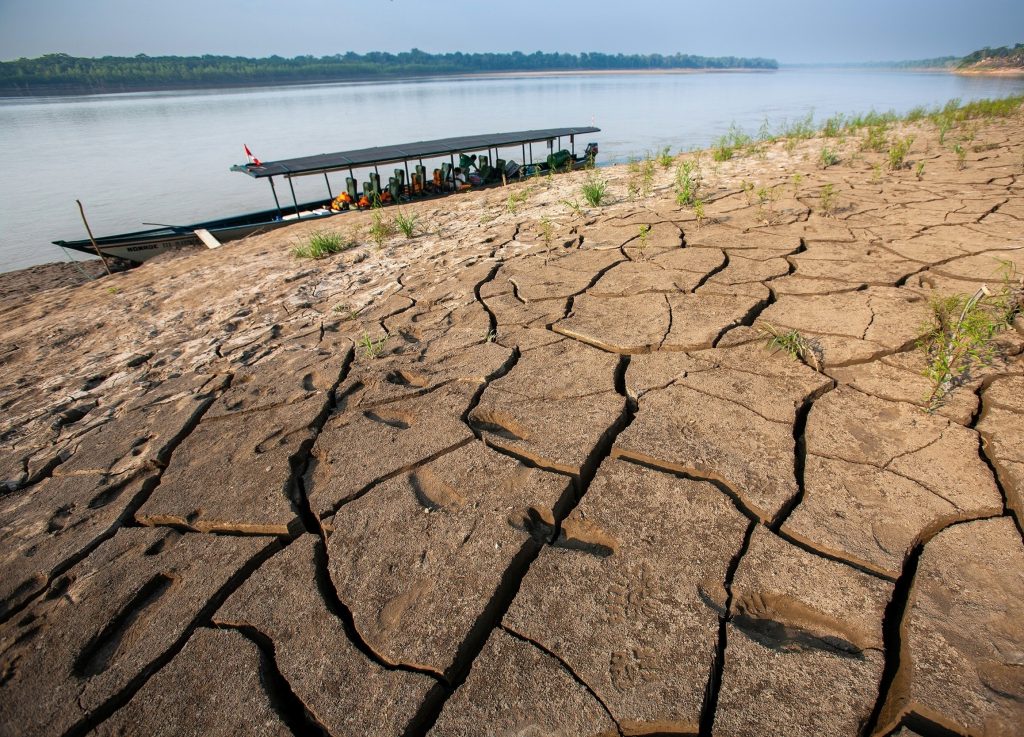
Something strange happened underground during the Amazon’s worst drought in living memory.
Soil that normally acts like a sponge, quietly pulling a plant-made gas called isoprene out of the air, mostly just stopped.

New research shows the ground’s capacity to absorb this gas fell to roughly a quarter of normal levels once drought and heat pushed conditions to extremes.
The shift has consequences that extend well beyond the rainforest floor.
The work was led by researchers at the Max Planck Institute for Chemistry in Mainz. The team spent multiple seasons measuring isoprene moving into rainforest soil.
The study included the record-breaking 2023 dry season, when a powerful El Niño drove river levels to historic lows and left vegetation across the region visibly stressed.
The Amazon’s invisible emissions
Isoprene comes from plants, and tropical forests churn out staggering amounts of it: over 500 megatons worldwide every year, with the Amazon among the planet’s biggest sources.
Soil plays an important role by absorbing isoprene from the atmosphere and helping keep levels in check.
How that actually plays out under real drought conditions, in an actual working rainforest rather than a lab, has remained a mystery.
Part of the reason is simply logistical. Measuring soil-atmosphere gas exchange season after season in the Amazon, then happening to be there when a historic drought unfolds, isn’t something researchers get to plan for.
Fortunately, this team caught this process in progress.
Drought stopped the soil
Study lead author Giovanni Pugliese is a researcher at the Max Planck Institute.
“Our results show that during the extreme climatic conditions imposed by the 2023 El Niño, soil isoprene uptake abruptly became unresponsive to the increased ambient isoprene concentrations,” said Pugliese.
“The results are consistent with a physiological constraint of isoprene-degrading soil microbes when the soil moisture falls below 20 percent.”
The microbes that normally break isoprene down in the soil seem to hit a wall once moisture drops past a certain point.
It doesn’t matter how much isoprene is floating in the air above them at that stage. The microbes simply can’t keep up.
Uptake capacity dropped by more than a factor of four compared to normal conditions, and the decline was abrupt.
A gas with big impacts
Isoprene doesn’t just float around forever once it’s released. It gets broken down mostly by hydroxyl radicals, the atmosphere’s main cleaning agent, with ozone playing a smaller role.
That chemistry has knock-on effects well beyond isoprene itself, shaping how long greenhouse gases like methane stick around and influencing how fast secondary organic aerosols form.
Isoprene levels in the air are really a tug-of-war between three things: how much the canopy emits, how fast the atmosphere breaks it down, and how much the soil manages to reclaim.
Mess with any one of the three – which is exactly what happened in 2023 – and the ripple effects don’t stay confined to the forest.
How forests fight back
The researchers found that when the faces short-term drought and heat extremes, it boosts atmospheric isoprene levels.
It does this by increasing canopy emissions while simultaneously weakening the soil sink.
That matches what scientists already know about why plants produce isoprene in the first place: to defend themselves against heat and oxidative stress.
During drought, the trees appear to ramp up isoprene production.
At the same time, the soil’s ability to absorb the gas falls apart, creating a one-two punch that drives atmospheric isoprene levels even higher.
A familiar drought response
This isn’t a totally new phenomenon, either. It echoes an earlier artificial rainforest experiment that looked at how drought and rewetting affect biogenic volatile organic compound (VOC) exchange in soil.
There, once moisture fell below 19 percent, the soil didn’t just absorb less. It flipped entirely, turning into a net source of VOCs instead of a sink.
That earlier finding lines up almost eerily well with what’s now been observed in the real Amazon.
It suggests this isn’t some fluke of the 2023 drought specifically, but a threshold behavior that soil microbes hit fairly consistently once things get dry enough, wherever they happen to be.
A hidden climate feedback
There’s a feedback loop hiding in all this. Higher isoprene levels don’t just reflect drought stress.
They also reduce the atmosphere’s oxidation capacity and extend how long methane lingers, adding another climate cost on top of the drought itself.
Whether this gets worse as El Niño droughts grow more frequent and intense, or whether the soil microbes eventually adjust to a hotter, drier normal, is still an open question.
The researchers say global climate models need to treat soil isoprene uptake as a real, variable factor rather than assuming it away.
Without that change, they are unlikely to accurately capture how these climate feedbacks unfold across the tropics.
The study is published in the journal Nature Communications Earth & Environment.
—-
Like what you read? Subscribe to our newsletter for engaging articles, exclusive content, and the latest updates.
Check us out on EarthSnap, a free app brought to you by Eric Ralls and Earth.com.
——