
Japan and India pledged to work together on issues from maritime security to artificial intelligence in an effort to reduce reliance on China
-
By Atul Dev
and Sakura Murakami /
Bloomberg
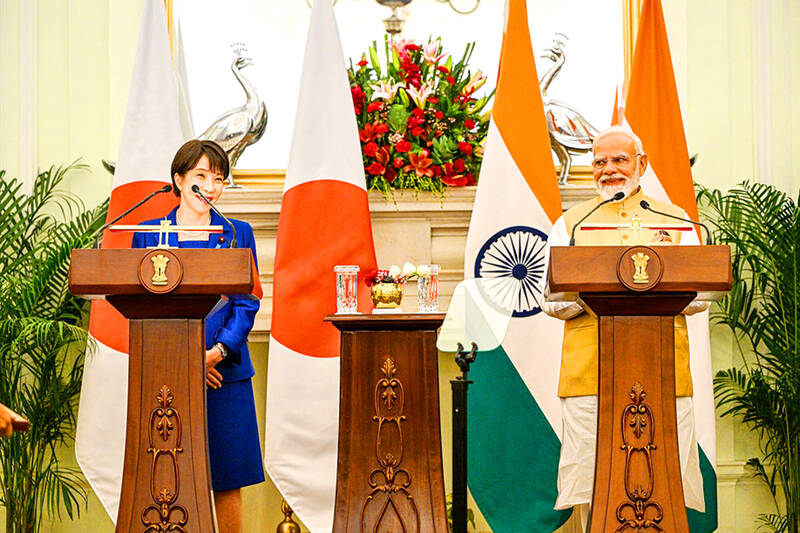
Standing in front of fresh lilies and silver statues of peafowls, Indian Prime Minister Narendra Modi and his Japanese counterpart Sanae Takaichi shared the new dynamic they have settled on: “little sister” and “big brother.”
“I was just referred to as ‘a beautiful little sister,’” Takaichi said with a smile during the brief remarks following their meeting. “In our earlier talks, we promised to work together as brother and sister.”
Takaichi’s first official visit to India did not deliver the same kind of headline-grabbing ¥10 trillion (US$62 billion) investment pledge made last year. Instead, it marked a deepening in ties as the warmth of the leaders’ exchanges was accompanied by agreements on everything from joint naval exercises to the production of a Bollywood film on Japan’s northernmost island of Hokkaido.
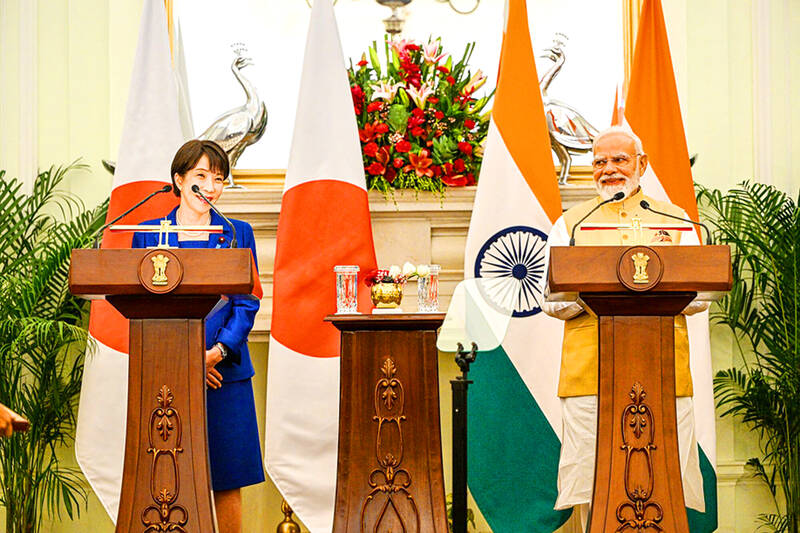
Photo: Bloomberg
“In the past couple of years, there’s been a spike in interest in India from Japanese companies,” said Kenji Hiramatsu, a chairman at The Japan Research Institute and a former Japanese Ambassador to India. “That’s not just coming from the bigger firms, but also small and mid-sized enterprises and start-ups. There is a real broadening of the relationship.”
The two leaders issued four joint statements that covered everything from maritime security to artificial intelligence and energy resilience. They also confirmed the signing of more than 100 agreements between Japanese and Indian businesses, including pledges to cooperate on semiconductors, ammonia, green energy, and to work together on a mission to the moon. There were also agreements on growing shiitake mushrooms and strawberries in India.
While traditionally much of the business was done in the autos industry, “there is much more diversity now,” Hiramatsu said. “For Japan and India to deepen ties on the economic front, I feel it’s important for medium and small-sized businesses that build up the supply chain and companies that have new technologies to go to India. It seems that trend is starting to happen.”
That push comes off the back of a pledge made last year for the Japanese government to urge companies to make some ¥10 trillion in investment over the next ten years. In their meeting, Modi and Takaichi acknowledged that companies are already set to invest ¥2 trillion in India, a statement by Japan’s foreign ministry said.
Takaichi was accompanied by more than 50 Japanese business representatives, including the chairman of Suzuki Motor Corp, which has earned massive dividends from India, its biggest market.
From the Indian side, billionaire Gautam Adani’s conglomerate is angling for a US$1.5 billion yen-dominated debt in its apparent push for de-dollarization. The Adani Group welcomed Takaichi with full-page advertisements in national newspapers, copies of which made their way into five-star hotel lobbies where the Japanese delegation mingled.
The close ties are also giving Japan’s megabanks — from Sumitomo Mitsui Financial Group to Mitsubishi UFJ Financial Group — an edge as they make an unprecedented push into India.
The visit comes as both countries seek to diversify trade partnerships beyond China and the US, and as they navigate the aftershocks of the Iran war.
Takaichi conveyed the need to identify solutions to ward off future geopolitical shocks, including securing energy and tech supplies as well as cushioning the economy against external shocks.
“Japan and India must leverage our respective strengths to become stronger and more prosperous together in the midst of international turmoil,” she said.
New Delhi shares those concerns. Its oil supplies were disrupted following the blockade of the Strait of Hormuz, dealing a blow to its growth momentum.
China is another area of shared concern, even if Tokyo and New Delhi are approaching it differently.
“Both countries, Japan and India, want stability and prosperity and therefore we need to work together to have a security environment that is conducive to growth,” Deepa Gopalan Wadhwa, former Indian ambassador to Japan, said on Friday. “We do try to make sure that all the countries in the region play by certain rules, which also includes China.”
India remains heavily reliant on China for the machines and inputs — not least rare earths — critical to its manufacturing ambitions and is tentatively seeking to improve ties with Beijing. Such relations are in deep freeze for Takaichi, who angered Beijing in November when she speculated over the potential for Japan to get involved in defensive military action in the event China attacked Taiwan.
“Expansion of maritime security cooperation is especially important for regional peace and stability,” Takaichi said, adding that Japan and India would continue to perform joint naval exercises in the Indian ocean. The relationship between India and Japan, she added, “has become ever more important.”