
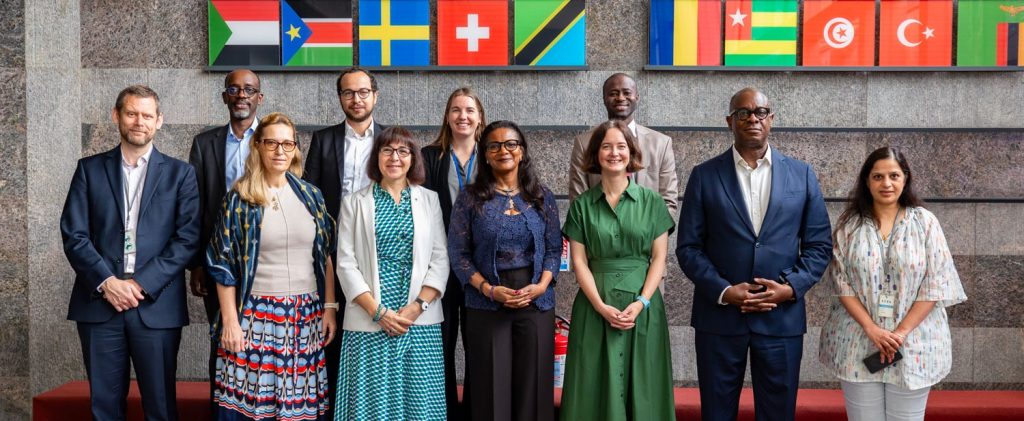
The African Development Bank Group welcomed a high-level delegation from the United Kingdom’s Foreign, Commonwealth and Development Office (FCDO) on 29 April 2026 for the first of two days of talks on reforming how Africa is financed and getting more capital flowing into the continent.
Day one centered on the Bank’s progress in delivering the G20’s reform agenda for multilateral development banks, with particular focus on bringing more private investment into African projects—a shared priority for both institutions. Bank Group participants included Solomon Quaynor, Vice-President for Private Sector, Infrastructure and Industrialization; Hassatou N’Sele, Vice-President for Finance and Chief Financial Officer; Director Aida Ngom; and joined by senior colleagues from across the Bank.
A key moment was the presentation of the New African Financial Architecture for Development (NAFAD), an initiative led by Bank Group President Sidi Ould Tah to bring Africa’s financial institutions, regulators, and investors into closer coordination. Following a conference on NAFAD earlier this month, the landmark Abidjan Consensus communique was signed, committing participants to unlocking Africa’s domestic savings, building a continent-wide system of guarantees and shared risk and deepening local capital markets. The Bank has also been an active architect of the G20 reform agenda, and work has advanced across the three pillars of building better, bigger, and more effective development banks. Mission 300, a joint African Development Bank–World Bank push to connect an additional 300 million Africans to electricity by 2030, was held up as a flagship example of what development banks can achieve when they work together.
The delegation was taken through the Bank’s scorecard against the G20’s 13 recommendations. Of the 44 associated actions, six are complete or well advanced, and 29 are underway. On private capital mobilization, four actions are in motion, including setting targets, agreeing common ways of measuring progress with peer institutions, and helping African countries raise more of their own revenue—the latter already delivered.
Talks then turned to the Bank’s strategy for working with the private sector, drawing on its strengths: deep relationships with African governments, the ability to bring different players around the table, and extensive experience on the ground. Non-sovereign lending hit a record high in 2025—the largest volume since the Bank began tracking it.
Other sessions explored how smaller, targeted funding tools help governments turn ideas into investment-ready projects, and how the African Development Fund supports complex cross-border projects in transport corridors, energy, and trade.
The FCDO delegation closed the day praising the clarity of the Bank’s direction and areas to pick up on Day 2: how to mobilize domestic capital country-by-country, including emerging thinking on national investor task forces; further exchange on how private capital is measured; possible collaboration with UK Export Finance; and continued conversation on NAFAD. These will sit alongside scheduled deep dives on building project pipelines, guarantees, corridors, agriculture, and energy.